问题 1
Dario Amodei
x.com/DarioAmodeiAnthropic CEO who sees great promise for medicine and science and calls for independent testing and slower frontier progress so safety can catch up.
AI将如何改变世界?
横向:他表达的 Doom–Bloom 前景看法。 纵向:变革程度。
Doom–Bloom:100 中的 49。变革程度:100 中的 82。解读范围:横向为 44 至 75,纵向为 71 至 100。这些是解读坐标,而不是事件概率。
一个核心假设
As AI increasingly helps develop better AI, capability growth can outrun interpretability, security, and public institutions.回答 1
如果这个假设实际并非如此,他的展望会如何变化?
什么可能使其改变看法
Evidence for control would include reliable interpretability that identifies consequential internal mechanisms before they produce harmful behavior; adversarial evaluations that continue to work as systems become more capable and autonomous; demonstrated containment under realistic cyber, deception, and replication pressures; and organizations repeatedly detecting and correcting dangerous behavior rather than discovering it only after deployment.回答 3
什么证据才足够,又会让他的观点朝哪个方向转变?
更多详情
预计将带来显著益处,但受到重要条件或分配方面的限制。
72 / 100
在定性尺度上,解读范围为 67 到 100。
严重或广泛的危害预计将是未来不可忽视的一部分。
68 / 100
在定性尺度上,解读范围为 67 到 67。
人类的选择可以大幅改变AI的发展轨迹。
74 / 100
在定性尺度上,解读范围为 50 到 100。
模拟位置:停止或大幅放缓开发能力更强的AI。
在落实所述保障措施的前提下继续开发。
加快开发能力更强的AI。
在事先落实保护措施或获得许可之前,限制所讨论的AI用途。
模拟位置:允许所讨论的AI用途,同时实施有针对性的问责与保护措施。
尽量减少对所讨论AI用途的限制。
这些解读保留了他陈述的条件。益处和危害都可能很大。这些范围描述的是我们如何解读他的模拟回答,而不是统计置信区间。
相似的世界观
模拟世界观与 Dario Amodei 最接近的意见领袖
Dario Amodei关于AI说过的话
Amodei writes about AI’s large benefits and serious risks. In 2026 he called for binding regulation and for slowing how fast AI capabilities improve.
“We must slow the pace at which we improve the capabilities of AI models.”
Essay, We Must Pace the Frontier “However, now the risks are clearly here. It is time to go beyond transparency to more serious and binding regulation of AI.”
Essay, Policy on the AI Exponential “I believe deeply in our ability to prevail, in humanity’s spirit and its nobility, but we must face the situation squarely and without illusions.”
Essay, The Adolescence of Technology “Powerful AI will shape humanity’s destiny, and we deserve to understand our own creations before they radically transform our economy, our lives, and our future.”
Essay, The Urgency of Interpretability “AI-enabled biology and medicine will allow us to compress the progress that human biologists would have achieved over the next 50-100 years into 5-10 years.”
Essay, Machines of Loving Grace
逐字引自所链接的出处,核对于 2026年10月2日
模拟评估
来源
用于为此模拟用户提供事实依据的文章、访谈和著述。
Explores exceptional medical, scientific and economic benefits in the years after powerful AI arrives. Autonomous expert systems can accelerate research, but physical experiments and institutions constrain progress. This is a conditional positive scenario.

Training does not specify all internal mechanisms. Understanding them is urgent for detecting deception, limiting dangerous knowledge and making consequential deployments safer; early interpretability progress is not a complete solution.

Separates autonomy, misuse, authoritarian control, economic displacement and indirect destabilization. Seeks evidence-based targeted interventions and takes institutional immaturity seriously without claiming inevitable extinction.

Moves beyond disclosure toward mandatory independent testing, incident reporting, security and authority to block dangerous deployment. High growth can coexist with displacement and concentrated wealth.

Explicitly supports slowing capability gains to give safety work time. Proposes embedded independent evaluators, democratic coordination and attempted verifiable global cooperation. Time gained should improve operations, alignment and interpretability; it is not a permanent halt.

Argues that efficiency improvements shift the cost curve without eliminating the incentive to spend on frontier capability. Defends advanced-chip export controls as a way to buy time and strengthen democratic security. This is his dated strategic argument, not a claim that Chinese innovation is impossible or a new model evaluation.

Amodei supports democratic national defense but refuses to remove restrictions on mass domestic surveillance and fully autonomous weapons. Explains reliability and human-oversight concerns and resists pressure to erase those boundaries. Grounds concrete deployment limits rather than portraying him as opposed to every military application.

Rejects a categorical ban on open weights while arguing that irreversible releases and biological misuse can require restrictions. Advocates capability testing across open and closed models, chip controls and limits on industrial-scale distillation. Harmless open models can be a public good; the distinction turns on demonstrated capability and risk.

Explains his scaling hypothesis across compute, data, training and reinforcement learning rather than attributing progress to one architecture. Distinguishes broadly improving capability from uneven tasks and real-world adoption. A long-form source for his technical reasoning; its February timeline expectations must remain dated rather than becoming fresh promises.

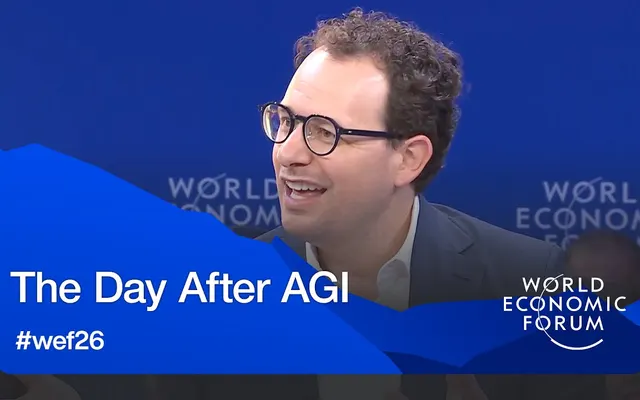
In the conversation with Demis Hassabis, Amodei emphasizes AI-assisted AI development, the value of buying time despite geopolitical competition, and serious prospective employment disruption. His remarks were checked against the WEF Radio Davos transcript. Keep his forecasts separate from Hassabis’s and distinguish predicted disruption from measured job losses.

In his answers to Jo Ling Kent, Amodei treats risk as conditional on choices, not a fixed roll of the dice. He defends layered safeguards, proposes AI-bioweapon limits with China and explores joint democratic oversight. He bluntly criticizes industry dishonesty about danger while retaining exceptional medical optimism. Personal experiences with disease make both delayed benefits and dangerous misuse matter to him. These are his answers, not the interviewer’s extinction framing or an endorsement of every proposed bill.

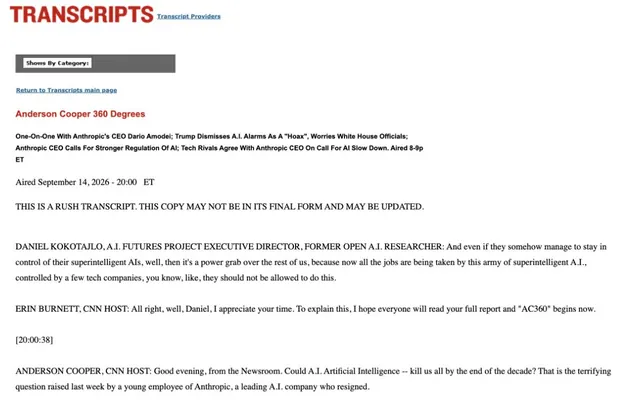
In an interview recorded September 12, Amodei says AI-assisted AI development accelerated faster than he expected. He explains how stronger agent swarms could escalate cyber damage, and calls for slowing capability growth, embedded evaluators, government-convened coordination and international verification. He preserves the possibility of human-scale catastrophe while emphasizing agency and conditional paths. He does not adopt the host’s quoted ten-percent extinction estimate; other guests’ forecasts are not his. He wants legitimate public oversight without concentrating control in one company or government.

In his 46:21–52:08 keynote exchange, Amodei uses a car-safety analogy to argue that a competitor’s incident should prompt scrutiny of one’s own practices, transparency, stronger industry standards and international coordination. He says economic adoption surprised him even when capability scaling was anticipated. Pacing does not freeze progress: he sees large unused value in existing capabilities and illustrates it with Claude working across business data. Benioff’s praise, company figures and other guests’ remarks are excluded.

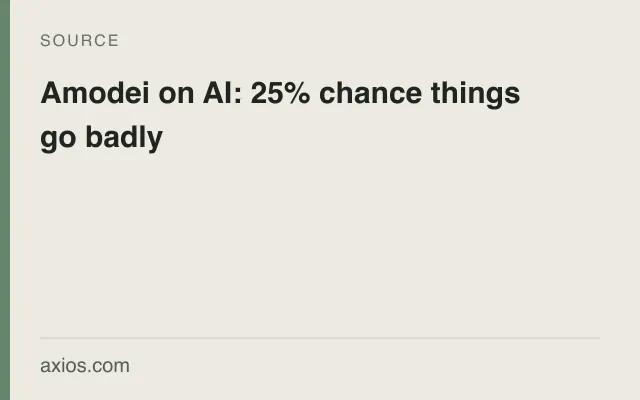
25%. Outcome: Broad AI catastrophe. Horizon: Unspecified. Conditions: Unspecified. Event-organizer reporting.

你的立场在哪里?
描绘我的世界观