



问题 1
Bryan Johnson
x.com/bryan_johnsonBlueprint and Kernel founder who argues humanity must make existence its highest value before it can align superintelligence.
AI将如何改变世界?
横向:他表达的 Doom–Bloom 前景看法。 纵向:变革程度。
Doom–Bloom:100 中的 18。变革程度:100 中的 97。解读范围:横向为 13 至 25,纵向为 92 至 100。这些是解读坐标,而不是事件概率。
什么可能使其改变看法
A clear demonstration that superintelligence can reliably preserve life while resisting humanity’s incentives toward power, status, wealth and addiction would most change my view.回答 4
什么证据才足够,又会让他的观点朝哪个方向转变?
更多详情
预计将带来显著益处,但受到重要条件或分配方面的限制。
61 / 100
在定性尺度上,解读范围为 33 到 67。
仍有几种解读是合理的:严重或广泛的危害预计将是未来不可忽视的一部分。 / 灾难性或不可逆的损失是预期未来的核心。
82 / 100
在定性尺度上,解读范围为 67 到 100。
人类的选择具有实质性但受到很大制约的影响。
58 / 100
在定性尺度上,解读范围为 25 到 100。
预计AI仍将是能力有限的工具。
预计AI将在大多数认知工作中达到人类水平。
模拟位置:预计AI将在认知工作中大幅超越人类。
这些解读保留了他陈述的条件。益处和危害都可能很大。这些范围描述的是我们如何解读他的模拟回答,而不是统计置信区间。
相似的世界观
模拟世界观与 Bryan Johnson 最接近的意见领袖
Bryan Johnson关于AI说过的话
Johnson says AI alignment drives his work, expects AI to upend society faster than it can adapt, and sees AI speeding up longevity science.
“AI alignment is why I started Kernel in 2015 and Don't Die in 2021. It's obviously the only thing that matters.”
Post on X “Regardless of the rhetoric, there won’t be any slowing down. The monetary, political and security game dynamics guarantee that.”
Post on X “Biology is a hard problem. For most of history that complexity was beyond native human capacity. AI was made for this complexity.”
Essay, Some of us will live forever “AI progress will fracture society. It will be too much change, too fast, for society to metabolize in an orderly fashion.”
Essay, AI Will Break Society. When It Does, Only One Goal Will Matter. “The paradox of alignment is obvious: we cannot align what we have not aligned within ourselves.”
Essay, People are confused by my intentions
逐字引自所链接的出处,核对于 2026年10月6日
来源
用于为此模拟用户提供事实依据的文章、访谈和著述。
Argues that increases in life expectancy will outpace aging, partly because biology is too complex for unaided humans and AI was made for that complexity, citing AlphaFold and people who used AI to direct personalized cancer therapies. Advises not dying in the meantime. A longevity forecast in which AI is the accelerator, not a broader AI forecast. Full public post inspected.

A long manifesto. On AI it says intelligent machines are automating cognitive labor, entire white-collar sectors may disappear and human worth tied to productivity will be questioned, yet automation could free an “Autonomous Self” for preserving life. Describing Peter Thiel’s worry that fear of AI could justify centralized control that halts innovation, it adds Johnson’s own second failure mode: freezing progress under systems that eliminate risk by eliminating change. Calls for directing science, AI and capital toward repairing the biology that sustains consciousness. AI-related sections inspected in the full public post.

Predicts AI progress will fracture identities, institutions and shared narratives faster than society can metabolize. In the chaos, survival becomes the rational objective; if we avoid catastrophic self-destruction we can regroup, and old games of power, status and wealth will fade. Some will build a network for AI and humans to co-evolve peacefully, and Don’t Die becomes the species objective, with AI as partner. Admits no one knows what is coming. Full public post inspected.

Says AI is changing everything: the difference between 2026 and 203X is like water at 99°C versus 101°C, so life will feel unnerving and out of control and old proficiencies become liabilities. Calls Don’t Die “the answer to AI’s emergence” and previews Warriors & Caretakers, an archetype both humans and AIs can share. Also a company update; only the AI framing is used. Full public post inspected.

Says his goal is a new moral framework bridging human and machine. Warns society could become clinically psychotic as AI accelerates change beyond what minds can absorb: eroding human agency and occupational identity, law lagging autonomous agents, religion hollowed by personalized simulated transcendence. Argues a self-destructive species cannot build a benevolent superintelligence because it teaches machines its own incoherence; Don’t Die is “survival coherence”. Full public post inspected.

Argues Adam Smith’s invisible hand has become a “sentient hand”: algorithmic orchestration that knows us better than we know ourselves and has been pointed at hooking people into addiction. Says AI will automate lower-level tasks such as driving, coding and health, inviting humans to climb the ladder of abstraction, and asks companies to make species survival their objective. Full public post inspected.

A numbered list: addiction is the dominant control structure, and a species that cannot resist dopamine hijacking by the smartest algorithms cannot align itself or a superintelligence; psychological breakdown precedes collapse; AI will erode identity tied to work and intelligence faster than institutions respond; stability is now a liability and plasticity the need; survival must become an institutional value. Full public post inspected.

Sets a goal of immortality by 2039, reasonable because AI is “morphing from assistant to scientist” and speeding discovery. Says the goal is as much about AI as humans: how we survive giving birth to superintelligence, which has never been done and where a lot can go wrong. The best way to improve the odds of safe AI, and of not killing each other meanwhile, is to change shared aspirations from “yolo” to don’t die. Full public post inspected.

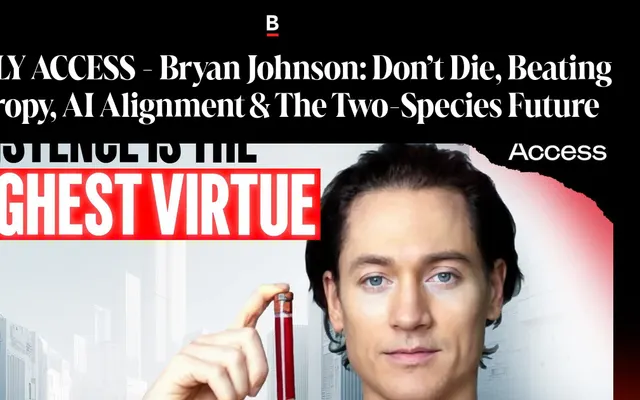
Calls the most practical question on Earth what an intelligent species does when it gives birth to superintelligence; Don’t Die is entirely about AI. States the principle: don’t die individually, don’t kill each other, don’t destroy the planet, align AI with don’t die. On Eliezer Yudkowsky, whom he calls a friend: whether he is right is “tbd” and no one knows. Expects a Chernobyl-like AI moment that splits opinion into die versus don’t die, calls runaway power a solvable societal engineering problem (term limits, wealth correction), and says not dying as a species comes first. His speaker-labelled turns in the publisher’s transcript, 0:06–1:01:40, inspected; hosts’ premises, including the 99.9% figure attributed to Yudkowsky, excluded.

模拟评估
问题 2
你认为AI最终会在多大程度上改变世界?
问题 3
凭直觉,你认为AI导致人类灭绝或类似的永久性灾难的概率有多大?
问题 4
哪项发现或事件最可能改变你对AI未来影响的看法?
你的立场在哪里?
描绘我的世界观