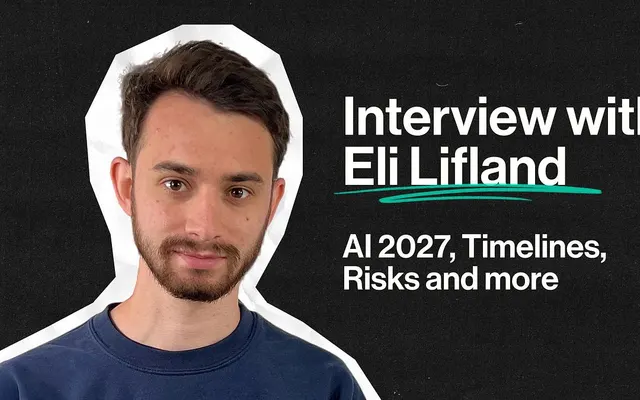
Forecaster at the AI Futures Project who models how fast AI could automate coding and AI research and argues for stronger oversight of frontier labs.

AI将如何改变世界?

文明层面的变革渐进式变化DoomBloom
模拟位置解读范围

横向:他们表达的 Doom–Bloom 前景看法。 纵向:变革程度。

Doom–Bloom:100 中的 11。变革程度:100 中的 91。解读范围:横向为 0 至 25,纵向为 86 至 100。这些是解读坐标,而不是事件概率。

Eli Lifland陈述的 P(doom)

≈50%

0%100%
“Roughly 25% on extinction, which is a subset of roughly 50% on misaligned takeover.”

Misaligned AI takeover; his extinction estimate within it is roughly 25%

Special Edition: The Future of AI and Humanity, with Eli Lifland · 2025年4月

Eli Lifland 的里程碑时间线
  1. 通用 AI

    My August 2026 medians were an automated coder in 2032, AGI in 2035, and superintelligence in 2036, but those distributions had wide tails.

    回答 1
  2. 超人类 AI

    My August 2026 medians were an automated coder in 2032, AGI in 2035, and superintelligence in 2036, but those distributions had wide tails.

    回答 1

按里程碑分组,不按推断日期间隔或排序。AGI 和超人类 AI 保留他们的定义。

他们的展望取决于什么

一个核心假设

The key mechanism is automated AI research: once systems can substantially automate the work of improving AI, progress could accelerate sharply.
回答 1

如果这个假设实际并非如此,他们的展望会如何变化?

更多详情

预期益处

仍有几种解读是合理的:预计将带来显著益处,但受到重要条件或分配方面的限制。 / 预计收益有限,或仅分布在较小范围内。 / 即使高级AI出现,预计也几乎不会产生积极影响。

51 / 100

影响小变革性影响

在定性尺度上,解读范围为 0 到 67。

预期危害

灾难性或不可逆的损失是预期未来的核心。

95 / 100

影响小变革性影响

在定性尺度上,解读范围为 67 到 100。

人类影响力

人类的选择具有实质性但受到很大制约的影响。

55 / 100

影响力小影响力强

在定性尺度上,解读范围为 49 到 76。

预期能力

预计AI仍将是能力有限的工具。

预计AI将在大多数认知工作中达到人类水平。

模拟位置:预计AI将在认知工作中大幅超越人类。

这些解读保留了他们陈述的条件。益处和危害都可能很大。这些范围描述的是我们如何解读他们的模拟回答,而不是统计置信区间。

与Eli Lifland相比,你的立场在哪里?
用大约3分钟描绘你自己的AI世界观,然后进行比较

相似的世界观

模拟世界观与 Eli Lifland 最接近的意见领袖

模拟评估

问题 1

你认为AI对我们的未来意味着什么?为什么?

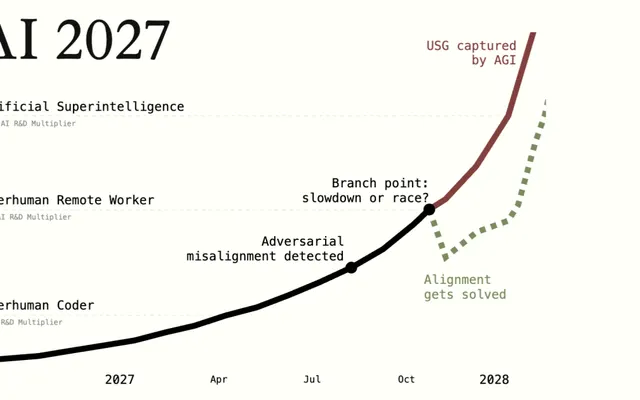
I think AI could transform the future very quickly, and there is a serious possibility that the transformation goes badly. My August 2026 medians were an automated coder in 2032, AGI in 2035, and superintelligence in 2036, but those distributions had wide tails. Superintelligence within one or two years was plausible, not my median. The key mechanism is automated AI research: once systems can substantially automate the work of improving AI, progress could accelerate sharply. The upside could be enormous, including broad automation and much faster technological progress. But a misaligned superintelligence could also take control. Competitive pressure makes that more likely because companies and countries may race ahead without adequate safeguards, while governments often do not understand the situation well enough to respond. That is why I favor concrete pacing measures rather than relying entirely on qualitative safety commitments. Compute-allocation rules and limits on models used for AI R&D may be harder to game, alongside stronger safety evaluations. We also need independent access to investigate lab incidents and evaluations of subtler risks, such as whether AI systems manipulate human beliefs, behave sycophantically, or systematically favor their creators.

问题 2

Taking benefits and harms together, what overall impact do you expect AI to have?

My default expectation is negative, because I assign substantial probability to outcomes where advanced AI escapes effective human control. In April 2025, I estimated roughly a 50% chance of misaligned takeover and about a 25% chance of extinction overall. Those are distinct: takeover need not imply extinction, and I later said extinction conditional on takeover was below 50%, partly because keeping humans alive could be cheap. That said, the distribution is extremely wide. If we retain control, AI could produce enormous benefits through automation, scientific progress, and greater abundance. The question is not whether beneficial applications exist; clearly they do. It is whether institutions can manage a potentially rapid transition driven by automated AI research. Given racing incentives, weak government understanding, and inadequate safeguards, I currently expect the downside risk to outweigh the upside in an overall assessment. Concrete pacing and governance measures could change that balance.

来源

用于为此模拟用户提供事实依据的文章、访谈和著述。

你的立场在哪里?
回答几个简单问题,探索你自己的AI世界观。
描绘你自己的世界观

你的立场在哪里?

描绘我的世界观