Jesse Genet

Jesse Genet

x.com/jessegenet

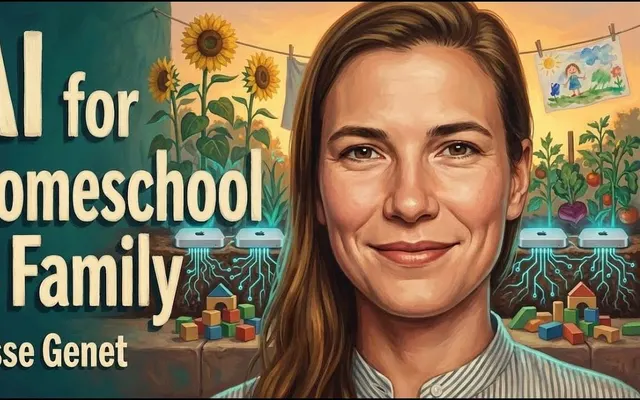
AI helping a family with learning and everyday work.

How will AI change the world?

Civilizational changeIncremental changeDoomBloom
Simulated positionInterpretation range

Across: their expressed Doom–Bloom outlook. Up: scale of transformation.

Doom–Bloom: 69 out of 100. Scale of transformation: 25 out of 100. Interpretation ranges: 50 to 75 horizontally, 23 to 27 vertically. These are interpretation coordinates, not event probabilities.

Jesse Genet’s estimated P(doom)

<1%

0%100%

Inferred from their broader worldview and priorities. Approximate interpretation range: 0–3%. Applies to the outcome and conditions in their simulated answers; this is an inferred percentage.

What their outlook hinges on

A central assumption

If agents can do more of that preparation, parents can spend more time teaching, talking, building things, going outside, and actually being present with their children.
Answer 1

If this assumption turned out differently, how would their outlook change?

What could change their mind

Conversely, strong evidence that local open models can handle real household workflows safely and affordably—not just in technically adventurous homes—would strengthen my view.
Answer 2

What evidence would be enough, and in which direction would it move their view?

More details

Expected upside

Substantial benefits are expected, with important conditions or distribution limits.

66 / 100

Little impactTransformative impact

Interpretation range 67 to 67 on the qualitative scale.

Expected harm

Manageable or localized harms are expected.

33 / 100

Little impactTransformative impact

Interpretation range 33 to 33 on the qualitative scale.

Demonstrated reasoning

Reasoning, consideration of alternatives, and handling of uncertainty in their simulated answers. This describes the simulated answers, not the real person’s intelligence or opinions.

94 / 100

Little demonstratedWell developed

Interpretation range 86 to 100 on the qualitative scale.

Human influence

A tentative estimate from your answers; the wider range shows other plausible readings.

52 / 100

Little influenceStrong influence

Interpretation range 6 to 100 on the qualitative scale.

Rules for using AI

Restrict the AI uses discussed until prior protections or permission are in place.

Simulated position: Allow the AI uses discussed with targeted accountability and protections.

Minimize restrictions on the AI uses discussed.

These interpretations keep their stated conditions. Benefits and harms can both be substantial. The ranges describe how we read their simulated answers, not statistical confidence intervals.

Simulated Assessment

Question 1

What do you think AI means for our future—and why?

I think AI can give families back time, especially by taking over the computer work surrounding family life rather than trying to replace parenting. Preparing lessons, organizing materials, managing schedules, tracking finances, and handling repetitive administrative tasks all consume attention. If agents can do more of that preparation, parents can spend more time teaching, talking, building things, going outside, and actually being present with their children. But useful agents are not magic. I think of them more like new team members: they need a defined role, good onboarding, access to the right context, and durable decisions they can refer back to. The setup friction is substantial, and something that works inside one technically engaged household is not automatically safe or secure enough to release to millions of families. Truthfulness is also especially important in education because children often do not yet know when or how to cross-check an answer. My hope—and my prediction—is that local open models become a practical, affordable, private alternative to relying on a handful of family-AI platforms. Provider pricing and terms can change, so access that looks inexpensive today may not remain that way. A future where families can run capable tools locally would give them more control over their information and make this kind of help more broadly durable.

Question 2

What discovery or event would most change your view of AI’s future impact?

The biggest change would be discovering that capable AI cannot become reliably truthful, affordable, and private outside a few centralized platforms. If families must continually expose sensitive household information, absorb unpredictable pricing, or supervise every educational answer so closely that the tool creates more work than it removes, my optimism would shrink substantially. Conversely, strong evidence that local open models can handle real household workflows safely and affordably—not just in technically adventurous homes—would strengthen my view. The key event would be ordinary families getting durable value without expert-level setup: less administration, better-prepared learning materials, and more time together. I would care more about that practical household outcome than a flashy benchmark or demo.

Sources

Articles, interviews, and writings used to ground this simulated user.

Where do you land?
Explore your own AI worldview by answering a few simple questions.
Map your own worldview