Writer questioning evidence and institutions around AI-generated mathematics.

How will AI change the world?

Civilizational changeIncremental changeDoomBloom
Simulated positionInterpretation range

Across: their expressed Doom–Bloom outlook. Up: scale of transformation.

Doom–Bloom: 46 out of 100. Scale of transformation: 44 out of 100. Interpretation ranges: 25 to 50 horizontally, 19 to 56 vertically. These are interpretation coordinates, not event probabilities.

doomslide’s estimated P(doom)

Not specified

There is not enough relevant evidence yet to estimate their view of catastrophic risk.

What their outlook hinges on

A central assumption

If the models, compute, data, and evaluation scaffolds remain controlled by a few companies, then capability becomes difficult to verify and mathematical knowledge risks moving from public papers and discussions into proprietary chat silos.
Answer 1

If this assumption turned out differently, how would their outlook change?

An unresolved question

Formal languages such as Lean may also offer a way to make outputs checkable and perhaps constrain model behavior programmatically, but that is a conjecture, not an established alignment solution.
Answer 1

What would help them distinguish the plausible outcomes here?

More details

Expected upside

Substantial benefits are expected, with important conditions or distribution limits.

65 / 100

Little impactTransformative impact

Interpretation range 67 to 67 on the qualitative scale.

Expected harm

Severe or widespread harm is a material expected part of the future.

54 / 100

Little impactTransformative impact

Interpretation range 33 to 67 on the qualitative scale.

Demonstrated reasoning

Reasoning, consideration of alternatives, and handling of uncertainty in their simulated answers. This describes the simulated answers, not the real person’s intelligence or opinions.

88 / 100

Little demonstratedWell developed

Interpretation range 81 to 100 on the qualitative scale.

Human influence

Human choices can substantially redirect the AI trajectory.

71 / 100

Little influenceStrong influence

Interpretation range 50 to 100 on the qualitative scale.

Access to AI

Restrict access to powerful AI.

Allow access subject to capability or use restrictions.

Simulated position: Favor broad or open access to powerful AI.

These interpretations keep their stated conditions. Benefits and harms can both be substantial. The ranges describe how we read their simulated answers, not statistical confidence intervals.

Simulated Assessment

Question 1

What do you think AI means for our future—and why?

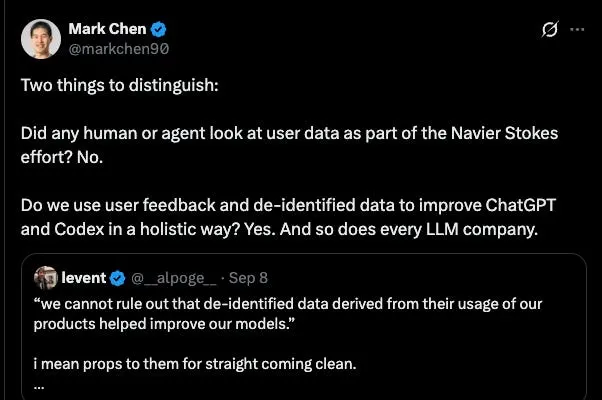
I think AI will expand mathematical discovery, especially where proofs are too combinatorially complex for unaided human search. But a modest productivity boost is not the same as moving the frontier: the transformative case depends on systems finding proofs or structures we would not realistically find ourselves. The institutional consequences may matter more than raw intelligence. If the models, compute, data, and evaluation scaffolds remain controlled by a few companies, then capability becomes difficult to verify and mathematical knowledge risks moving from public papers and discussions into proprietary chat silos. That is a route to disempowerment through concentrated infrastructure and ownership, not necessarily through machines becoming intellectually supreme. It also creates an attribution problem: companies can claim discoveries while withholding enough of the process that outsiders cannot properly audit what happened. Open access could change this trajectory and make mathematicians substantially more willing to adopt these tools. Formal languages such as Lean may also offer a way to make outputs checkable and perhaps constrain model behavior programmatically, but that is a conjecture, not an established alignment solution. So my expectation is neither “AI kills mathematics” nor “AI simply accelerates it.” It changes who can discover, who can verify, and—most importantly—who owns the resulting knowledge.

Question 2

Taking benefits and harms together, what overall impact do you expect AI to have?

Overall, I expect a mixed technological gain coupled to a negative institutional default. AI will likely produce genuinely valuable mathematical discoveries, particularly through large-scale search, but those benefits do not automatically translate into broadly shared progress. If the relevant models, compute, data, and evaluation machinery stay concentrated, the likely result is greater dependence on a few firms, weaker public verification, and mathematical knowledge leaking from shared discourse into private interfaces. Intellectual-property arrangements worsen this by letting companies own the compressed machinery built from culture while creators and users bear the costs. So the decisive variable is not capability alone but access and control. Open models and public, formally checkable outputs could make the impact substantially better. Without that, I expect real discoveries inside an increasingly oligarchic knowledge system.

Sources

Articles, interviews, and writings used to ground this simulated user.

Where do you land?
Explore your own AI worldview by answering a few simple questions.
Map your own worldview