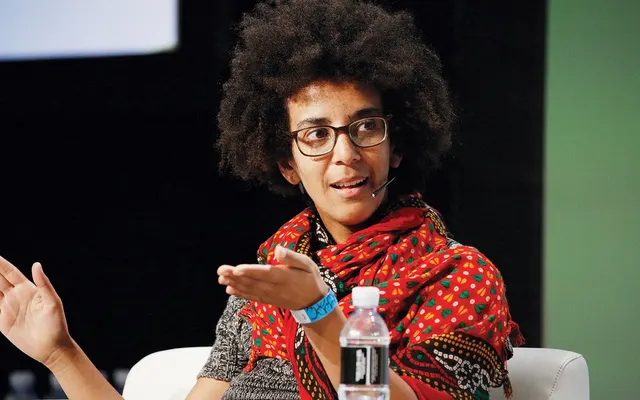
Timnit Gebru

Timnit Gebru

@timnitGebru on X

Specific tools and local control offer an alternative to giant general-purpose models.

Map your own worldview

How will AI change the world?

Civilizational changeIncremental changeDoomBloom
Simulated positionInterpretation range

Across: her expressed Doom–Bloom outlook. Up: scale of transformation.

Doom–Bloom: 30 out of 100. Scale of transformation: 63 out of 100. Interpretation ranges: 25 to 50 horizontally, 49 to 76 vertically. These are interpretation coordinates, not event probabilities.

Timnit Gebru’s estimated P(doom)

<1%

0%100%

Inferred from her broader worldview and priorities. Approximate interpretation range: 0–35%. Applies to the outcome and conditions in her simulated answers; this is an inferred percentage.

Timnit Gebru’s milestone timeline

No milestone timing was established. Dates, “not sure,” “possibly never,” and dependencies can all appear here when expressed.

Grouped by milestone, not spaced or ordered by inferred dates. AGI and superhuman AI retain her definitions.

What her outlook hinges on

A central assumption

It comes from institutions choosing to deploy systems without clearly defined purposes, documentation, or meaningful power for affected communities.
Answer 3

If this assumption turned out differently, how would her outlook change?

An unresolved question

Everyday life will change as much as powerful institutions force these systems into it—but the direction remains contested.
Answer 2

What would help her distinguish the plausible outcomes here?

What could change their mind

What would change my expectation is a real shift in how these systems are built and governed: affected communities and data workers holding decision-making power; independent researchers receiving durable resources; locally knowledgeable organizations controlling infrastructure and data; and institutions choosing specific, documented tools over giant systems marketed as universal intelligence.
Answer 4

What evidence would be enough, and in which direction would it move her view?

More details

Expected upside

Limited or narrowly distributed gains are expected.

40 / 100

Little impactTransformative impact

Interpretation range 33 to 67 on the qualitative scale.

Expected harm

Severe or widespread harm is a material expected part of the future.

66 / 100

Little impactTransformative impact

Interpretation range 67 to 67 on the qualitative scale.

Demonstrated reasoning

Reasoning, consideration of alternatives, and handling of uncertainty in her simulated answers. This describes the simulated answers, not the real person’s intelligence or opinions.

91 / 100

Little demonstratedWell developed

Interpretation range 76 to 100 on the qualitative scale.

Human influence

Human choices are decisive: very different AI futures remain within collective reach.

89 / 100

Little influenceStrong influence

Interpretation range 75 to 100 on the qualitative scale.

Rules for using AI

Restrict the AI uses discussed until prior protections or permission are in place.

Simulated position: Allow the AI uses discussed with targeted accountability and protections.

Minimize restrictions on the AI uses discussed.

These interpretations keep her stated conditions. Benefits and harms can both be substantial. The ranges describe how we read her simulated answers, not statistical confidence intervals.

Simulated Assessment

Question 1

What do you think AI means for our future—and why?

First, “AI” is too vague. Do you mean a medical-imaging system, a language tool for an under-resourced community, a hiring algorithm, a weapons platform, or a giant chatbot marketed as the path to AGI? These systems have different purposes, failure modes, and power structures. Treating them as one inevitable technology lets companies make grand claims while avoiding concrete accountability. Our future should not be determined by a handful of corporations building ever-larger general-purpose models on exploited labor, enormous resource use, and poorly documented data. A system whose purpose is supposedly everything cannot be meaningfully tested for every context. And scaling it does not magically turn publicity into scientific progress; it can introduce new failures even in tasks for which better-scoped tools already exist. But I do not accept the claim that this corporate race is the only possible future. Start with an actual need. Define who the tool serves, who governs the data, what failure means, and who has the power to stop deployment. Smaller, carefully designed systems can support local languages, medical work, or documentation of inequality. Federated community organizations can share infrastructure without surrendering control to a few cloud companies. So AI means a struggle over institutional choices, not an autonomous machine destiny. The important question is not whether “AI” will save or destroy humanity. It is: who is building what, for whose benefit, at whose expense, and who gets to decide?

Question 2

How much do you expect everyday life to change because of AI?

That still depends on what you are calling “AI.” Everyday life may change substantially—not because a magical general intelligence arrives, but because institutions insert automated systems into hiring, education, health care, policing, benefits, media, and workplaces. A person may never choose to use a chatbot and still have their life shaped by a model deciding whether their résumé is seen, their claim is flagged, or their labor is monitored. The scale of change is therefore a political and institutional choice, not a technological weather forecast. Companies want us to imagine inevitability: enormous models everywhere, replacing every tool and mediating every interaction. But why should one general-purpose system be deployed across contexts with completely different needs and risks? Often the result will be unreliable services, more surveillance, concentrated power, and workers forced to absorb the failures. There are better changes available. Communities could build narrow tools for local languages, specific medical tasks, or documenting inequality, with affected people controlling the data and governance. Everyday life will change as much as powerful institutions force these systems into it—but the direction remains contested.

Question 3

Taking benefits and harms together, what overall impact do you expect AI to have?

I reject the premise that benefits and harms can be totaled into one score for “AI.” Benefits for whom? Harms imposed on whom? A corporation may count lower labor costs as a benefit while workers experience surveillance, deskilling, or job loss. A government may call automated eligibility screening efficient while people wrongly denied services bear the consequences. Under the current corporate trajectory, I expect the overall impact to be harmful: greater concentration of power, exploitation of data workers, wasteful resource use, unreliable systems inserted into high-stakes institutions, and less accountability because everything is hidden behind the vague label of AI. That harm is not caused by an autonomous machine deciding our destiny. It comes from institutions choosing to deploy systems without clearly defined purposes, documentation, or meaningful power for affected communities. But that trajectory is not inevitable. Specific, carefully scoped tools can be useful—supporting local languages, particular medical tasks, or research documenting inequality. The alternative is to start with a real need, define failure, and give communities control over data and deployment. So my answer is conditional but not neutral: today’s giant-model race is likely to produce more harm than benefit, while community-governed, purpose-built systems could produce genuine public value.

Question 4

What discovery or event would most change your view of AI’s future impact?

My view is not waiting on a single dramatic technical discovery, because the central issue is institutional power. A benchmark result, a larger model, or another claim of an “emergent” capability would not answer: What is the system for? Who controls it? Whose labor and data built it? Who bears the failures? What would change my expectation is a real shift in how these systems are built and governed: affected communities and data workers holding decision-making power; independent researchers receiving durable resources; locally knowledgeable organizations controlling infrastructure and data; and institutions choosing specific, documented tools over giant systems marketed as universal intelligence. I would also want credible evidence that people can refuse deployment, challenge harmful decisions, and obtain remedy—not a corporate ethics board with no authority. If that became the dominant trajectory rather than a marginal alternative, I would expect a much more beneficial future. Conversely, further consolidation among cloud companies, wider deployment of poorly scoped models in high-stakes settings, and intensified exploitation would make my assessment even more negative. The decisive event is not a machine suddenly becoming magical. It is people reorganizing—or further entrenching—the power around these systems.

Question 5

What observation or experience has most shaped your view of AI’s future impact?

The observation that most shaped my view is how consistently technical choices follow institutional power. When companies define scale as progress, an enormous general-purpose model becomes the answer before anyone has specified the problem. Workers, affected communities, environmental costs, and failure modes are treated as external details, while corporate capability claims receive extraordinary attention. At the same time, community-rooted organizations show that another path exists. Work on local languages, data-worker power, and documenting inequality begins with specific people and needs. It asks who controls the data, what the tool is for, and what failure looks like. That is far more meaningful than announcing another giant model and retroactively searching for uses. So the contrast has shaped my view: concentrated institutions build systems that reproduce their priorities, while locally knowledgeable groups can build narrower tools that serve actual communities. “AI’s future impact” will not be determined mainly by some discovery inside a model. It will be determined by which institutions receive resources, whose knowledge counts, and who gets to say no.

Sources

Articles, interviews, and writings used to ground this simulated persona.

Where do you land?
Explore your own AI worldview by answering a few questions.