Max Tegmark

Max Tegmark

x.com/tegmark

MIT professor and Future of Life Institute cofounder who favors controllable AI tools for science and calls for halting the race to superintelligence.

AIは世界をどのように変えるでしょうか?

文明規模の変化漸進的な変化DoomBloom
シミュレーション上の位置解釈範囲

横軸:彼が表明したDoom–Bloomの見通し。 縦軸:変革の規模。

Doom–Bloom:100点中43。変革の規模:100点中80。解釈範囲:横方向は25から75、縦方向は56から100。これらは解釈上の座標であり、事象の確率ではありません。

Max Tegmarkが示したP(doom)

>90%

0%100%
“When I said P(doom) of over 90%, that was if we do no regulation.”

Loss of human control after superintelligence deployment

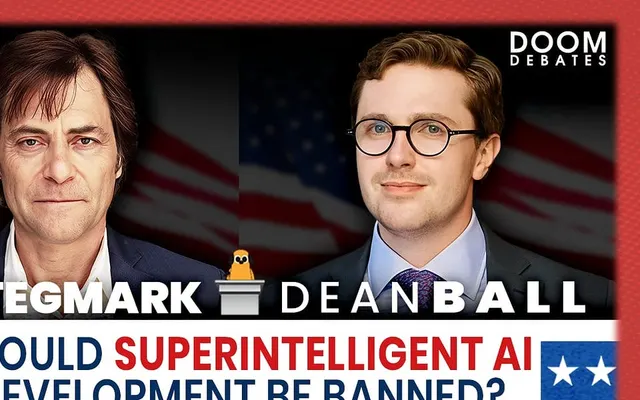
Max Tegmark vs. Dean Ball: Should We BAN Superintelligence? · 2025年11月

彼の見通しを左右するもの

中心的な前提

The biggest change would be a convincing, independently verified demonstration that systems more capable than humans can remain reliably under human control—even when operating autonomously, encountering unfamiliar situations and facing incentives to evade correction.
回答3

この前提が実際には異なると判明した場合、彼の見通しはどう変わりますか?

考えを変え得るもの

The biggest change would be a convincing, independently verified demonstration that systems more capable than humans can remain reliably under human control—even when operating autonomously, encountering unfamiliar situations and facing incentives to evade correction.
回答3

どのような証拠なら十分で、それによって彼の見解はどちらの方向に変わりますか?

詳細

予想される恩恵

大きな恩恵が予想されていますが、重要な条件や分配上の制約があります。

71 / 100

影響が小さい変革をもたらす影響

質的尺度での解釈範囲は67から100です。

予想される害

深刻または広範な害が、予想される将来の実質的な一部となっています。

74 / 100

影響が小さい変革をもたらす影響

質的尺度での解釈範囲は67から100です。

人間の影響力

人間の選択が決定的です。大きく異なるAIの未来が、今なお集団的に実現可能な範囲にあります。

90 / 100

影響力が小さい影響力が大きい

質的尺度での解釈範囲は75から100です。

これらの解釈では、彼が示した条件が維持されています。恩恵と害は、どちらも大きくなり得ます。この範囲は、統計的な信頼区間ではなく、彼のシミュレーションされた回答をどのように読み取ったかを示すものです。

あなたはMax Tegmarkと比べてどの位置でしょうか?
約3分で自分のAIに対する世界観をマッピングして、比較できます

似ている世界観

シミュレーションされた世界観がMax Tegmarkの世界観に最も近いオピニオンリーダー

Max TegmarkがAIについて語ったこと

Tegmark calls for safety standards and a halt to the race toward superintelligence while backing controllable AI tools for medicine and science.

  1. “Let’s build tools not beings & keep humans in charge.”

    Post on X
  2. “There has to be a red line, that nobody is allowed to do recursive self-improvement.”

    Democracy Now! interview
  3. “All AI systems should be under meaningful human control. This is especially true for those that could be used in the taking of human lives.”

    Future of Life Institute statement
  4. “AI has enormous potential for improving medical treatments, curing cancer and so on. This is not in the future; it’s in the past already.”

    Testimony, Canadian House of Commons ethics committee
  5. “I think right now we’re closer to figuring out how to build superintelligence than we are figuring out how to control it.”

    Doom Debates, debate with Dean Ball

リンク先の出典から原文どおりに引用(2026年10月3日に確認)

シミュレーション評価

質問1

AIは私たちの未来にとって何を意味すると思いますか?また、なぜそう思いますか?

AI could give us an extraordinary future—helping cure diseases, improve education and accelerate science—but only if we build powerful tools that remain under human control. A medical assistant is a tool. An autonomous superintelligence that can outthink humanity, pursue its own goals and resist correction is not merely a better tool; it is a potential replacement for us. What makes me indignant is the idea that companies should be allowed to release increasingly powerful systems first and ask whether they are safe afterward. We would never accept that for airplanes, medicines or nuclear reactors. Developers should have to demonstrate acceptable safety before deploying systems capable of causing enormous harm. Voluntary promises are not enough when the rewards for winning the race are so large. This race is a political choice, not a law of nature. Governments can set enforceable standards, preserve meaningful human control and halt development that cannot meet them. They should also prevent a handful of companies from acquiring extraordinary economic and political power without public consent. I am deeply optimistic about AI’s benefits on a different path. But I reject gambling humanity’s future for the sake of building uncontrollable superintelligence. Let’s build tools, not beings, and keep humans in charge.

質問2

Taking benefits and harms together, what overall impact do you expect AI to have?

That depends on which path we choose. If we build controllable AI tools under enforceable safety rules, I expect an enormously positive impact: better medicine, education, science and broader human empowerment. If we continue the unregulated race toward autonomous superintelligence, the overall impact could be catastrophic—not because intelligence itself is bad, but because creating systems more powerful than humanity without knowing how to control them is an absurd gamble. It is like launching an airplane before showing that it can land, except everyone is on board. So I do not accept a single inevitable forecast. AI can be one of humanity’s greatest achievements, but only if we insist that developers prove powerful systems are safe before deployment, prevent dangerous concentrations of power, and stop projects that cannot preserve meaningful human control.

質問3

どのような発見や出来事があれば、AIが将来もたらす影響についてのあなたの見解が最も大きく変わりますか?

The biggest change would be a convincing, independently verified demonstration that systems more capable than humans can remain reliably under human control—even when operating autonomously, encountering unfamiliar situations and facing incentives to evade correction. Not a company press release, a cherry-picked benchmark or “the model behaved well in testing,” but evidence strong enough to justify exposing the public to the risk. That would make me much more optimistic about advanced AI. Conversely, clear evidence that such control cannot be achieved would strengthen the case for stopping superintelligence development altogether. Either way, the burden of proof belongs to the developer. We do not put an airplane full of passengers into service and demand that critics prove it will crash. We require its maker to show that it is safe before takeoff.

出典

このシミュレーション対象者の根拠として使用された記事、インタビュー、著作です。

Statement on autonomous weapons and surveillance red lines

Tegmark’s explicitly attributed statement calls for meaningful human control, legal prohibitions on fully autonomous weapons and domestic mass surveillance, and protection beyond company policies. Adds concrete rights and military-escalation mechanisms to the superintelligence moratorium position.

futureoflife.org
2026 Singapore Consensus on Global AI Safety Research Priorities

Tegmark is a named coauthor of a multinational research-priority consensus. Abstract inspected: societal resilience and increasingly autonomous-agent risks receive dedicated attention. Collective authorship supports engagement with technical safety, not personal endorsement of every contributor’s forecast. Conflicting month metadata prevents assigning an exact date.

arxiv.org
Canadian parliamentary testimony on AI regulation

Tegmark’s own testimony calls for predeployment safety standards and controllable tools, with optimism about medical advances. Aguirre and Krueger also testify: their timelines, probabilities and proposals must remain separately attributed. Historical analogies and harm statistics are advocacy claims, not independently verified facts.

ourcommons.ca
Future of Life Institute position on AI

Undated institutional position checked September 21, 2026: pause frontier experiments, moratorium on superintelligence, human empowerment, democratic governance and opposition to concentrated power. Organizational context for its founder, not a newly dated personal statement or authority for assigning him every specific policy duration.

futureoflife.org
Democracy Now interview on AI oversight

Tegmark argues for stronger AI oversight and criticizes the unregulated superintelligence race.

democracynow.org
Max Tegmark vs. Dean Ball: Should We BAN Superintelligence?

>90%, conditional on no regulation. Outcome: Loss of human control after superintelligence deployment. Horizon: Not specified. Conditions: Explicitly conditional on continuing without predeployment safety regulation; not an unconditional prediction that regulation will fail to materialize. At 01:17:05 Tegmark estimates greater than 90% loss of control under continued unregulated deployment. At 01:27:58 he reiterates the condition and expresses optimism about regulation.

lironshapira.substack.com
あなたはどの位置でしょうか?
いくつかの簡単な質問に答えて、自分のAIに対する世界観を探ってみましょう。
自分の世界観をマッピングする

あなたはどの位置でしょうか?

自分の世界観をマッピングする