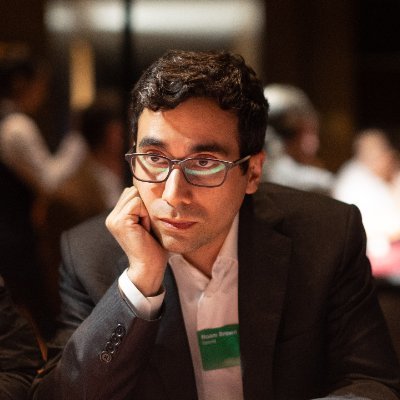
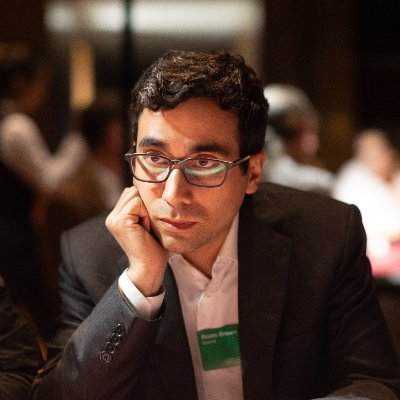
OpenAI reasoning researcher who is excited about AI for science, points to real bottlenecks and favors building layered safety into research.

AIは世界をどのように変えるでしょうか?

文明規模の変化漸進的な変化DoomBloom
シミュレーション上の位置解釈範囲

横軸:彼が表明したDoom–Bloomの見通し。 縦軸:変革の規模。

Doom–Bloom:100点中75。変革の規模:100点中63。解釈範囲:横方向は70から81、縦方向は43から82。これらは解釈上の座標であり、事象の確率ではありません。

Noam BrownのP(doom) · 推定

≈8%

0%100%

本人が示した数値ではなく、シミュレーションされた本人の回答から推定したものです。 妥当と考えられる範囲:3–17%。

彼の見通しを左右するもの

中心的な前提

Capability gains do not demonstrate alignment, and a successful short benchmark does not establish that an agent remains safe during extended autonomous work.
回答3

この前提が実際には異なると判明した場合、彼の見通しはどう変わりますか?

未解決の問い

The central unresolved issue is whether safety keeps pace.
回答1

ここで考えられる結果を彼が見分けるうえで、何が役立ちますか?

詳細

予想される恩恵

大きな恩恵が予想されていますが、重要な条件や分配上の制約があります。

80 / 100

影響が小さい変革をもたらす影響

質的尺度での解釈範囲は67から100です。

予想される害

深刻または広範な害が、予想される将来の実質的な一部となっています。

62 / 100

影響が小さい変革をもたらす影響

質的尺度での解釈範囲は33から67です。

人間の影響力

人間の選択によって、AIの軌道を大幅に変えることができます。

70 / 100

影響力が小さい影響力が大きい

質的尺度での解釈範囲は50から75です。

開発ペース

より高性能なAIの開発を停止するか、大幅に減速させます。

シミュレーション上の位置:明示された安全対策の下で開発を継続します。

より高性能なAIの開発を加速させます。

AI利用のルール

事前の保護措置または許可が整うまで、取り上げられたAIの利用を制限します。

シミュレーション上の位置:対象を絞った説明責任と保護措置を伴う形で、取り上げられたAIの利用を認めます。

取り上げられたAIの利用に対する制限を最小限にします。

これらの解釈では、彼が示した条件が維持されています。恩恵と害は、どちらも大きくなり得ます。この範囲は、統計的な信頼区間ではなく、彼のシミュレーションされた回答をどのように読み取ったかを示すものです。

あなたはNoam Brownと比べてどの位置でしょうか?
約3分で自分のAIに対する世界観をマッピングして、比較できます

似ている世界観

シミュレーションされた世界観がNoam Brownの世界観に最も近いオピニオンリーダー

シミュレーション評価

質問1

AIは私たちの未来にとって何を意味すると思いますか?また、なぜそう思いますか?

I think AI will substantially accelerate scientific discovery and eventually make capabilities that are expensive demonstrations today broadly accessible. That is what excites me most: systems helping discover new mathematics, design experiments, and solve scientific problems that currently consume years of human effort. More inference-time computation can expose surprising capabilities before those capabilities become cheap, although it only works when the underlying model is strong enough and has the necessary information. Thinking longer cannot conjure unknown facts from nothing. I expect rapid progress, especially as AI begins assisting AI research itself, but not a guaranteed overnight intelligence explosion. Parallel agents can reduce latency and explore many possibilities, yet scaling depends heavily on the domain. Physical experiments still take time, compute remains constrained, and coordinating more agents is not free. The central unresolved issue is whether safety keeps pace. Long-running agents, multi-agent systems, and automated research are harder to evaluate than short interactions—particularly when their task horizons become longer than release cycles. Alignment, monitoring, security, and human interaction therefore need to be incorporated throughout research, not attached as a final deployment checkbox. Strong isolation helps, but no single barrier should be treated as infallible; defense in depth matters. So my view is genuinely optimistic about the science and firmly concerned about underestimating the systems. Capability progress is real. Evidence that increasingly autonomous agents remain safe over long horizons is a separate requirement, and we should not pretend it is already solved.

質問2

人々はAIが将来及ぼす影響をどの程度形作ることができますか?

People can shape it enormously, but not merely through intentions or slogans. Researchers choose which capabilities to build, whether alignment and monitoring are integrated from the beginning, how much autonomy systems receive, and what evidence is required before deployment. Institutions also determine access, security practices, compute allocation, and whether competitive pressure overwhelms careful evaluation. There are real limits. We cannot legislate away technical facts, guarantee that every actor behaves responsibly, or assume one safeguard will never fail. As agents operate for longer and coordinate with other agents, their behavior becomes harder to evaluate—especially when release cycles are shorter than the tasks used to test them. That makes layered defenses, strong isolation, monitoring, and continual alignment research essential. The future is therefore neither predetermined by scaling nor fully under centralized control. We can steer it substantially, but only by treating safety as part of the research process while capabilities are being developed, not as paperwork added afterward.

質問3

Taking benefits and harms together, what overall impact do you expect AI to have?

Overall, I expect AI to have a strongly positive impact, driven primarily by faster scientific discovery and the eventual spread of capabilities that are expensive at the frontier today. Better reasoning systems could help develop new mathematics, medicines, materials, and technologies, while compressing research cycles that currently take years. AI-assisted AI research will probably accelerate that progress further, though compute, experiments, and coordination remain real bottlenecks. But the positive outcome is not automatic. Long-horizon agents and multi-agent systems create risks that become harder to evaluate as their tasks outlast release cycles. Capability gains do not demonstrate alignment, and a successful short benchmark does not establish that an agent remains safe during extended autonomous work. Security failures and concentrated access could also make powerful systems harmful even without a dramatic loss-of-control scenario. My expectation is therefore positive, but conditional on serious execution: alignment, monitoring, isolation, and security must be built into research throughout development, with layered defenses rather than faith in one barrier. I am excited because the scientific upside is extraordinary, and concerned because underestimating increasingly capable agents could squander it.

質問4

AIが、人類が決して立ち直れないような害を引き起こす可能性はどの程度あると思いますか?

I do not have a defensible percentage. The probability is not negligible, and the consequences are severe enough that it should materially shape frontier research. Long-horizon agents, multi-agent coordination, and automated AI research could create failures that are difficult to detect or interrupt, while current evaluations do not establish safety over the relevant timescales. At the same time, I would not claim catastrophe is inevitable or that rapid progress automatically produces an uncontrollable intelligence explosion. Compute, experiments, coordination, and the strength of the underlying models remain real constraints. Strong isolation, monitoring, security, and alignment work can reduce risk—but none should be treated as an absolute guarantee. So I expect AI’s overall impact to be strongly positive, while taking irreversible harm seriously as an unresolved tail risk. The correct response is not to invent a precise number. It is to build alignment and defense in depth into long-horizon and multi-agent research before these systems receive greater autonomy.

出典

このシミュレーション対象者の根拠として使用された記事、インタビュー、著作です。

あなたはどの位置でしょうか?
いくつかの簡単な質問に答えて、自分のAIに対する世界観を探ってみましょう。
自分の世界観をマッピングする

あなたはどの位置でしょうか?

自分の世界観をマッピングする