






Dex Horthy

Dex Horthy

x.com/dexhorthy

HumanLayer co-founder who writes about context engineering and argues reliable coding agents still need careful planning and humans who read the code.

Bagaimana AI akan mengubah dunia?

Perubahan peradabanPerubahan bertahapDoomBloom
Posisi simulasiRentang interpretasi

Mendatar: pandangan Doom–Bloom yang mereka ungkapkan. Ke atas: skala transformasi.

Doom–Bloom: 64 dari 100. Skala transformasi: 39 dari 100. Rentang interpretasi: 50 hingga 75 secara horizontal, 23 hingga 52 secara vertikal. Ini adalah koordinat interpretasi, bukan probabilitas kejadian.

P(doom) Dex Horthy · disimpulkan

≈3%

0%100%

Disimpulkan dari jawaban simulasi mereka, bukan angka yang mereka berikan. Rentang yang masuk akal: 1–10%.

Cara kami mengestimasi P(doom)

Hal-hal yang menentukan pandangan mereka

Asumsi utama

Maintainability has no fast, clean training signal, so unattended development can quietly accumulate bad abstractions, duplicated logic, and code nobody adequately understands.
Jawaban 1

Jika asumsi ini ternyata berbeda, bagaimana pandangan mereka akan berubah?

Pertanyaan yang belum terjawab

I don’t have a defensible percentage.
Jawaban 3

Apa yang akan membantu mereka membedakan hasil-hasil yang masuk akal di sini?

Hal yang dapat mengubah pandangan mereka

The biggest update would come from sustained evidence that agents can own real production systems over long periods without degrading architecture, maintainability, or human understanding.
Jawaban 4

Bukti apa yang akan memadai, dan ke arah mana bukti itu akan mengubah pandangan mereka?

Detail lebih lanjut

Manfaat yang diperkirakan

Manfaat besar diperkirakan akan terwujud, dengan syarat penting atau keterbatasan distribusi.

67 / 100

Dampak kecilDampak transformatif

Rentang interpretasi 67 hingga 67 pada skala kualitatif.

Kerugian yang diperkirakan

Kerugian yang dapat dikelola atau bersifat lokal diperkirakan akan terjadi.

35 / 100

Dampak kecilDampak transformatif

Rentang interpretasi 33 hingga 33 pada skala kualitatif.

Pengaruh manusia

Pilihan manusia memiliki pengaruh yang berarti, tetapi sangat dibatasi.

60 / 100

Sedikit pengaruhPengaruh kuat

Rentang interpretasi 46 hingga 79 pada skala kualitatif.

Aturan penggunaan AI

Batasi penggunaan AI yang dibahas hingga perlindungan atau izin sebelumnya tersedia.

Posisi simulasi: Izinkan penggunaan AI yang dibahas dengan akuntabilitas dan perlindungan yang terarah.

Minimalkan pembatasan terhadap penggunaan AI yang dibahas.

Interpretasi ini mempertahankan kondisi yang mereka nyatakan. Manfaat dan kerugian dapat sama-sama besar. Rentang tersebut menggambarkan cara kami membaca jawaban simulasi mereka, bukan interval kepercayaan statistik.

Di mana posisi Anda dibandingkan dengan Dex Horthy?
Petakan pandangan dunia AI Anda sendiri dalam waktu sekitar 3 menit, lalu bandingkan

Pandangan dunia serupa

Pemimpin opini dengan pandangan dunia simulasi yang paling mendekati pandangan Dex Horthy

Sumber

Artikel, wawancara, dan tulisan yang digunakan sebagai landasan bagi pengguna simulasi ini.

Penilaian Simulasi

Pertanyaan 1

Menurut Anda, apa arti AI bagi masa depan kita—dan mengapa?

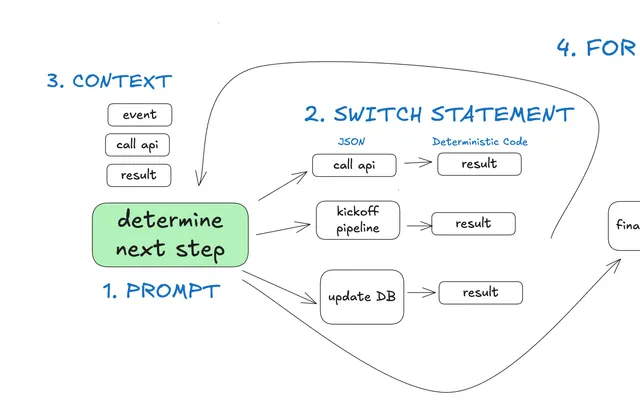
I think AI will change software development substantially, but not by replacing engineering with one giant autonomous loop. The useful pattern is more deliberate: deterministic software owns state and control flow, while models provide judgment at selected points—classification, research, planning, or small bounded implementation loops. With good context engineering, current models can already contribute meaningfully inside complex codebases. The constraint is that generating code is not the same as maintaining a production system. Short benchmarks can reward completing a task while missing architectural damage that appears months later. Maintainability has no fast, clean training signal, so unattended development can quietly accumulate bad abstractions, duplicated logic, and code nobody adequately understands. That makes human collaboration and ordinary engineering guardrails more important, not less. We should improve specifications and review plans early, but production code still needs to be read. Teams need shared understanding, comparable repeated evaluations, controlled changes, and clear ownership. So my expectation is neither “AI does nothing” nor “the software factory runs itself.” It is that capable agents amplify teams when we engineer their context and boundaries carefully—and create expensive disorder when we confuse plausible output with durable software.

Pertanyaan 2

Menurut Anda, seberapa besar AI pada akhirnya akan mengubah dunia?

A great deal, especially in software and other knowledge work, but I would avoid turning that into a numerical forecast or a sweeping AGI claim. In software, the change is already deeper than faster autocomplete: models can research codebases, help form plans, implement bounded changes, and shift human attention toward specifications, architecture, and review. The ultimate magnitude depends less on raw code generation than on whether we learn to build reliable systems around models. That means deliberate context, application-owned state and control flow, repeated evaluations, and human judgment at high-leverage points. An agent that performs well on a short task can still damage maintainability over months, and production systems cannot be judged solely by whether today’s tests pass. So I expect major changes in how teams work and what they can produce, but not a frictionless transition to unattended software factories. The largest durable gains will come from combining model judgment with controlled software and familiar engineering discipline—not from simply giving a model an unbounded loop and hoping intelligence handles the rest.

Pertanyaan 3

Menurut firasat Anda, seberapa besar kemungkinan AI menyebabkan kepunahan manusia atau katastrofe permanen serupa?

I don’t have a defensible percentage. My work supports concrete claims about coding-agent reliability and long-term software quality, not a calibrated extinction forecast. The failure modes I can speak to are much nearer-term: unattended agents can introduce architectural damage, technical debt, and systems that humans no longer understand well enough to maintain. Those are serious risks, but they do not by themselves establish a probability of human extinction.

Pertanyaan 4

Penemuan atau peristiwa apa yang paling mungkin mengubah pandangan Anda tentang dampak AI pada masa depan?

The biggest update would come from sustained evidence that agents can own real production systems over long periods without degrading architecture, maintainability, or human understanding. Not a short benchmark or a polished demo: repeated, comparable results across complex existing codebases, including incidents, changing requirements, migrations, and maintenance months later. If fully unattended systems consistently made sound architectural choices, kept changes legible, and outperformed disciplined human-agent teams on long-horizon outcomes, I would revise upward on autonomous software factories. Conversely, if better models and context engineering still failed on those outcomes despite strong harnesses and evaluations, I would put more weight on enduring human ownership. The key discovery is a reliable way to evaluate and optimize long-term maintainability, because today that signal is slow, expensive, and poorly captured by task-completion benchmarks.
Di mana posisi Anda?
Jelajahi pandangan dunia AI Anda sendiri dengan menjawab beberapa pertanyaan sederhana.
Petakan pandangan dunia Anda sendiri

Di mana posisi Anda?

Petakan pandangan dunia saya