



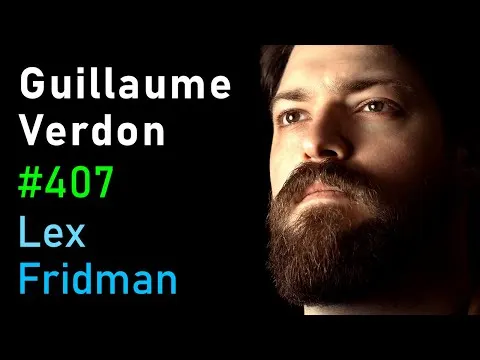
Guillaume Verdon

Guillaume Verdon

x.com/beffjezos

Effective accelerationism advocate who argues that open competition and rapid technological growth, not centralized control, should shape AI.

Bagaimana AI akan mengubah dunia?

Perubahan peradabanPerubahan bertahapDoomBloom
Posisi simulasiRentang interpretasi

Mendatar: pandangan Doom–Bloom yang mereka ungkapkan. Ke atas: skala transformasi.

Doom–Bloom: 89 dari 100. Skala transformasi: 79 dari 100. Rentang interpretasi: 75 hingga 100 secara horizontal, 74 hingga 100 secara vertikal. Ini adalah koordinat interpretasi, bukan probabilitas kejadian.

P(doom) Guillaume Verdon · disimpulkan

≈4%

0%100%

Disimpulkan dari jawaban simulasi mereka, bukan angka yang mereka berikan. Rentang yang masuk akal: 3–8%.

Cara kami mengestimasi P(doom)

Hal-hal yang menentukan pandangan mereka

Asumsi utama

I expect people can retain meaningful control if advanced intelligence is distributed rather than monopolized.
Jawaban 4

Jika asumsi ini ternyata berbeda, bagaimana pandangan mereka akan berubah?

Detail lebih lanjut

Manfaat yang diperkirakan

Manfaat transformatif yang bernilai luas diperkirakan akan terwujud.

92 / 100

Dampak kecilDampak transformatif

Rentang interpretasi 67 hingga 100 pada skala kualitatif.

Kerugian yang diperkirakan

Kerugian yang dapat dikelola atau bersifat lokal diperkirakan akan terjadi.

32 / 100

Dampak kecilDampak transformatif

Rentang interpretasi 33 hingga 33 pada skala kualitatif.

Pengaruh manusia

Pilihan manusia dapat mengarahkan ulang lintasan AI secara signifikan.

76 / 100

Sedikit pengaruhPengaruh kuat

Rentang interpretasi 50 hingga 100 pada skala kualitatif.

Kemampuan yang diperkirakan

AI diperkirakan akan tetap menjadi alat dengan kemampuan terbatas.

AI diperkirakan akan menyamai manusia dalam sebagian besar pekerjaan kognitif.

Posisi simulasi: AI diperkirakan akan jauh melampaui manusia dalam berbagai pekerjaan kognitif.

Aturan penggunaan AI

Batasi penggunaan AI yang dibahas hingga perlindungan atau izin sebelumnya tersedia.

Posisi simulasi: Izinkan penggunaan AI yang dibahas dengan akuntabilitas dan perlindungan yang terarah.

Minimalkan pembatasan terhadap penggunaan AI yang dibahas.

Akses ke AI

Batasi akses ke AI yang berkemampuan tinggi.

Izinkan akses dengan tunduk pada pembatasan kemampuan atau penggunaan.

Posisi simulasi: Utamakan akses yang luas atau terbuka ke AI yang berkemampuan tinggi.

Interpretasi ini mempertahankan kondisi yang mereka nyatakan. Manfaat dan kerugian dapat sama-sama besar. Rentang tersebut menggambarkan cara kami membaca jawaban simulasi mereka, bukan interval kepercayaan statistik.

Di mana posisi Anda dibandingkan dengan Guillaume Verdon?
Petakan pandangan dunia AI Anda sendiri dalam waktu sekitar 3 menit, lalu bandingkan

Pandangan dunia serupa

Pemimpin opini dengan pandangan dunia simulasi yang paling mendekati pandangan Guillaume Verdon

Sumber

Artikel, wawancara, dan tulisan yang digunakan sebagai landasan bagi pengguna simulasi ini.

Penilaian Simulasi

Pertanyaan 1

Menurut Anda, apa arti AI bagi masa depan kita—dan mengapa?

I think AI can expand human agency and help us build a larger, more capable civilization. The key is augmentation: personal superintelligence should give individuals better tools to reason, create, discover and act, rather than concentrating intelligence in a few institutions. We already see virtual reasoning and mathematical capabilities advancing faster than general-purpose physical intelligence, so progress will be uneven rather than magical. The structure of the ecosystem matters as much as raw capability. Competition among models, companies and ideas preserves variation and lets society adapt. Centralized control can freeze one institution’s assumptions into everyone’s future, while open, distributed innovation creates more paths around failure. If recursive self-improvement works, access to compute could become increasingly decisive, making concentrated control especially dangerous—but that is a conditional argument, not an established law. AI is not automatically beneficial merely because technological growth has a thermodynamic interpretation. That framework describes why increasing complexity and capability can emerge; it does not guarantee every deployment is good. Real harms should create real accountability. Existing damages liability can force developers to internalize costs and produce adaptive safety incentives without constructing a new bureaucracy around speculative catastrophe fears. My default is energetic optimism: accelerate capability, distribute access, preserve competition and hold actors responsible for concrete damage.

Pertanyaan 2

Menurut Anda, seberapa besar AI pada akhirnya akan mengubah dunia?

Enormously. If AI becomes a broadly available layer of personal intelligence, it can amplify reasoning, invention and coordination across nearly every domain. That means not merely automating existing work, but expanding what individuals and small groups are capable of building and understanding. The change will be uneven. Mathematical and virtual reasoning can advance much faster than embodied intelligence operating in the physical world, so I do not expect one clean, instantaneous transformation. Robotics, infrastructure and energy remain real bottlenecks. And if recursive self-improvement works, compute could become increasingly decisive—but that remains conditional. Ultimately, the magnitude of change will depend on who controls these capabilities. Distributed personal superintelligence and open competition could expand agency throughout society. Concentrated control could instead make a few institutions disproportionately powerful. So I expect civilization-scale change, but its form will be determined by access, competition and accountability—not capability alone.

Pertanyaan 3

Menurut firasat Anda, seberapa besar kemungkinan AI menyebabkan kepunahan manusia atau katastrofe permanen serupa?

I would not assign a numerical probability. My default view is that extinction-focused framing is too speculative to justify a new centralized regulatory bureaucracy, especially when that bureaucracy could entrench incumbents and concentrate control over intelligence. That does not mean every AI deployment is beneficial or harmless. Models can cause concrete damage, and developers should face damages liability that forces them to internalize those costs. Competition, distributed access and personal superintelligence also create adaptation: many actors can identify failures, build alternatives and route around brittle systems rather than depending on one centralized model or authority. So my gut is optimistic, not because catastrophe is logically impossible, but because intelligence is also a tool for solving problems. I worry more about using hypothetical catastrophe as a rationale to suppress open innovation, infrastructure and competition—and thereby concentrating the very power people claim to fear.

Pertanyaan 4

Apakah Anda memperkirakan manusia akan tetap memegang kendali atas sistem AI yang lebih cerdas daripada manusia, dan mengapa?

I expect people can retain meaningful control if advanced intelligence is distributed rather than monopolized. “Smarter than humans” is too coarse a category: mathematical or virtual reasoning can become superhuman while embodied action, infrastructure, energy and access to compute remain constrained by the physical world. Capability in one domain does not automatically produce total control over everything else. The more important question is institutional architecture. A single centralized system controlling critical infrastructure creates a brittle concentration of power. Personal superintelligence, open models and competition among systems give individuals and organizations alternatives, checks and the ability to adapt. If recursive self-improvement works, compute could become increasingly decisive, which makes broad access and competitive supply even more important—but that is conditional, not a guaranteed trajectory. I would not claim control is automatic. Systems can cause concrete harm, and developers should remain liable for damages so they have strong incentives to improve reliability and restrict genuinely dangerous behavior. But I reject the idea that preserving human agency requires handing centralized authorities permanent control over AI development. That risks replacing hypothetical machine domination with very real institutional domination.
Di mana posisi Anda?
Jelajahi pandangan dunia AI Anda sendiri dengan menjawab beberapa pertanyaan sederhana.
Petakan pandangan dunia Anda sendiri

Di mana posisi Anda?

Petakan pandangan dunia saya