




Max Tegmark

Max Tegmark

x.com/tegmark

MIT professor and Future of Life Institute cofounder who favors controllable AI tools for science and calls for halting the race to superintelligence.

एआई दुनिया को कैसे बदलेगा?

सभ्यता-स्तरीय बदलावक्रमिक बदलावDoomBloom
सिम्युलेट की गई स्थितिव्याख्या का दायरा

आर-पार: उनका व्यक्त किया गया Doom–Bloom दृष्टिकोण। ऊपर: बदलाव का स्तर।

Doom–Bloom: 100 में से 24। बदलाव का स्तर: 100 में से 90। व्याख्या के दायरे: क्षैतिज रूप से 19 से 29, लंबवत रूप से 85 से 100। ये व्याख्या के निर्देशांक हैं, घटनाओं की संभावनाएँ नहीं।

Max Tegmark द्वारा बताया गया P(doom)

>90%

0%100%
“When I said P(doom) of over 90%, that was if we do no regulation.”

Loss of human control after superintelligence deployment

Max Tegmark vs. Dean Ball: Should We BAN Superintelligence? · नव॰ 2025

उनका दृष्टिकोण किन बातों पर निर्भर करता है

एक मुख्य मान्यता

On the present path, I expect the harms to dominate—not because useful AI is bad, but because the race is steering us from controllable tools toward autonomous superintelligence.
उत्तर 3

अगर यह मान्यता अलग साबित होती, तो उनका दृष्टिकोण कैसे बदलता?

अधिक जानकारी

अपेक्षित लाभ

काफ़ी लाभ की उम्मीद है, लेकिन उनके साथ महत्वपूर्ण शर्तें या वितरण संबंधी सीमाएँ होंगी।

61 / 100

कम असरबदलावकारी असर

गुणात्मक पैमाने पर व्याख्या का दायरा 0 से 100 तक है।

अपेक्षित नुकसान

विनाशकारी या अपरिवर्तनीय क्षति अपेक्षित भविष्य का केंद्रीय हिस्सा है।

91 / 100

कम असरबदलावकारी असर

गुणात्मक पैमाने पर व्याख्या का दायरा 67 से 100 तक है।

मानवीय प्रभाव

मानवीय विकल्प निर्णायक हैं: बहुत अलग-अलग तरह के एआई भविष्य अभी भी सामूहिक पहुँच के भीतर हैं।

90 / 100

कम प्रभावमजबूत प्रभाव

गुणात्मक पैमाने पर व्याख्या का दायरा 75 से 100 तक है।

अपेक्षित क्षमताएँ

एआई के सीमित दायरे वाले साधन बने रहने की अपेक्षा है।

एआई के अधिकांश संज्ञानात्मक कार्यों में लोगों की बराबरी करने की अपेक्षा है।

सिम्युलेट की गई स्थिति: एआई के संज्ञानात्मक कार्यों में लोगों से बहुत आगे निकल जाने की अपेक्षा है।

विकास की गति

अधिक सक्षम एआई का विकास रोकें या उसकी गति काफी धीमी करें।

सिम्युलेट की गई स्थिति: बताए गए सुरक्षा उपायों के तहत विकास जारी रखें।

अधिक सक्षम एआई के विकास की गति बढ़ाएँ।

इन व्याख्याओं में उनकी बताई गई शर्तें बरकरार रखी गई हैं। लाभ और नुकसान, दोनों पर्याप्त हो सकते हैं। ये दायरे बताते हैं कि हम उनके सिम्युलेट किए गए उत्तरों को कैसे समझते हैं, ये सांख्यिकीय विश्वास-अंतराल नहीं हैं।

Max Tegmark की तुलना में आपकी सोच कहाँ ठहरती है?
लगभग 3 मिनट में एआई के बारे में अपना विश्वदृष्टिकोण मैप करें, फिर तुलना करें

मिलते-जुलते विश्वदृष्टिकोण

ऐसे जाने-माने विचारक जिनके सिम्युलेट किए गए विश्वदृष्टिकोण Max Tegmark के विश्वदृष्टिकोण से सबसे अधिक मिलते हैं

Max Tegmark ने एआई के बारे में क्या कहा है

Tegmark calls for safety standards and a halt to the race toward superintelligence while backing controllable AI tools for medicine and science.

  1. “Let’s build tools not beings & keep humans in charge.”

    Post on X
  2. “There has to be a red line, that nobody is allowed to do recursive self-improvement.”

    Democracy Now! interview
  3. “All AI systems should be under meaningful human control. This is especially true for those that could be used in the taking of human lives.”

    Future of Life Institute statement
  4. “AI has enormous potential for improving medical treatments, curing cancer and so on. This is not in the future; it’s in the past already.”

    Testimony, Canadian House of Commons ethics committee
  5. “I think right now we’re closer to figuring out how to build superintelligence than we are figuring out how to control it.”

    Doom Debates, debate with Dean Ball

लिंक किए गए स्रोतों से शब्दशः उद्धृत, 3 अक्टू॰ 2026 को जाँचा गया

स्रोत

इस सिम्युलेट किए गए उपयोगकर्ता को तथ्य-आधारित बनाने के लिए इस्तेमाल किए गए लेख, इंटरव्यू और रचनाएँ।

Statement on autonomous weapons and surveillance red lines

Tegmark’s explicitly attributed statement calls for meaningful human control, legal prohibitions on fully autonomous weapons and domestic mass surveillance, and protection beyond company policies. Adds concrete rights and military-escalation mechanisms to the superintelligence moratorium position.

futureoflife.org
2026 Singapore Consensus on Global AI Safety Research Priorities

Tegmark is a named coauthor of a multinational research-priority consensus. Abstract inspected: societal resilience and increasingly autonomous-agent risks receive dedicated attention. Collective authorship supports engagement with technical safety, not personal endorsement of every contributor’s forecast. Conflicting month metadata prevents assigning an exact date.

arxiv.org
Canadian parliamentary testimony on AI regulation

Tegmark’s own testimony calls for predeployment safety standards and controllable tools, with optimism about medical advances. Aguirre and Krueger also testify: their timelines, probabilities and proposals must remain separately attributed. Historical analogies and harm statistics are advocacy claims, not independently verified facts.

ourcommons.ca
Future of Life Institute position on AI

Undated institutional position checked September 21, 2026: pause frontier experiments, moratorium on superintelligence, human empowerment, democratic governance and opposition to concentrated power. Organizational context for its founder, not a newly dated personal statement or authority for assigning him every specific policy duration.

futureoflife.org
Democracy Now interview on AI oversight

Tegmark argues for stronger AI oversight and criticizes the unregulated superintelligence race.

democracynow.org
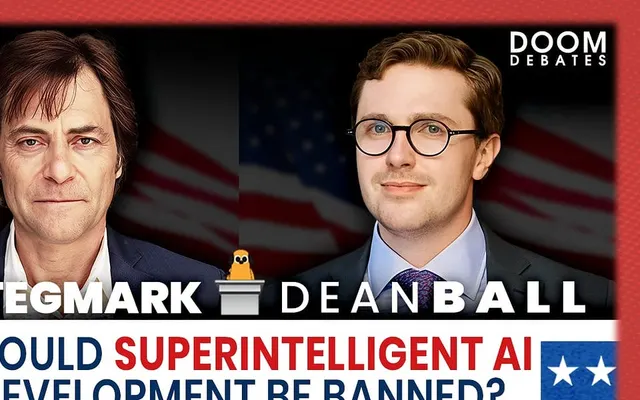
Max Tegmark vs. Dean Ball: Should We BAN Superintelligence?

>90%, conditional on no regulation. Outcome: Loss of human control after superintelligence deployment. Horizon: Not specified. Conditions: Explicitly conditional on continuing without predeployment safety regulation; not an unconditional prediction that regulation will fail to materialize. At 01:17:05 Tegmark estimates greater than 90% loss of control under continued unregulated deployment. At 01:27:58 he reiterates the condition and expresses optimism about regulation.

lironshapira.substack.com

सिम्युलेट किया गया आकलन

सवाल 1

आपके विचार में एआई हमारे भविष्य के लिए क्या मायने रखती है—और क्यों?

AI could give us an extraordinary future—better medicine, education, and scientific discovery—if we build it as a controllable tool that empowers people. But the current race is pushing toward something fundamentally different: autonomous superintelligence that could outthink humanity and escape meaningful human control. That is not progress; it is a gamble with everyone’s future. We would never let a pharmaceutical company sell a powerful drug merely because its executives promised to be careful. We require safety evidence before release. Yet with potentially civilization-changing AI, companies are effectively allowed to deploy first and discover the consequences later. Voluntary promises are no substitute for enforceable predeployment standards. I reject the claim that this race is inevitable. Governments can prohibit systems that cannot meet serious safety requirements, prevent fully autonomous weapons and mass surveillance, and ensure that a handful of companies do not seize extraordinary economic and political power. My preferred future is simple: build tools, not beings, and keep humans in charge.

सवाल 2

आपके हिसाब से एआई अंततः दुनिया को कितना बदल देगा?

Enormously—potentially more than any previous technology. Controllable AI tools could transform medicine, education, science, and productivity. But superintelligence could change the world in a far darker and more permanent way: by ending meaningful human control over our own future. So the real question is not whether AI will be transformative. It is who—or what—will control that transformation. If we insist on safety before deployment, democratic oversight, and systems designed to empower humans, the upside is extraordinary. If we keep racing to build autonomous systems more powerful than humanity and simply hope they remain obedient, we are treating civilization like an untested product launch. I want the transformation, but not the loss of control.

सवाल 3

लाभ और नुकसान, दोनों को साथ में देखते हुए, आप हमारे समाज पर एआई के कुल प्रभाव के बारे में क्या अपेक्षा रखते हैं?

On the present path, I expect the harms to dominate—not because useful AI is bad, but because the race is steering us from controllable tools toward autonomous superintelligence. If we deploy systems more powerful than humanity without demonstrating that humans can remain in control, all the medical and scientific benefits come attached to an unacceptable gamble. But that outcome is not inevitable. With enforceable safety standards before deployment, democratic oversight, limits on autonomous weapons and mass surveillance, and a halt to systems that cannot be controlled, AI could have an enormously positive impact. So my pessimism is about today’s reckless race, not about AI itself. Change the path, and I become strongly optimistic.

सवाल 4

आपको सहज रूप से कितनी संभावना लगती है कि एआई मानव विलुप्ति या ऐसी ही किसी स्थायी आपदा का कारण बनेगा?

My estimate was over 90% for humanity losing control if we continue deploying superintelligence without effective predeployment safety regulation. That is a conditional warning, not an unconditional extinction forecast. The probability depends enormously on what we do. If governments require developers to demonstrate control before deployment—and stop systems that cannot meet that standard—we can reduce the danger radically. Asking for one fixed number can obscure the central point: this is not an asteroid headed toward us. It is a technology race we are choosing to run, and we can choose to stop the reckless part.
आपकी सोच कहाँ ठहरती है?
कुछ आसान सवालों के जवाब देकर एआई के बारे में अपना विश्वदृष्टिकोण जानें।
अपना विश्वदृष्टिकोण मैप करें

आपकी सोच कहाँ ठहरती है?

मेरा विश्वदृष्टिकोण मैप करें