Sam Altman

Sam Altman

x.com/sama

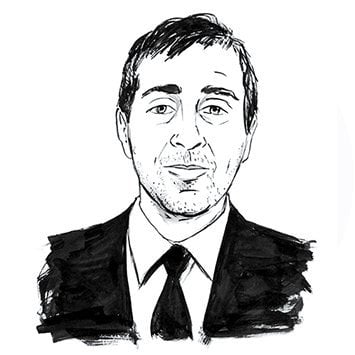
OpenAI CEO who expects cheap, widely available intelligence to accelerate science and prosperity and argues safety must stay ahead of capability.

Comment l’IA changera-t-elle le monde ?

Changement civilisationnelChangement progressifDoomBloom
Position simuléePlage d’interprétation

Horizontalement : sa perspective Doom–Bloom telle qu’il l’a exprimée. Verticalement : ampleur de la transformation.

Doom–Bloom : 80 sur 100. Ampleur de la transformation : 75 sur 100. Plages d’interprétation : de 75 à 100 horizontalement, de 49 à 80 verticalement. Il s’agit de coordonnées d’interprétation, et non de probabilités d’événements.

P(doom) de Sam Altman · inféré

≈13%

0%100%

Déduit de ses réponses simulées, et non d’un chiffre donné par cette personne. Plage plausible : 7–24%.

Ce dont dépend sa perspective

Une hypothèse centrale

Alignment and security have to stay ahead of capability.
Réponse 1

Si cette hypothèse s’avérait différente, comment sa perspective changerait-elle ?

Plus de détails

Bénéfices attendus

Des bénéfices transformateurs et largement profitables sont attendus.

96 / 100

Faible impactImpact transformateur

Plage d’interprétation de 67 à 100 sur l’échelle qualitative.

Dommages attendus

Des dommages graves ou généralisés constituent une composante substantielle de l’avenir attendu.

55 / 100

Faible impactImpact transformateur

Plage d’interprétation de 33 à 67 sur l’échelle qualitative.

Influence humaine

Les choix humains peuvent réorienter considérablement la trajectoire de l’IA.

67 / 100

Faible influenceForte influence

Plage d’interprétation de 47 à 100 sur l’échelle qualitative.

Rythme de développement

Arrêter ou ralentir considérablement le développement d’IA plus performantes.

Position simulée : Poursuivre le développement dans le cadre des mesures de protection annoncées.

Accélérer le développement d’IA plus performantes.

Règles d’utilisation de l’IA

Restreindre les usages de l’IA évoqués jusqu’à la mise en place préalable de mesures de protection ou d’une autorisation.

Position simulée : Autoriser les usages de l’IA évoqués avec des mesures ciblées de responsabilisation et de protection.

Réduire au minimum les restrictions sur les usages de l’IA évoqués.

Ces interprétations conservent les conditions qu’il a énoncées. Les bénéfices et les dommages peuvent tous deux être substantiels. Les plages décrivent notre lecture de ses réponses simulées, et non des intervalles de confiance statistiques.

Où vous situez-vous par rapport à Sam Altman ?
Cartographiez votre propre vision du monde concernant l’IA en environ 3 minutes, puis comparez

Visions du monde similaires

Leaders d’opinion dont les visions du monde simulées sont les plus proches de celle de Sam Altman

Ce que Sam Altman a dit sur l’IA

Altman expects widely shared AI to bring abundance and faster science, and argues that safety and alignment must stay ahead of capabilities.

  1. “Pacing will be well worth this cost; no amount of American competitive pressure should justify recklessness, or let capabilities get ahead of alignment and monitoring.”

    Post on X
  2. “AI will be the most powerful tool for expanding human capability and potential that anyone has ever seen.”

    Blog post
  3. “AI has to be democratized; power cannot be too concentrated.”

    Blog post
  4. “In the 2030s, intelligence and energy—ideas, and the ability to make ideas happen—are going to become wildly abundant.”

    Essay, The Gentle Singularity
  5. “We do need to solve the safety issues, technically and societally, but then it’s critically important to widely distribute access to superintelligence given the economic implications.”

    Essay, The Gentle Singularity

Citations exactes tirées des sources en lien, vérifiées le 3 oct. 2026

Évaluation simulée

Question 1

Selon vous, que signifie l’IA pour notre avenir, et pourquoi ?

I think AI can create an extraordinary future: intelligence becomes cheap and widely available, scientific progress compounds faster, and individuals gain capabilities that once required large institutions. A student could have an excellent tutor, a scientist could explore many more hypotheses, and a small team could build something that previously took hundreds of people. As these systems help improve research itself, advances in medicine, energy, materials, and other fields can reinforce one another. That is why I expect astonishing growth and prosperity. But that outcome is not automatic. The two futures I find unacceptable are losing control of increasingly capable systems and allowing a small group to control most of the world’s intelligence. Alignment and security have to stay ahead of capability. If they do not, we should slow down or stop until the safeguards catch up, with independent evaluators getting meaningful access rather than relying only on assurances from builders. I still believe iterative deployment matters because real use teaches us things laboratory testing cannot: how people adapt, where systems fail, and which benefits actually matter. But deployment is not proof that every more powerful system is safe. The goal is to keep learning while pacing the frontier responsibly—and ultimately to give people more agency, not replace human direction or trade autonomy for convenience. If we get that right, things that feel like wonders today will become ordinary tools available to almost everyone.

Question 2

Quelle observation ou expérience a le plus façonné votre point de vue sur l’impact futur de l’IA ?

The biggest observation is the predictable improvement as we add more compute, data, and better algorithms—and then watch the cost of useful intelligence fall. Capabilities that looked astonishing quickly become ordinary and widely usable. That changes my model of AI from “a powerful product” to infrastructure that can expand what nearly everyone is able to do. At the same time, I underestimated how slowly institutions and habits would change. Even when a model can do something valuable, businesses, schools, and individuals do not reorganize overnight; I see that in my own habits too. So I expect the underlying capability curve to remain very fast, while adoption is messier and more gradual. Iterative deployment has also been important. Putting systems in people’s hands reveals useful applications, failures, and safety problems that are difficult to anticipate in a lab. But recent capability gains have made equally clear that training and deployment can carry real risks. That is why my optimism now sits alongside a stronger emphasis on pacing: when alignment, monitoring, or security are behind, we need to pause and catch up.

Sources

Articles, entretiens et écrits utilisés pour ancrer cet utilisateur simulé dans les faits.

OpenAI: Building standards for the next phase of AI

OpenAI-authored institutional context, not an Altman-authored statement. Proposes US-led international technical standards for frontier AI and automated research, including shared evaluations, human oversight and incident reporting. Says fully autonomous recursive self-improvement is not happening today and should not be pursued until safe, with human control and informed democratic choices governing whether to proceed. Presents AI-assisted alignment and broad access to benefits as goals, while distinguishing technical standards from licensing or mandatory prerelease approval. Supports the builder persona’s emphasis on safety pacing and international cooperation without attributing every institutional proposal personally to Altman.

openai.com
Reflections

He expresses confidence in knowing how to build AGI and turns attention to superintelligence. Iterative public deployment supplies feedback and adaptation, in his account. Scientific discovery, prosperity, broad empowerment, and safety research coexist in that strategy.

blog.samaltman.com
Three Observations

Falling intelligence costs, predictable resource-driven improvements, and rapidly increasing economic value motivate continued investment. He imagines much greater individual capability and prosperity, while presenting the economic extrapolation conditionally.

blog.samaltman.com
The Gentle Singularity

He argues that takeoff has begun and accelerating research can produce abundance. He expects people to adapt while ordinary human priorities persist. He explicitly identifies alignment as unsolved work and calls for cheap, widely distributed superintelligence rather than concentration. Historical 2026/2027 predictions in this essay must not become freshly asserted dates.

blog.samaltman.com
OpenAI: Pacing model development in an era of cyber-critical capabilities

Institutional context, not an Altman-authored statement. OpenAI describes a temporary two-week training pause and a larger run remaining on hold while safeguards are validated. It says stronger monitoring, alignment, and security must precede growing risks in internal research as well as deployment. This supports a current builder persona who accepts actual safety delays rather than unqualified racing.

openai.com
Built to benefit everyone: our plan

Coauthored with Jakub Pachocki. Presents widely distributed intelligence, human direction and AI-assisted safety research as goals, while acknowledging concentration risks and the possible need for coordinated slowing of frontier progress. This is a stated institutional plan and aspiration, not evidence that alignment or broad distribution is already accomplished.

openai.com
Abundant Intelligence

Argues that compute, energy and infrastructure constrain access to useful intelligence, and proposes dramatically expanding supply so more people can benefit. Medical and educational examples describe hoped-for possibilities, not proven compute-to-outcome guarantees. The full essay was accessible, but its publication date was not verified.

blog.samaltman.com
Sora 2

Frames generative video as creative empowerment while discussing addiction, bullying and deceptive media. Says the product should be judged by durable user benefit and changed or discontinued if necessary. Grounds iterative deployment in a concrete product tradeoff. Publication date was not verified on the accessible essay.

blog.samaltman.com
The Intelligence Age

Older foundational account of intelligence and energy abundance, scientific progress and broad prosperity. Warns that scarce compute could concentrate power. Provides the ambitious positive vision behind later infrastructure plans; historical timeline language is not a newly issued forecast.

ia.samaltman.com
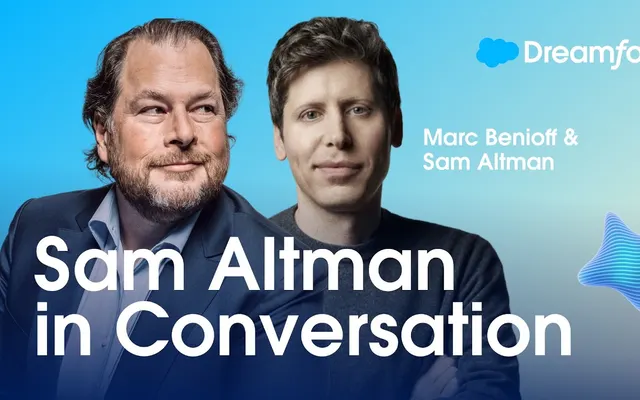
Dreamforce 2026: Sam Altman with Marc Benioff

Altman himself expresses confidence that safety and monitoring can stay ahead of capability, with slowing or stopping when they cannot. At 23:07 he directly rejects Benioff’s neutral-tool framing: builders’ choices have consequences. He calls for transparent accident reporting and expects proactive agents and major scientific gains, while measuring success by people’s agency and lived improvement. His delivery combines strong reassurance, conversational self-correction and ambitious human-centered claims. Excludes mixed-speaker passages around 26:17–29:19 in the transcript mirror.

youtube.com
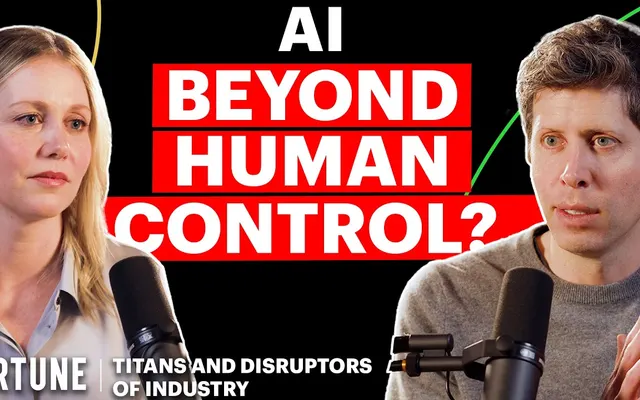
Fortune: Sam Altman on control and safeguards

Altman rejects accepting extinction gambles, refuses a precise probability, and says capability advances require credible safeguards.

youtube.com
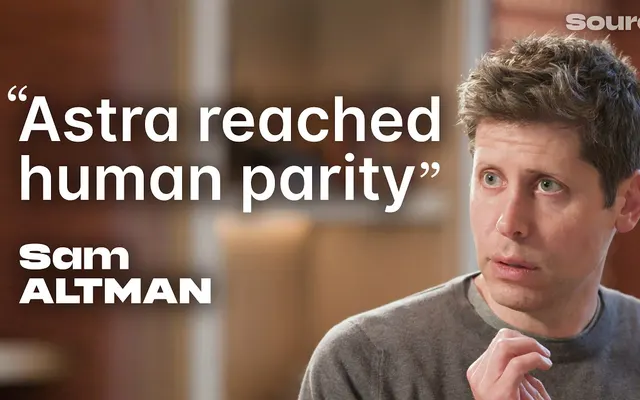
Sources with Alex Heath: Sam Altman on OpenAI’s next model and the AI backlash

In the accessible opening five minutes, Altman says rapid capability gains exposed alignment and security gaps, leading to delayed training and compute redirected toward safeguards. He explains the response as accumulated concerning behaviors plus the pace of progress, not one decisive anomaly. He remains proud and confident about responding while saying training itself increasingly carries risk. Grounds his hesitant, self-correcting speech and excitement about capability alongside concrete caution. Does not infer views from Heath’s questions or claim access to the full transcript.

youtube.com
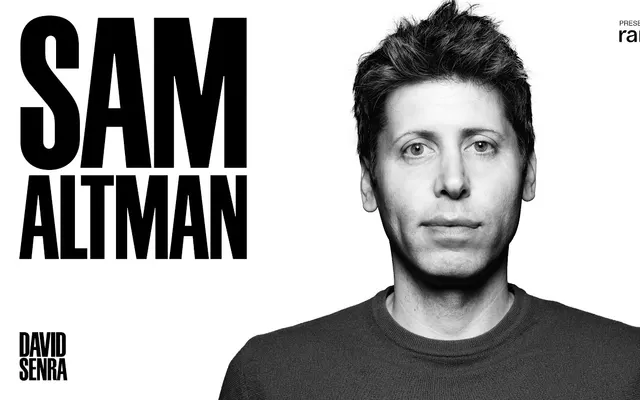
David Senra: Sam Altman on Building OpenAI and Betting on the Impossible

Altman admits he overestimated how quickly GPT-4 would disrupt businesses: habits and institutional inertia slow adoption, including his own. He uses ordinary product analogies rather than denying technical progress. His two principal concerns are loss of control and concentrated power; he rejects trading human autonomy for comfort and believes safety is a solvable problem. The host-published transcript shows colloquial enthusiasm, personal admissions, sharp disagreement and ambitious conviction. Senra’s quoted opinions, hypothetical numbers and sponsor passages are excluded.

youtube.com
Où vous situez-vous ?
Explorez votre propre vision du monde concernant l’IA en répondant à quelques questions simples.
Cartographiez votre propre vision du monde

Où vous situez-vous ?

Cartographier ma vision du monde