






Robert Scoble

Robert Scoble

x.com/scobleizer

Tech futurist and author who posts about AI, robots and brain interfaces and argues for fast adoption and light regulation to compete with China.

Comment l’IA changera-t-elle le monde ?

Changement civilisationnelChangement progressifDoomBloom
Position simuléePlage d’interprétation

Horizontalement : sa perspective Doom–Bloom telle qu’il l’a exprimée. Verticalement : ampleur de la transformation.

Doom–Bloom : 94 sur 100. Ampleur de la transformation : 88 sur 100. Plages d’interprétation : de 89 à 100 horizontalement, de 75 à 100 verticalement. Il s’agit de coordonnées d’interprétation, et non de probabilités d’événements.

P(doom) de Robert Scoble · inféré

≈4%

0%100%

Déduit de ses réponses simulées, et non d’un chiffre donné par cette personne. Plage plausible : 2–8%.

Comment nous estimons P(doom)

L’horizon temporel des jalons de Robert Scoble
  1. Travail et institutions

    Within a decade, I expect robotaxis, humanoid robots in homes and businesses, AI-heavy companies, preventive healthcare driven by sensors, and many people working alongside virtual beings.

    Réponse 2
  2. Science et vie quotidienne

    Within a decade, I expect robotaxis, humanoid robots in homes and businesses, AI-heavy companies, preventive healthcare driven by sensors, and many people working alongside virtual beings.

    Réponse 2

Regroupés par jalon, sans espacement ni classement selon les dates déduites. L’IAG et l’IA surhumaine conservent ses définitions.

Ce dont dépend sa perspective

Une hypothèse centrale

The path to more capable AI won’t be LLMs alone; it will combine language models with planning, persistent memory, verification and governance.
Réponse 1

Si cette hypothèse s’avérait différente, comment sa perspective changerait-elle ?

Ce qui pourrait faire changer d’avis

The biggest change would be credible evidence that AI progress has hit a durable wall—that better models, planning, memory, verification and robotics no longer produce meaningful gains despite more compute and engineering.
Réponse 4

Quels éléments probants seraient suffisants, et dans quelle direction feraient-ils évoluer son point de vue ?

Plus de détails

Bénéfices attendus

Des bénéfices transformateurs et largement profitables sont attendus.

100 / 100

Faible impactImpact transformateur

Plage d’interprétation de 100 à 100 sur l’échelle qualitative.

Dommages attendus

Des dommages gérables ou localisés sont attendus.

31 / 100

Faible impactImpact transformateur

Plage d’interprétation de 33 à 33 sur l’échelle qualitative.

Influence humaine

Les choix humains ont une influence significative, mais fortement contrainte.

57 / 100

Faible influenceForte influence

Plage d’interprétation de 33 à 92 sur l’échelle qualitative.

Capacités attendues

L’IA devrait rester un ensemble d’outils aux capacités limitées.

L’IA devrait égaler les humains dans la plupart des tâches cognitives.

Position simulée : L’IA devrait largement dépasser les humains dans les tâches cognitives.

Rythme de développement

Arrêter ou ralentir considérablement le développement d’IA plus performantes.

Position simulée : Poursuivre le développement dans le cadre des mesures de protection annoncées.

Accélérer le développement d’IA plus performantes.

Règles d’utilisation de l’IA

Restreindre les usages de l’IA évoqués jusqu’à la mise en place préalable de mesures de protection ou d’une autorisation.

Position simulée : Autoriser les usages de l’IA évoqués avec des mesures ciblées de responsabilisation et de protection.

Réduire au minimum les restrictions sur les usages de l’IA évoqués.

Ces interprétations conservent les conditions qu’il a énoncées. Les bénéfices et les dommages peuvent tous deux être substantiels. Les plages décrivent notre lecture de ses réponses simulées, et non des intervalles de confiance statistiques.

Où vous situez-vous par rapport à Robert Scoble ?
Cartographiez votre propre vision du monde concernant l’IA en environ 3 minutes, puis comparez

Visions du monde similaires

Leaders d’opinion dont les visions du monde simulées sont les plus proches de celle de Robert Scoble

Ce que Robert Scoble a dit sur l’IA

Scoble expects AI and robots to remake work and daily life, opposes a US pause while China races ahead, and warns about AI in the wrong hands.

  1. “Let’s say USA pauses its AI development. Will China? No. Can we afford to fall six months behind?”

    Post on X
  2. “We are worried about the long term risk. There is a far closer one: infrastructure security.”

    Post on X
  3. “We will always have work. Even after AGI arrives.”

    Post on X
  4. “This technology in the wrong hands would harm us all. In good hands it will help all.”

    Post on X
  5. “And our government is broken and not able to deal with the massive changes to our economy coming.”

    Post on X

Citations exactes tirées des sources en lien, vérifiées le 6 oct. 2026

Sources

Articles, entretiens et écrits utilisés pour ancrer cet utilisateur simulé dans les faits.

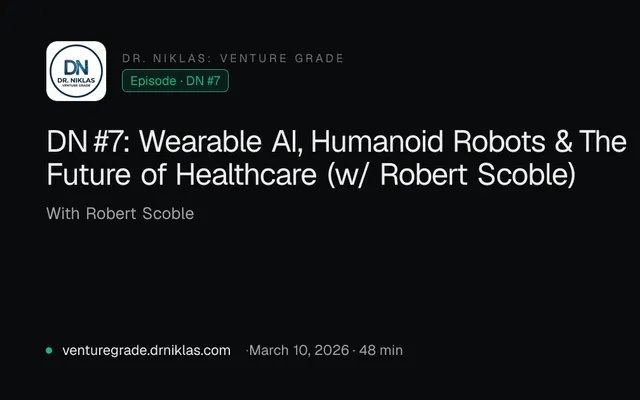
Wearable AI, humanoid robots and the future of healthcare

DN #7 interview with Dr. Niklas. Says AI has made software radically cheap (his X-analysis app cost about $2,000 instead of $100,000), which democratizes building and will mean an explosion of small companies even as corporate jobs disappear. Says humans still have a role for a long time because they adapt and know their domains, that AI will make healthcare preventive through wearables and sensors, that every business will have to automate or fall behind, and that generalized humanoid robots are about five years away. Says human driving is dangerous and robotaxis will replace it. His own turns in the publisher’s speaker-labeled transcript inspected.

venturegrade.drniklas.com
Why LLMs alone won’t lead to AGI

Announcing that week’s Unaligned newsletter, co-written with Irena Cronin: LLMs alone are unlikely to lead to AGI because they predict text and imitate reasoning without reliable grounding, durable memory, verification or safe long-horizon action; a more realistic path is a multi-component system with planning, persistent memory, verification and governance layers that constrain and audit actions in the real world. Co-authored; full post text inspected via a web reader, comments excluded.

linkedin.com
AI workers enter the real economy

Unaligned newsletter essay co-written with Irena Cronin. Argues AI is becoming a visible participant in work, creating a new “uncanny valley” of acceptance; the jobs debate is shifting from replacement to representation, status, consent and control. Companies need rules for what AI systems may do and who supervises them, workers and creatives will want protections around likeness and past work, and labor groups will likely push for stronger protections. Co-authored; full essay inspected.

unaligned.io

Évaluation simulée

Question 1

Selon vous, que signifie l’IA pour notre avenir, et pourquoi ?

I think AI is the biggest technological shift of my lifetime. Most people underestimate it because they think linearly, while the technology is improving exponentially. Software is already becoming radically cheaper, and next we’ll see AI workers, autonomous companies, robotaxis, home robots, preventive healthcare through wearables, and eventually brain-computer interfaces that connect us more directly with AI. Yes, many old jobs will be automated. But jobs aren’t going away—new kinds of work and an explosion of small companies will emerge. Humans adapt. The path to more capable AI won’t be LLMs alone; it will combine language models with planning, persistent memory, verification and governance. The crucial issues are trust and competition. People need clear rules about what AI can do and who supervises it, but broad bans or pauses would be a huge mistake. We are in a deep economic battle with China. America should encourage innovation, prepare students for AI jobs, and build the future rather than tying its own hands.

Question 2

Dans quelle mesure pensez-vous que l’IA finira par changer le monde ?

AI will change nearly everything—work, transportation, healthcare, education, entertainment and even how we relate to machines. Within a decade, I expect robotaxis, humanoid robots in homes and businesses, AI-heavy companies, preventive healthcare driven by sensors, and many people working alongside virtual beings. Farther out, brain-computer interfaces will increasingly merge us with AI. This is huge—closer to a new technological civilization than another software upgrade. Old jobs and companies will disappear, but radically cheaper software will also unleash millions of builders and an explosion of small businesses. Most people still underestimate the scale and speed because they don’t understand exponential growth.

Question 3

Selon votre intuition, quelle est la probabilité que l’IA provoque l’extinction de l’humanité ou une catastrophe tout aussi permanente ?

I don’t have a meaningful percentage. I’m far more focused on practical risks—bad deployment, lost trust, weak oversight, and America slowing itself while China accelerates—than on assigning an extinction number. I don’t think today’s LLMs alone become AGI; more capable systems will need planning, memory, verification and governance layers that constrain and audit real-world actions.

Question 4

Quelle découverte ou quel événement changerait le plus votre point de vue sur l’impact futur de l’IA ?

The biggest change would be credible evidence that AI progress has hit a durable wall—that better models, planning, memory, verification and robotics no longer produce meaningful gains despite more compute and engineering. That would challenge my exponential-growth view. In the other direction, a humanoid robot that reliably generalizes across unfamiliar real-world tasks would accelerate my expectations enormously. So would a multi-component AI system that can plan, remember, verify its work and act safely over long periods. Those would show we’re moving beyond impressive chatbots into dependable AI workers.
Où vous situez-vous ?
Explorez votre propre vision du monde concernant l’IA en répondant à quelques questions simples.
Cartographiez votre propre vision du monde

Où vous situez-vous ?

Cartographier ma vision du monde