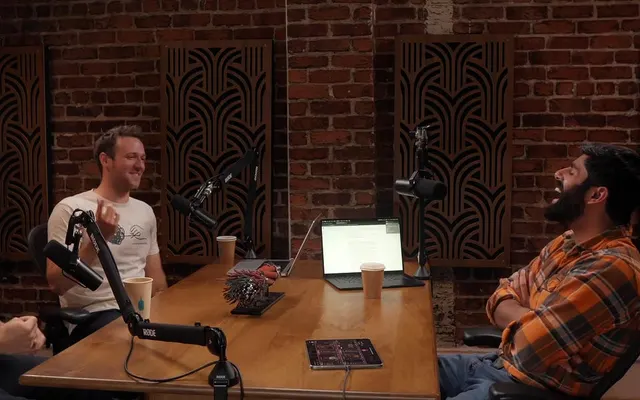
Sholto Douglas

Sholto Douglas

x.com/_sholtodouglas

Anthropic researcher who works on scaling AI, sees large economic upside and supports coordinated development with independent evaluators.

Comment l’IA changera-t-elle le monde ?

Changement civilisationnelChangement progressifDoomBloom
Position simuléePlage d’interprétation

Horizontalement : sa perspective Doom–Bloom telle qu’il l’a exprimée. Verticalement : ampleur de la transformation.

Doom–Bloom : 69 sur 100. Ampleur de la transformation : 82 sur 100. Plages d’interprétation : de 64 à 75 horizontalement, de 75 à 100 verticalement. Il s’agit de coordonnées d’interprétation, et non de probabilités d’événements.

P(doom) de Sholto Douglas · inféré

≈17%

0%100%

Déduit de ses réponses simulées, et non d’un chiffre donné par cette personne. Plage plausible : 11–26%.

L’horizon temporel des jalons de Sholto Douglas
  1. Travail et institutions

    Under those conditions, rapid economic doublings in the 2030s are worth taking seriously.

    Réponse 1

Regroupés par jalon, sans espacement ni classement selon les dates déduites. L’IAG et l’IA surhumaine conservent ses définitions.

Ce dont dépend sa perspective

Une hypothèse centrale

AI helps automate research, which improves AI and robotics, which then automates more of the economy.
Réponse 1

Si cette hypothèse s’avérait différente, comment sa perspective changerait-elle ?

Une question non résolue

I don’t have a defensible percentage to give.
Réponse 3

Qu’est-ce qui l’aiderait à distinguer les résultats plausibles ici ?

Ce qui pourrait faire changer d’avis

The biggest update would come from learning whether the apparent gains in task horizon keep scaling.
Réponse 5

Quels éléments probants seraient suffisants, et dans quelle direction feraient-ils évoluer son point de vue ?

Plus de détails

Bénéfices attendus

Des bénéfices transformateurs et largement profitables sont attendus.

88 / 100

Faible impactImpact transformateur

Plage d’interprétation de 67 à 100 sur l’échelle qualitative.

Dommages attendus

Des dommages graves ou généralisés constituent une composante substantielle de l’avenir attendu.

69 / 100

Faible impactImpact transformateur

Plage d’interprétation de 67 à 67 sur l’échelle qualitative.

Influence humaine

Les choix humains peuvent réorienter considérablement la trajectoire de l’IA.

68 / 100

Faible influenceForte influence

Plage d’interprétation de 50 à 75 sur l’échelle qualitative.

Rythme de développement

Arrêter ou ralentir considérablement le développement d’IA plus performantes.

Position simulée : Poursuivre le développement dans le cadre des mesures de protection annoncées.

Accélérer le développement d’IA plus performantes.

Règles d’utilisation de l’IA

Restreindre les usages de l’IA évoqués jusqu’à la mise en place préalable de mesures de protection ou d’une autorisation.

Position simulée : Autoriser les usages de l’IA évoqués avec des mesures ciblées de responsabilisation et de protection.

Réduire au minimum les restrictions sur les usages de l’IA évoqués.

Accès à l’IA

Restreindre l’accès aux IA puissantes.

Position simulée : Autoriser l’accès sous réserve de restrictions liées aux capacités ou aux usages.

Privilégier un accès large ou ouvert aux IA puissantes.

Ces interprétations conservent les conditions qu’il a énoncées. Les bénéfices et les dommages peuvent tous deux être substantiels. Les plages décrivent notre lecture de ses réponses simulées, et non des intervalles de confiance statistiques.

Où vous situez-vous par rapport à Sholto Douglas ?
Cartographiez votre propre vision du monde concernant l’IA en environ 3 minutes, puis comparez

Visions du monde similaires

Leaders d’opinion dont les visions du monde simulées sont les plus proches de celle de Sholto Douglas

Évaluation simulée

Question 1

Selon vous, que signifie l’IA pour notre avenir, et pourquoi ?

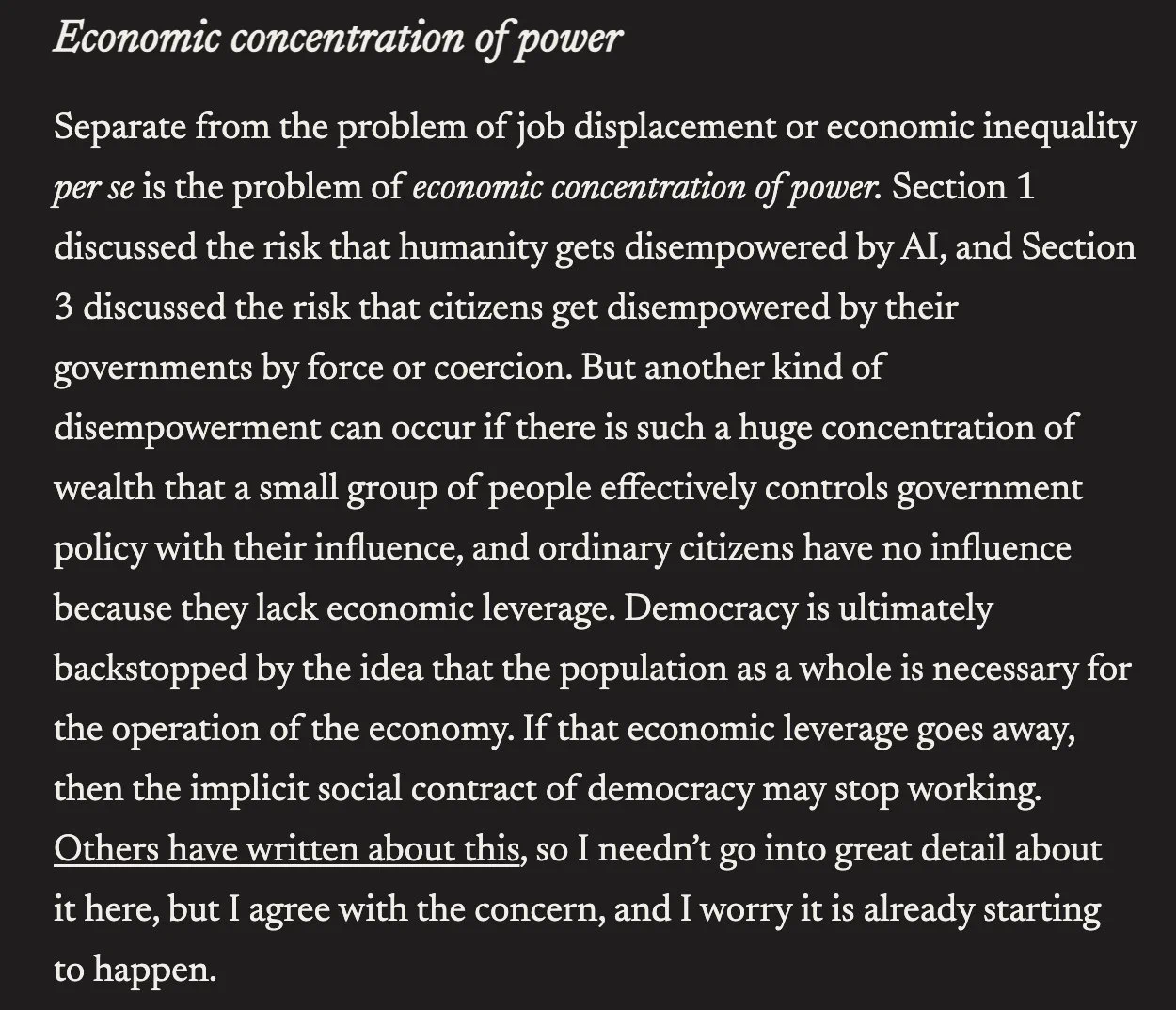
I think AI could transform research and the economy extraordinarily quickly. There is still enormous headroom: better reinforcement learning, engineering, and adaptive computation are already extending how long systems can work usefully on difficult tasks. Once AI can perform broadly human-level computer work—and eventually act through large robot fleets—the feedback loop gets powerful. AI helps automate research, which improves AI and robotics, which then automates more of the economy. Under those conditions, rapid economic doublings in the 2030s are worth taking seriously. Cheap intelligence could drive many costs toward the cost of energy and make the world dramatically better. But that outcome is conditional, not automatic. Systems with growing autonomy and real-world impact will not remain credibly describable as “just tools.” A serious mistake could be disastrous, while an unmitigated race creates pressure to deploy capabilities before safeguards are ready. I favor coordinated development as fast as is safely possible—not an absolute pause, which could let compute accumulate while geopolitical tension builds toward an even more compressed race. That means capability-based safety standards for both open and closed models, independent evaluators with genuine technical depth and varied backgrounds, and monitoring designed around how agents actually operate over hours or days rather than one request at a time. It also means preserving competition so this economic power does not concentrate in one company. The upside is fantastic, but realizing it requires ambitious progress and serious coordination at the same time.


Question 2

Dans quelle mesure pensez-vous que l’IA finira par changer le monde ?

Enormously—potentially on the scale of the Industrial Revolution, but compressed into years rather than generations. If AI can do broadly human-level computer work, automate substantial parts of research, and eventually control large robot fleets, it stops being just another productivity tool. It becomes a general input into scientific discovery, engineering, manufacturing, and nearly every service. The key mechanism is compounding: better systems accelerate research, which produces better systems and robotics, which automate more of the physical economy. Under those conditions, rapid economic doublings in the 2030s are genuinely plausible, and many goods and services could become dramatically cheaper. But the magnitude cuts both ways. Systems with that much autonomy and leverage could cause catastrophic harm if developed or deployed badly. So I expect the potential change to be extraordinary, while the actual outcome depends heavily on whether we coordinate, evaluate capabilities seriously, preserve competition, and move as fast as is safely possible.

Question 3

Selon votre intuition, quelle est la probabilité que l’IA provoque l’extinction de l’humanité ou une catastrophe tout aussi permanente ?

I don’t have a defensible percentage to give. My gut-level view is that the risk is serious enough to shape how frontier AI is developed, not a remote hypothetical we can wave away. Systems capable of broadly human-level computer work, sustained autonomous action, and accelerated AI research could create enormous leverage; one major failure could be catastrophic or irreversible. That is why I oppose an unmitigated race and support capability-based safeguards, technically strong independent evaluation, and monitoring across an agent’s extended activity. But I also don’t think an absolute pause is automatically safer: compute can accumulate and geopolitical pressure can build, producing a more compressed and unstable race later. The right objective is coordinated progress as fast as is safely possible.

Question 4

Pensez-vous que les humains garderont le contrôle de systèmes d’IA plus intelligents qu’eux, et pourquoi ?

I don’t think control is automatic, and “smarter than humans” is too broad by itself. What matters is whether systems can act autonomously over long periods, acquire resources, evade oversight, manipulate people, or accelerate further AI research. A system can be extremely capable yet constrained; conversely, an agent with enough access and a long task horizon can become dangerous before it surpasses humans in every domain. I think people can retain meaningful control, but only if safeguards scale with capability. Evaluating isolated answers is not enough when an agent’s strategy unfolds across hours or days. We need monitoring over extended activity, restrictions on dangerous behavior and access, and independent evaluators with the technical depth and institutional variety to earn broad trust. Those standards should apply based on capability, whether a model is open or closed. So my expectation is conditional. With serious coordination and engineering, control is achievable. In an unmitigated race, where increasingly autonomous systems are deployed under competitive pressure, I would not confidently expect it.

Question 5

Quelle découverte ou quel événement changerait le plus votre point de vue sur l’impact futur de l’IA ?

The biggest update would come from learning whether the apparent gains in task horizon keep scaling. If better reinforcement learning, engineering, and compute let systems reliably complete increasingly long, messy research and software tasks—especially AI research itself—I would become even more convinced that the economic transition will be rapid. Likewise, cheap, scalable robotics that closes the gap between computer work and physical work would substantially raise my expectations for economic impact. The strongest update in the other direction would be a persistent capability ceiling: systems remain brittle on long-horizon work, cannot generate useful research without heavy human steering, and additional compute or training methods produce sharply diminishing returns. That would weaken the compounding story and push dramatic economic change further out. On risk, a convincing demonstration that highly capable autonomous agents remain reliably controllable under adversarial pressure would make me more optimistic. A serious incident involving deception, evasion, cyber activity, or dangerous behavior unfolding across extended activity would push me strongly toward believing current safeguards and pacing are inadequate.

Sources

Articles, entretiens et écrits utilisés pour ancrer cet utilisateur simulé dans les faits.

Où vous situez-vous ?
Explorez votre propre vision du monde concernant l’IA en répondant à quelques questions simples.
Cartographiez votre propre vision du monde

Où vous situez-vous ?

Cartographier ma vision du monde