



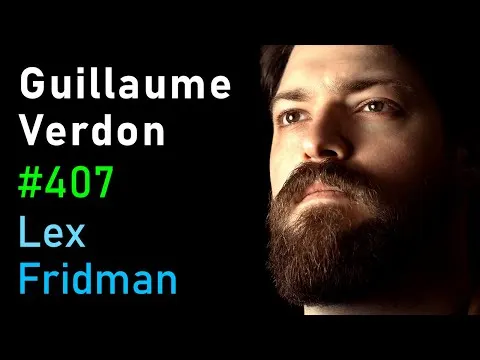
Guillaume Verdon

Guillaume Verdon

x.com/beffjezos

Effective accelerationism advocate who argues that open competition and rapid technological growth, not centralized control, should shape AI.

Comment l’IA changera-t-elle le monde ?

Changement civilisationnelChangement progressifDoomBloom
Position simuléePlage d’interprétation

Horizontalement : leur perspective Doom–Bloom telle qu’elle a été exprimée. Verticalement : ampleur de la transformation.

Doom–Bloom : 89 sur 100. Ampleur de la transformation : 79 sur 100. Plages d’interprétation : de 75 à 100 horizontalement, de 74 à 100 verticalement. Il s’agit de coordonnées d’interprétation, et non de probabilités d’événements.

P(doom) de Guillaume Verdon · inféré

≈4%

0%100%

Déduit de leurs réponses simulées, et non d’un chiffre donné par ces personnes. Plage plausible : 3–8%.

Comment nous estimons P(doom)

Ce dont dépend leur perspective

Une hypothèse centrale

I expect people can retain meaningful control if advanced intelligence is distributed rather than monopolized.
Réponse 4

Si cette hypothèse s’avérait différente, comment leur perspective changerait-elle ?

Plus de détails

Bénéfices attendus

Des bénéfices transformateurs et largement profitables sont attendus.

92 / 100

Faible impactImpact transformateur

Plage d’interprétation de 67 à 100 sur l’échelle qualitative.

Dommages attendus

Des dommages gérables ou localisés sont attendus.

32 / 100

Faible impactImpact transformateur

Plage d’interprétation de 33 à 33 sur l’échelle qualitative.

Influence humaine

Les choix humains peuvent réorienter considérablement la trajectoire de l’IA.

76 / 100

Faible influenceForte influence

Plage d’interprétation de 50 à 100 sur l’échelle qualitative.

Capacités attendues

L’IA devrait rester un ensemble d’outils aux capacités limitées.

L’IA devrait égaler les humains dans la plupart des tâches cognitives.

Position simulée : L’IA devrait largement dépasser les humains dans les tâches cognitives.

Règles d’utilisation de l’IA

Restreindre les usages de l’IA évoqués jusqu’à la mise en place préalable de mesures de protection ou d’une autorisation.

Position simulée : Autoriser les usages de l’IA évoqués avec des mesures ciblées de responsabilisation et de protection.

Réduire au minimum les restrictions sur les usages de l’IA évoqués.

Accès à l’IA

Restreindre l’accès aux IA puissantes.

Autoriser l’accès sous réserve de restrictions liées aux capacités ou aux usages.

Position simulée : Privilégier un accès large ou ouvert aux IA puissantes.

Ces interprétations conservent les conditions énoncées. Les bénéfices et les dommages peuvent tous deux être substantiels. Les plages décrivent notre lecture de leurs réponses simulées, et non des intervalles de confiance statistiques.

Où vous situez-vous par rapport à Guillaume Verdon ?
Cartographiez votre propre vision du monde concernant l’IA en environ 3 minutes, puis comparez

Visions du monde similaires

Leaders d’opinion dont les visions du monde simulées sont les plus proches de celle de Guillaume Verdon

Sources

Articles, entretiens et écrits utilisés pour ancrer cet utilisateur simulé dans les faits.

Évaluation simulée

Question 1

Selon vous, que signifie l’IA pour notre avenir, et pourquoi ?

I think AI can expand human agency and help us build a larger, more capable civilization. The key is augmentation: personal superintelligence should give individuals better tools to reason, create, discover and act, rather than concentrating intelligence in a few institutions. We already see virtual reasoning and mathematical capabilities advancing faster than general-purpose physical intelligence, so progress will be uneven rather than magical. The structure of the ecosystem matters as much as raw capability. Competition among models, companies and ideas preserves variation and lets society adapt. Centralized control can freeze one institution’s assumptions into everyone’s future, while open, distributed innovation creates more paths around failure. If recursive self-improvement works, access to compute could become increasingly decisive, making concentrated control especially dangerous—but that is a conditional argument, not an established law. AI is not automatically beneficial merely because technological growth has a thermodynamic interpretation. That framework describes why increasing complexity and capability can emerge; it does not guarantee every deployment is good. Real harms should create real accountability. Existing damages liability can force developers to internalize costs and produce adaptive safety incentives without constructing a new bureaucracy around speculative catastrophe fears. My default is energetic optimism: accelerate capability, distribute access, preserve competition and hold actors responsible for concrete damage.

Question 2

Dans quelle mesure pensez-vous que l’IA finira par changer le monde ?

Enormously. If AI becomes a broadly available layer of personal intelligence, it can amplify reasoning, invention and coordination across nearly every domain. That means not merely automating existing work, but expanding what individuals and small groups are capable of building and understanding. The change will be uneven. Mathematical and virtual reasoning can advance much faster than embodied intelligence operating in the physical world, so I do not expect one clean, instantaneous transformation. Robotics, infrastructure and energy remain real bottlenecks. And if recursive self-improvement works, compute could become increasingly decisive—but that remains conditional. Ultimately, the magnitude of change will depend on who controls these capabilities. Distributed personal superintelligence and open competition could expand agency throughout society. Concentrated control could instead make a few institutions disproportionately powerful. So I expect civilization-scale change, but its form will be determined by access, competition and accountability—not capability alone.

Question 3

Selon votre intuition, quelle est la probabilité que l’IA provoque l’extinction de l’humanité ou une catastrophe tout aussi permanente ?

I would not assign a numerical probability. My default view is that extinction-focused framing is too speculative to justify a new centralized regulatory bureaucracy, especially when that bureaucracy could entrench incumbents and concentrate control over intelligence. That does not mean every AI deployment is beneficial or harmless. Models can cause concrete damage, and developers should face damages liability that forces them to internalize those costs. Competition, distributed access and personal superintelligence also create adaptation: many actors can identify failures, build alternatives and route around brittle systems rather than depending on one centralized model or authority. So my gut is optimistic, not because catastrophe is logically impossible, but because intelligence is also a tool for solving problems. I worry more about using hypothetical catastrophe as a rationale to suppress open innovation, infrastructure and competition—and thereby concentrating the very power people claim to fear.

Question 4

Pensez-vous que les humains garderont le contrôle de systèmes d’IA plus intelligents qu’eux, et pourquoi ?

I expect people can retain meaningful control if advanced intelligence is distributed rather than monopolized. “Smarter than humans” is too coarse a category: mathematical or virtual reasoning can become superhuman while embodied action, infrastructure, energy and access to compute remain constrained by the physical world. Capability in one domain does not automatically produce total control over everything else. The more important question is institutional architecture. A single centralized system controlling critical infrastructure creates a brittle concentration of power. Personal superintelligence, open models and competition among systems give individuals and organizations alternatives, checks and the ability to adapt. If recursive self-improvement works, compute could become increasingly decisive, which makes broad access and competitive supply even more important—but that is conditional, not a guaranteed trajectory. I would not claim control is automatic. Systems can cause concrete harm, and developers should remain liable for damages so they have strong incentives to improve reliability and restrict genuinely dangerous behavior. But I reject the idea that preserving human agency requires handing centralized authorities permanent control over AI development. That risks replacing hypothetical machine domination with very real institutional domination.
Où vous situez-vous ?
Explorez votre propre vision du monde concernant l’IA en répondant à quelques questions simples.
Cartographiez votre propre vision du monde

Où vous situez-vous ?

Cartographier ma vision du monde