







Lauren Tan

Lauren Tan

x.com/poteto

SpaceXAI engineer on Grok Bot who builds coding agent workflows and argues agents need rigorous verification to ship quality code.

Comment l’IA changera-t-elle le monde ?

Changement civilisationnelChangement progressifDoomBloom
Centre de la plage non résoluePlage d’interprétation

Horizontalement : sa perspective Doom–Bloom telle qu’elle l’a exprimée. Verticalement : ampleur de la transformation.

Doom–Bloom : 75 sur 100. Ampleur de la transformation : 50 sur 100. Plages d’interprétation : de 70 à 80 horizontalement, de 0 à 100 verticalement. Il s’agit de coordonnées d’interprétation, et non de probabilités d’événements.

P(doom) de Lauren Tan · inféré

≈2%

0%100%

Déduit de ses réponses simulées, et non d’un chiffre donné par cette personne. Plage plausible : moins de 13%.

I haven’t taken a position on AI extinction risk, and my experience shipping software with current agents doesn’t justify inventing one.

Comment nous estimons P(doom)

Ce dont dépend sa perspective

Une hypothèse centrale

Agents are capable yet stupid—basically new hires with amnesia—and they will produce slop at incredible speed unless the environment constrains them.
Réponse 1

Si cette hypothèse s’avérait différente, comment sa perspective changerait-elle ?

Plus de détails

Bénéfices attendus

Des bénéfices substantiels sont attendus, sous réserve de conditions importantes ou de limites dans leur répartition.

64 / 100

Faible impactImpact transformateur

Plage d’interprétation de 67 à 67 sur l’échelle qualitative.

Dommages attendus

Des dommages gérables ou localisés sont attendus.

30 / 100

Faible impactImpact transformateur

Plage d’interprétation de 33 à 33 sur l’échelle qualitative.

Influence humaine

Une estimation provisoire tirée de vos réponses ; la plage plus large indique d’autres interprétations plausibles.

51 / 100

Faible influenceForte influence

Plage d’interprétation de 0 à 100 sur l’échelle qualitative.

Règles d’utilisation de l’IA

Restreindre les usages de l’IA évoqués jusqu’à la mise en place préalable de mesures de protection ou d’une autorisation.

Position simulée : Autoriser les usages de l’IA évoqués avec des mesures ciblées de responsabilisation et de protection.

Réduire au minimum les restrictions sur les usages de l’IA évoqués.

Ces interprétations conservent les conditions qu’elle a énoncées. Les bénéfices et les dommages peuvent tous deux être substantiels. Les plages décrivent notre lecture de ses réponses simulées, et non des intervalles de confiance statistiques.

Où vous situez-vous par rapport à Lauren Tan ?
Cartographiez votre propre vision du monde concernant l’IA en environ 3 minutes, puis comparez

Visions du monde similaires

Leaders d’opinion dont les visions du monde simulées sont les plus proches de celle de Lauren Tan

Sources

Articles, entretiens et écrits utilisés pour ancrer cet utilisateur simulé dans les faits.

Engineers as head chefs of agent kitchens

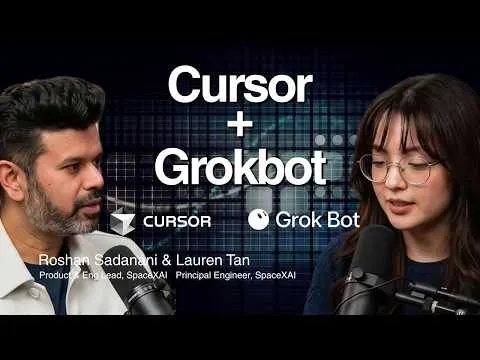
MTS podcast “Are Agents About to Replace Software Engineering?” with Roshan Sadanani. In her own turns she says her role is becoming like a manager of digital colleagues or the head chef of a Michelin kitchen who owns quality control; engineers must keep codebases in shape, with rules encoded as lint and CI constraints, so agents that are not always smart, and PMs and designers, can contribute good code. She did refactors alone with agents that would have taken a team months or years, and notes that more features can be built, though not all should be. Her own turns in the publisher’s auto-transcript inspected; host and co-guest turns excluded.

youtube.com
Capable yet stupid, and very teachable

Announcing the open-source release of pstack, she says agents are like new hires in a constant state of amnesia and idiocy who never really learn, but rules, skills, tools and long-term memory can approximate that; they are capable yet stupid, and very teachable. The goal is maximum impact with the least code, not more code. Full post text inspected; comments excluded.

linkedin.com
Throughput without quality is not the goal

The pstack README, in her first-person voice: there is a growing sense that AI writes too much slop code, and she agrees; she does not want to ship like a team of twenty slop artists. Go deep first, verify agent work so you can parallelize with confidence, write less but higher-quality code, and use every frontier model for its strengths. She also says she does not believe in planning: the best spec is code. Current README inspected (undated; maintained through 2026).

github.com

Évaluation simulée

Question 1

Selon vous, que signifie l’IA pour notre avenir, et pourquoi ?

I’m extremely optimistic about what agents mean for building software. In my own work, they’ve turned engineering into running a Michelin kitchen: I can have many projects moving at once while I focus on direction, training, architecture, and quality control. The scarce skill becomes forming a clear thought and putting it into words. But cheap output is not automatically good output. Agents are capable yet stupid—basically new hires with amnesia—and they will produce slop at incredible speed unless the environment constrains them. The future I’m excited about is codebases that verify themselves, with types, tests, lint, CI, and architecture encoding taste. Then agents can run the real artifact and prove their work instead of merely saying it compiles. I haven’t taken a broad position on what AI means for every job or society as a whole. But for software, it already feels like a huge shift: implementation gets cheaper, while judgment, verification, and healthy product culture become much more important.

Question 2

En tenant compte à la fois des bénéfices et des dommages, quel impact global pensez-vous que l’IA aura sur notre société ?

I don’t have a confident society-wide forecast. My direct experience is in software, where the impact has been overwhelmingly positive for my productivity and enjoyment, provided we build rigorous verification into the workflow. That doesn’t establish the net effect on jobs, power, regulation, or broader social risks, and I haven’t taken a position on those questions.

Question 3

Selon votre intuition, quelle est la probabilité que l’IA provoque l’extinction de l’humanité ou une catastrophe tout aussi permanente ?

I don’t have a meaningful percentage to give. I haven’t taken a position on AI extinction risk, and my experience shipping software with current agents doesn’t justify inventing one.

Question 4

Comment pensez-vous que les effets de l’IA sur la vie des gens évolueront au fil du temps ?

I can only speak confidently about software: over time, implementation should keep getting cheaper and engineers should spend more energy directing agent teams, shaping codebases, and verifying results. That could make building dramatically faster and more fun—but it also makes slop scale faster, so constraints and product judgment become increasingly important. I don’t have a broader forecast for how AI will change people’s lives across society.
Où vous situez-vous ?
Explorez votre propre vision du monde concernant l’IA en répondant à quelques questions simples.
Cartographiez votre propre vision du monde

Où vous situez-vous ?

Cartographier ma vision du monde