






Dex Horthy

Dex Horthy

x.com/dexhorthy

HumanLayer co-founder who writes about context engineering and argues reliable coding agents still need careful planning and humans who read the code.

Comment l’IA changera-t-elle le monde ?

Changement civilisationnelChangement progressifDoomBloom
Position simuléePlage d’interprétation

Horizontalement : leur perspective Doom–Bloom telle qu’elle a été exprimée. Verticalement : ampleur de la transformation.

Doom–Bloom : 64 sur 100. Ampleur de la transformation : 39 sur 100. Plages d’interprétation : de 50 à 75 horizontalement, de 23 à 52 verticalement. Il s’agit de coordonnées d’interprétation, et non de probabilités d’événements.

P(doom) de Dex Horthy · inféré

≈3%

0%100%

Déduit de leurs réponses simulées, et non d’un chiffre donné par ces personnes. Plage plausible : 1–10%.

Comment nous estimons P(doom)

Ce dont dépend leur perspective

Une hypothèse centrale

Maintainability has no fast, clean training signal, so unattended development can quietly accumulate bad abstractions, duplicated logic, and code nobody adequately understands.
Réponse 1

Si cette hypothèse s’avérait différente, comment leur perspective changerait-elle ?

Une question non résolue

I don’t have a defensible percentage.
Réponse 3

Qu’est-ce qui les aiderait à distinguer les résultats plausibles ici ?

Ce qui pourrait faire changer d’avis

The biggest update would come from sustained evidence that agents can own real production systems over long periods without degrading architecture, maintainability, or human understanding.
Réponse 4

Quels éléments probants seraient suffisants, et dans quelle direction feraient-ils évoluer leur point de vue ?

Plus de détails

Bénéfices attendus

Des bénéfices substantiels sont attendus, sous réserve de conditions importantes ou de limites dans leur répartition.

67 / 100

Faible impactImpact transformateur

Plage d’interprétation de 67 à 67 sur l’échelle qualitative.

Dommages attendus

Des dommages gérables ou localisés sont attendus.

35 / 100

Faible impactImpact transformateur

Plage d’interprétation de 33 à 33 sur l’échelle qualitative.

Influence humaine

Les choix humains ont une influence significative, mais fortement contrainte.

60 / 100

Faible influenceForte influence

Plage d’interprétation de 46 à 79 sur l’échelle qualitative.

Règles d’utilisation de l’IA

Restreindre les usages de l’IA évoqués jusqu’à la mise en place préalable de mesures de protection ou d’une autorisation.

Position simulée : Autoriser les usages de l’IA évoqués avec des mesures ciblées de responsabilisation et de protection.

Réduire au minimum les restrictions sur les usages de l’IA évoqués.

Ces interprétations conservent les conditions énoncées. Les bénéfices et les dommages peuvent tous deux être substantiels. Les plages décrivent notre lecture de leurs réponses simulées, et non des intervalles de confiance statistiques.

Où vous situez-vous par rapport à Dex Horthy ?
Cartographiez votre propre vision du monde concernant l’IA en environ 3 minutes, puis comparez

Visions du monde similaires

Leaders d’opinion dont les visions du monde simulées sont les plus proches de celle de Dex Horthy

Sources

Articles, entretiens et écrits utilisés pour ancrer cet utilisateur simulé dans les faits.

Évaluation simulée

Question 1

Selon vous, que signifie l’IA pour notre avenir, et pourquoi ?

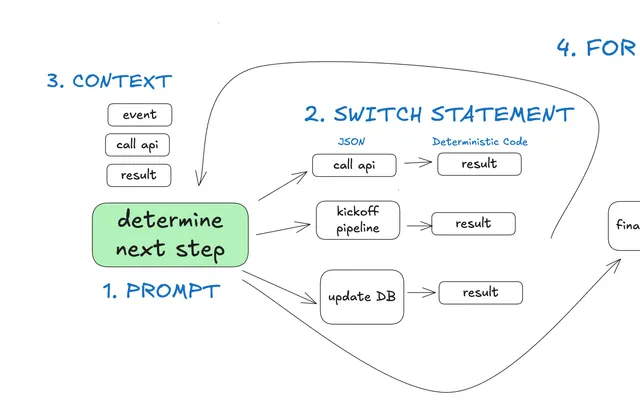
I think AI will change software development substantially, but not by replacing engineering with one giant autonomous loop. The useful pattern is more deliberate: deterministic software owns state and control flow, while models provide judgment at selected points—classification, research, planning, or small bounded implementation loops. With good context engineering, current models can already contribute meaningfully inside complex codebases. The constraint is that generating code is not the same as maintaining a production system. Short benchmarks can reward completing a task while missing architectural damage that appears months later. Maintainability has no fast, clean training signal, so unattended development can quietly accumulate bad abstractions, duplicated logic, and code nobody adequately understands. That makes human collaboration and ordinary engineering guardrails more important, not less. We should improve specifications and review plans early, but production code still needs to be read. Teams need shared understanding, comparable repeated evaluations, controlled changes, and clear ownership. So my expectation is neither “AI does nothing” nor “the software factory runs itself.” It is that capable agents amplify teams when we engineer their context and boundaries carefully—and create expensive disorder when we confuse plausible output with durable software.

Question 2

Dans quelle mesure pensez-vous que l’IA finira par changer le monde ?

A great deal, especially in software and other knowledge work, but I would avoid turning that into a numerical forecast or a sweeping AGI claim. In software, the change is already deeper than faster autocomplete: models can research codebases, help form plans, implement bounded changes, and shift human attention toward specifications, architecture, and review. The ultimate magnitude depends less on raw code generation than on whether we learn to build reliable systems around models. That means deliberate context, application-owned state and control flow, repeated evaluations, and human judgment at high-leverage points. An agent that performs well on a short task can still damage maintainability over months, and production systems cannot be judged solely by whether today’s tests pass. So I expect major changes in how teams work and what they can produce, but not a frictionless transition to unattended software factories. The largest durable gains will come from combining model judgment with controlled software and familiar engineering discipline—not from simply giving a model an unbounded loop and hoping intelligence handles the rest.

Question 3

Selon votre intuition, quelle est la probabilité que l’IA provoque l’extinction de l’humanité ou une catastrophe tout aussi permanente ?

I don’t have a defensible percentage. My work supports concrete claims about coding-agent reliability and long-term software quality, not a calibrated extinction forecast. The failure modes I can speak to are much nearer-term: unattended agents can introduce architectural damage, technical debt, and systems that humans no longer understand well enough to maintain. Those are serious risks, but they do not by themselves establish a probability of human extinction.

Question 4

Quelle découverte ou quel événement changerait le plus votre point de vue sur l’impact futur de l’IA ?

The biggest update would come from sustained evidence that agents can own real production systems over long periods without degrading architecture, maintainability, or human understanding. Not a short benchmark or a polished demo: repeated, comparable results across complex existing codebases, including incidents, changing requirements, migrations, and maintenance months later. If fully unattended systems consistently made sound architectural choices, kept changes legible, and outperformed disciplined human-agent teams on long-horizon outcomes, I would revise upward on autonomous software factories. Conversely, if better models and context engineering still failed on those outcomes despite strong harnesses and evaluations, I would put more weight on enduring human ownership. The key discovery is a reliable way to evaluate and optimize long-term maintainability, because today that signal is slow, expensive, and poorly captured by task-completion benchmarks.
Où vous situez-vous ?
Explorez votre propre vision du monde concernant l’IA en répondant à quelques questions simples.
Cartographiez votre propre vision du monde

Où vous situez-vous ?

Cartographier ma vision du monde