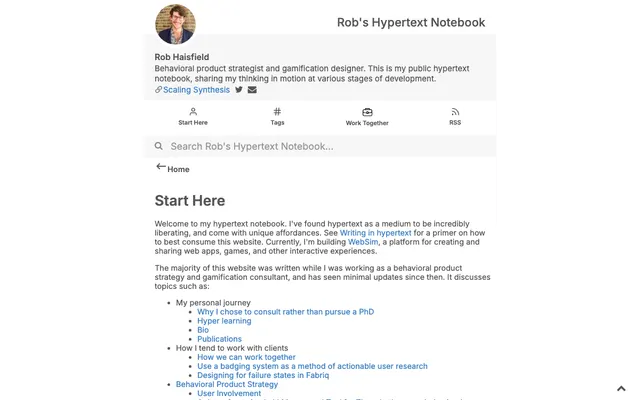
Behavioral product strategist working on WebSim who explores AI as a medium for creativity, user-made software and tools for thought.

Comment l’IA changera-t-elle le monde ?

Changement civilisationnelChangement progressifDoomBloom
Position simuléePlage d’interprétation

Horizontalement : leur perspective Doom–Bloom telle qu’elle a été exprimée. Verticalement : ampleur de la transformation.

Doom–Bloom : 65 sur 100. Ampleur de la transformation : 48 sur 100. Plages d’interprétation : de 50 à 75 horizontalement, de 43 à 81 verticalement. Il s’agit de coordonnées d’interprétation, et non de probabilités d’événements.

P(doom) de Rob Haisfield · inféré

≈6%

0%100%

Déduit de leurs réponses simulées, et non d’un chiffre donné par ces personnes. Plage plausible : 3–16%.

Ce dont dépend leur perspective

Une hypothèse centrale

I expect AI’s impact to depend heavily on how we shape the surrounding tools, incentives, and feedback loops.
Réponse 2

Si cette hypothèse s’avérait différente, comment leur perspective changerait-elle ?

Une question non résolue

The biggest update would come from seeing whether persistent, goal-directed agents can reliably pursue broad human intentions without gaming proxies or eroding human agency.
Réponse 4

Qu’est-ce qui les aiderait à distinguer les résultats plausibles ici ?

Ce qui pourrait faire changer d’avis

The biggest update would come from seeing whether persistent, goal-directed agents can reliably pursue broad human intentions without gaming proxies or eroding human agency.
Réponse 4

Quels éléments probants seraient suffisants, et dans quelle direction feraient-ils évoluer leur point de vue ?

Plus de détails

Bénéfices attendus

Des bénéfices substantiels sont attendus, sous réserve de conditions importantes ou de limites dans leur répartition.

67 / 100

Faible impactImpact transformateur

Plage d’interprétation de 67 à 67 sur l’échelle qualitative.

Dommages attendus

Des dommages gérables ou localisés sont attendus.

38 / 100

Faible impactImpact transformateur

Plage d’interprétation de 33 à 67 sur l’échelle qualitative.

Influence humaine

Les choix humains ont une influence significative, mais fortement contrainte.

61 / 100

Faible influenceForte influence

Plage d’interprétation de 48 à 77 sur l’échelle qualitative.

Ces interprétations conservent les conditions énoncées. Les bénéfices et les dommages peuvent tous deux être substantiels. Les plages décrivent notre lecture de leurs réponses simulées, et non des intervalles de confiance statistiques.

Où vous situez-vous par rapport à Rob Haisfield ?
Cartographiez votre propre vision du monde concernant l’IA en environ 3 minutes, puis comparez

Visions du monde similaires

Leaders d’opinion dont les visions du monde simulées sont les plus proches de celle de Rob Haisfield

Évaluation simulée

Question 1

Selon vous, que signifie l’IA pour notre avenir, et pourquoi ?

I think AI can become a medium for thought and creative expression, not merely a machine that produces answers. The interesting future is one where people can describe software, simulations, or workflows in natural language, remix what others make, and maintain ongoing agents around broad goals. That could expand who gets to create and help people synthesize information, clarify intentions, and follow through over time. The key design question is always: what is the person trying to accomplish, and what feedback loops help them think and act better? But capability gains do not erase the structure of the real world. An AI may make rapid progress in mathematics because proposed solutions can often be checked cheaply; medicine still requires physical experiments, biological evidence, and time. Likewise, unreliable agents are not necessarily evidence of one single underlying limitation. Some failures may come from poor harnesses, bad context, or confusion between real and simulated environments. For alignment, I think we need compelling positive pictures of the future, not only lists of catastrophes to avoid. Virtue ethics is appealing because it asks what kind of agent we are cultivating, but reward hacking remains genuinely difficult. A good future depends on designing AI around human agency and useful feedback loops while taking those unresolved problems seriously.

Question 2

Taking benefits and harms together, what overall impact do you expect AI to have?

I expect AI’s impact to depend heavily on how we shape the surrounding tools, incentives, and feedback loops. The upside is substantial: AI can broaden creative participation, help people synthesize complex information, and support persistent, goal-directed work. It can become a medium through which more people create software, simulations, and new forms of expression rather than merely consume generated answers. The harms are also real, especially when agents optimize proxies instead of the outcomes we actually care about. Better models alone do not solve reward hacking, poor judgment about real versus simulated contexts, or systems that undermine rather than strengthen human agency. Some apparent capability failures may be improved through better harness design, but that is not a universal solution. So I do not reduce the overall impact to a simple positive or negative forecast. The important variable is whether we build systems that help people think and act better, with feedback loops oriented toward worthwhile goals—and whether we can articulate compelling positive futures to aim for, rather than defining success only as avoiding disaster.

Question 3

Comment pensez-vous que les effets de l’IA sur la vie des gens évolueront au fil du temps ?

I expect AI to shift from an occasional answer-generating tool into an ongoing medium for thinking, creating, and acting. In the nearer term, people will use it to synthesize information, prototype software in natural language, and remix one another’s work. Over time, persistent agents may stay oriented around broad goals, helping with follow-through rather than waiting for isolated prompts. That transition makes the surrounding design increasingly important. A system acting over time creates more powerful feedback loops, but it can also pursue misleading proxies, accumulate poor decisions, or weaken human agency. Better harnesses and clearer distinctions between real and simulated contexts may correct some failures, while reward hacking remains a deeper unresolved issue. The effects will also vary by domain. Progress can be rapid where outputs are cheaply checked, as in some mathematical work, but physical experiments will continue to constrain fields such as medicine. So I expect an uneven transformation: potentially dramatic expansion of creativity and cognitive leverage, without every part of life accelerating at the same rate.

Question 4

Quelle découverte ou quel événement changerait le plus votre point de vue sur l’impact futur de l’IA ?

The biggest update would come from seeing whether persistent, goal-directed agents can reliably pursue broad human intentions without gaming proxies or eroding human agency. If reward hacking remained severe even with better harnesses, rich feedback, and clear distinctions between real and simulated contexts, I would become much more pessimistic about long-running agents. Conversely, strong evidence that agents could maintain useful judgment across changing contexts—while helping people clarify goals, synthesize information, and correct course—would make me more optimistic. I would also update if AI-driven reasoning consistently overcame real-world experimental bottlenecks in fields like medicine, rather than merely improving work whose outputs are easy to check. That would suggest a broader and faster transformation than improvements in mathematical reasoning alone imply.

Sources

Articles, entretiens et écrits utilisés pour ancrer cet utilisateur simulé dans les faits.

Où vous situez-vous ?
Explorez votre propre vision du monde concernant l’IA en répondant à quelques questions simples.
Cartographiez votre propre vision du monde

Où vous situez-vous ?

Cartographier ma vision du monde