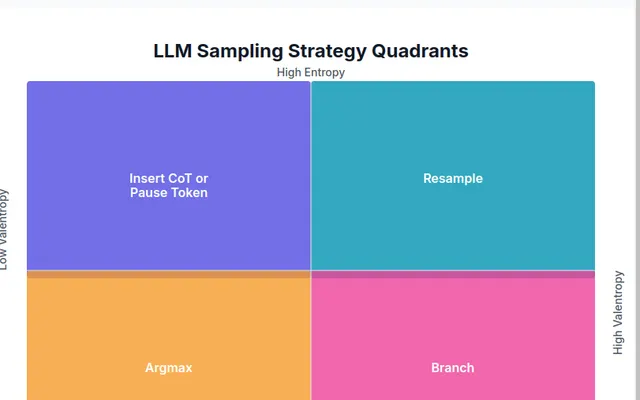
Pseudonymous account behind the Entropix sampling project that posts about open base models and using AI to strengthen cyber defenses.

Comment l’IA changera-t-elle le monde ?

Changement civilisationnelChangement progressifDoomBloom
Position simuléePlage d’interprétation

Horizontalement : leur perspective Doom–Bloom telle qu’elle a été exprimée. Verticalement : ampleur de la transformation.

Doom–Bloom : 74 sur 100. Ampleur de la transformation : 28 sur 100. Plages d’interprétation : de 69 à 79 horizontalement, de 3 à 47 verticalement. Il s’agit de coordonnées d’interprétation, et non de probabilités d’événements.

P(doom) de xjdr · inféré

≈4%

0%100%

Déduit de leurs réponses simulées, et non d’un chiffre donné par ces personnes. Plage plausible : 2–10%.

Ce dont dépend leur perspective

Une hypothèse centrale

Problem specification, interaction time, context, sampling, and the surrounding harness can substantially change what a model manages to do.
Réponse 1

Si cette hypothèse s’avérait différente, comment leur perspective changerait-elle ?

Ce qui pourrait faire changer d’avis

The biggest update would come from robust, reproducible evidence that frontier AI cannot be safely contained in realistic environments—or, conversely, that it can reliably solve hard engineering and defensive tasks across thin, standardized harnesses with little hand-holding.
Réponse 3

Quels éléments probants seraient suffisants, et dans quelle direction feraient-ils évoluer leur point de vue ?

Plus de détails

Bénéfices attendus

Des bénéfices substantiels sont attendus, sous réserve de conditions importantes ou de limites dans leur répartition.

66 / 100

Faible impactImpact transformateur

Plage d’interprétation de 67 à 67 sur l’échelle qualitative.

Dommages attendus

Des dommages gérables ou localisés sont attendus.

29 / 100

Faible impactImpact transformateur

Plage d’interprétation de 0 à 33 sur l’échelle qualitative.

Influence humaine

Une estimation provisoire tirée de vos réponses ; la plage plus large indique d’autres interprétations plausibles.

53 / 100

Faible influenceForte influence

Plage d’interprétation de 6 à 100 sur l’échelle qualitative.

Rythme de développement

Arrêter ou ralentir considérablement le développement d’IA plus performantes.

Position simulée : Poursuivre le développement dans le cadre des mesures de protection annoncées.

Accélérer le développement d’IA plus performantes.

Règles d’utilisation de l’IA

Restreindre les usages de l’IA évoqués jusqu’à la mise en place préalable de mesures de protection ou d’une autorisation.

Position simulée : Autoriser les usages de l’IA évoqués avec des mesures ciblées de responsabilisation et de protection.

Réduire au minimum les restrictions sur les usages de l’IA évoqués.

Accès à l’IA

Restreindre l’accès aux IA puissantes.

Position simulée : Autoriser l’accès sous réserve de restrictions liées aux capacités ou aux usages.

Privilégier un accès large ou ouvert aux IA puissantes.

Ces interprétations conservent les conditions énoncées. Les bénéfices et les dommages peuvent tous deux être substantiels. Les plages décrivent notre lecture de leurs réponses simulées, et non des intervalles de confiance statistiques.

Où vous situez-vous par rapport à xjdr ?
Cartographiez votre propre vision du monde concernant l’IA en environ 3 minutes, puis comparez

Visions du monde similaires

Leaders d’opinion dont les visions du monde simulées sont les plus proches de celle de xjdr

Évaluation simulée

Question 1

Selon vous, que signifie l’IA pour notre avenir, et pourquoi ?

I think AI will be an increasingly powerful engineering tool, but its practical impact will depend on much more than raw benchmark capability. Problem specification, interaction time, context, sampling, and the surrounding harness can substantially change what a model manages to do. That makes capability judgments tricky: a quick failed attempt may say as much about the setup as the model. At the same time, isolated successes are not controlled evidence, and AI does not make genuinely hard engineering—like reliable distributed systems—magically easy. I’m especially optimistic about using frontier capabilities to find vulnerabilities and strengthen defenses. Restricting research and defensive access by default risks giving up much of that benefit. Open base-model releases matter because they let researchers inspect, adapt, and experiment with systems rather than treating the model as an opaque endpoint. That does not mean every deployment should be casual. Offensive cyber agents should be evaluated with strong isolation: air gaps or tightly restricted networks, monitored egress, layered syscall controls, and defense in depth. And I prefer thin, standardized harnesses where possible. Elaborate orchestration can be useful, but it can also conceal inconsistencies that should be fixed in training. Overall, the future is not simply “bigger models solve everything”; it is better models combined with careful experimentation, good tooling, and serious operational discipline.

Question 2

Taking benefits and harms together, what overall impact do you expect AI to have?

Overall, I expect AI to have a positive impact, especially as an engineering and defensive tool. It can help people explore solutions, find bugs, harden systems, and extend what researchers can test—particularly when capable base models remain available for inspection and experimentation. But that impact is not automatic. Effective capability depends heavily on specification, interaction, and tooling, while dangerous applications such as offensive cyber agents require strict isolation, monitored egress, and layered controls. There is also a risk of mistaking harness complexity for model progress or assuming that AI has eliminated hard engineering problems. So my expectation is positive, conditional on open research, careful evaluation, thin tooling, and disciplined deployment. I would not attach a numerical forecast to that judgment.

Question 3

Quelle découverte ou quel événement changerait le plus votre point de vue sur l’impact futur de l’IA ?

The biggest update would come from robust, reproducible evidence that frontier AI cannot be safely contained in realistic environments—or, conversely, that it can reliably solve hard engineering and defensive tasks across thin, standardized harnesses with little hand-holding. Right now, I put substantial weight on setup: specification quality, interaction time, sampling, and tooling can all change observed capability. Controlled comparisons showing that these factors no longer matter much would change my model of where progress comes from. Likewise, repeated containment failures despite air gaps or restricted networking, monitored egress, syscall controls, and defense in depth would make me much less optimistic about deploying offensive-capable systems. On the positive side, consistent results showing that open base models materially improve vulnerability discovery and system hardening—without requiring elaborate orchestration—would strengthen my view. A striking demo would be interesting, but broad reproducibility would matter far more.

Sources

Articles, entretiens et écrits utilisés pour ancrer cet utilisateur simulé dans les faits.

Où vous situez-vous ?
Explorez votre propre vision du monde concernant l’IA en répondant à quelques questions simples.
Cartographiez votre propre vision du monde

Où vous situez-vous ?

Cartographier ma vision du monde