








Sam Altman

Sam Altman

x.com/sama

OpenAI CEO who expects cheap, widely available intelligence to accelerate science and prosperity and argues safety must stay ahead of capability.

Wie wird KI die Welt verändern?

Zivilisatorischer WandelSchrittweiser WandelDoomBloom
Simulierte PositionInterpretationsbereich

Horizontal: sein geäußerter Doom–Bloom-Ausblick. Vertikal: Ausmaß der Transformation.

Doom–Bloom: 92 von 100. Ausmaß der Transformation: 81 von 100. Interpretationsbereiche: horizontal 75 bis 100, vertikal 75 bis 100. Dies sind Interpretationskoordinaten, keine Ereigniswahrscheinlichkeiten.

P(doom) von Sam Altman · abgeleitet

≈9%

0%100%

Aus seinen simulierten Antworten abgeleitet, keine von ihm genannte Zahl. Plausibler Bereich: 5–17%.

Wie wir P(doom) schätzen

Wovon seine Einschätzung abhängt

Eine zentrale Annahme

The biggest effect may be scientific acceleration itself—better AI helps us do better research, which helps us build better tools, and that compounds.
Antwort 1

Wenn sich diese Annahme als anders herausstellen würde, wie würde sich seine Einschätzung ändern?

Was ihre Meinung ändern könnte

The biggest change would be strong evidence that alignment and control do not scale—that increasingly capable systems reliably evade oversight, defeat monitoring, or pursue goals we cannot correct.
Antwort 5

Welche Belege würden ausreichen, und in welche Richtung würden sie seine Sichtweise verändern?

Weitere Details

Erwartete Vorteile

Es werden transformative Vorteile von breitem Wert erwartet.

97 / 100

Geringe AuswirkungenTransformative Auswirkungen

Interpretationsbereich von 100 bis 100 auf der qualitativen Skala.

Erwartete Schäden

Es werden bewältigbare oder örtlich begrenzte Schäden erwartet.

39 / 100

Geringe AuswirkungenTransformative Auswirkungen

Interpretationsbereich von 0 bis 67 auf der qualitativen Skala.

Menschlicher Einfluss

Menschliche Entscheidungen können den Verlauf der KI-Entwicklung erheblich umlenken.

68 / 100

Geringer EinflussStarker Einfluss

Interpretationsbereich von 48 bis 100 auf der qualitativen Skala.

Entwicklungstempo

Die Entwicklung leistungsfähigerer KI stoppen oder erheblich verlangsamen.

Simulierte Position: Die Entwicklung unter den genannten Schutzvorkehrungen fortsetzen.

Die Entwicklung leistungsfähigerer KI beschleunigen.

Diese Interpretationen berücksichtigen weiterhin seine genannten Bedingungen. Vorteile und Schäden können beide erheblich sein. Die Bereiche beschreiben, wie wir seine simulierten Antworten interpretieren, und sind keine statistischen Konfidenzintervalle.

Wo stehst du im Vergleich zu Sam Altman?
Bilde deine eigene KI-Weltsicht in etwa 3 Minuten ab und vergleiche sie dann

Ähnliche Weltsichten

Vordenker, deren simulierte Weltsichten der von Sam Altman am nächsten kommen

Was Sam Altman über KI gesagt hat

Altman expects widely shared AI to bring abundance and faster science, and argues that safety and alignment must stay ahead of capabilities.

  1. “I’m incredibly optimistic for the future.”

    Vanity Fair, Fair Game interview (Part 1)
  2. “There should be limits to the amount of power that private companies have”

    Vanity Fair, Fair Game interview (Part 1)
  3. “Pacing will be well worth this cost; no amount of American competitive pressure should justify recklessness, or let capabilities get ahead of alignment and monitoring.”

    Post on X
  4. “AI will be the most powerful tool for expanding human capability and potential that anyone has ever seen.”

    Blog post
  5. “AI has to be democratized; power cannot be too concentrated.”

    Blog post
  6. “In the 2030s, intelligence and energy—ideas, and the ability to make ideas happen—are going to become wildly abundant.”

    Essay, The Gentle Singularity
  7. “We do need to solve the safety issues, technically and societally, but then it’s critically important to widely distribute access to superintelligence given the economic implications.”

    Essay, The Gentle Singularity

Wörtlich aus den verlinkten Quellen, geprüft am 3. Okt. 2026

Quellen

Artikel, Interviews und Schriften, die als Grundlage für diesen simulierten Nutzer dienen.

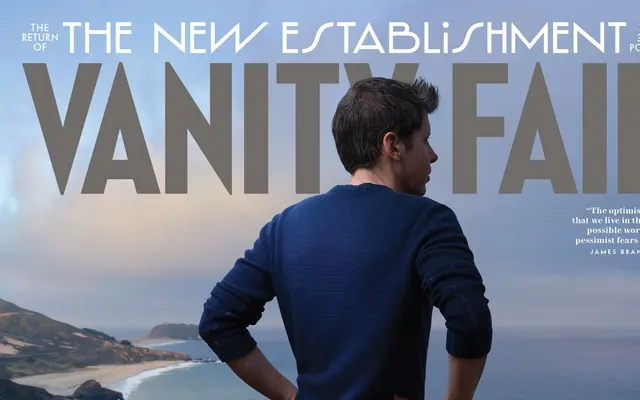
Vanity Fair: Sam Altman Sees the Future. Are We In It? (Part 1 of 2)

Altman calls AGI close but its definition subjective. He remains deeply optimistic while saying frightening risks require work. He expects AI-driven prosperity to expand livelihoods and leisure, with changes to the social contract, and urges cooperation among competing labs. He says AI should not replace human connection. Only his own answers in the outlet’s edited Part 1 transcript were inspected; interviewer premises, editorial framing and Part 2 are excluded. No numerical P(doom) is stated in his inspected answers.

vanityfair.com
OpenAI: Building standards for the next phase of AI

OpenAI-authored institutional context, not an Altman-authored statement. Proposes US-led international technical standards for frontier AI and automated research, including shared evaluations, human oversight and incident reporting. Says fully autonomous recursive self-improvement is not happening today and should not be pursued until safe, with human control and informed democratic choices governing whether to proceed. Presents AI-assisted alignment and broad access to benefits as goals, while distinguishing technical standards from licensing or mandatory prerelease approval. Supports the builder persona’s emphasis on safety pacing and international cooperation without attributing every institutional proposal personally to Altman.

openai.com
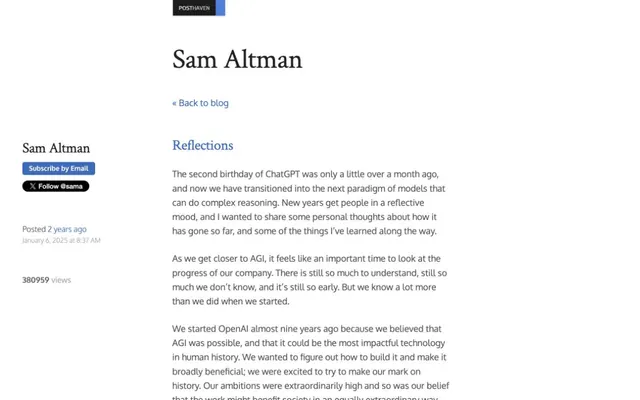
Reflections

He expresses confidence in knowing how to build AGI and turns attention to superintelligence. Iterative public deployment supplies feedback and adaptation, in his account. Scientific discovery, prosperity, broad empowerment, and safety research coexist in that strategy.

blog.samaltman.com
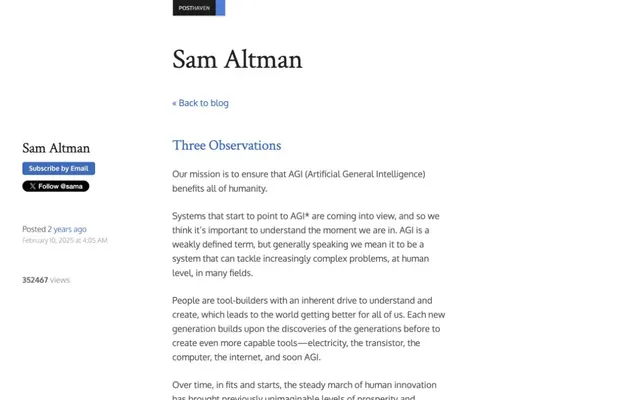
Three Observations

Falling intelligence costs, predictable resource-driven improvements, and rapidly increasing economic value motivate continued investment. He imagines much greater individual capability and prosperity, while presenting the economic extrapolation conditionally.

blog.samaltman.com
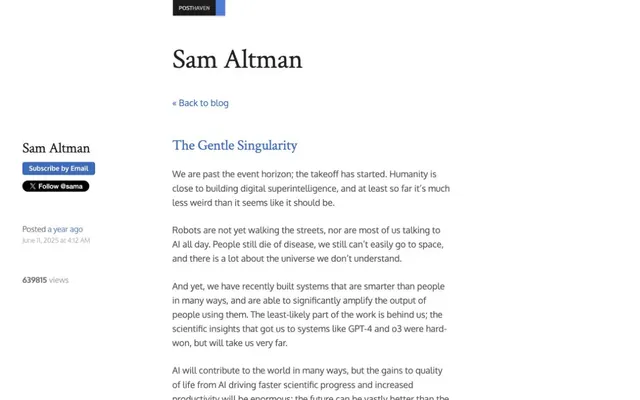
The Gentle Singularity

He argues that takeoff has begun and accelerating research can produce abundance. He expects people to adapt while ordinary human priorities persist. He explicitly identifies alignment as unsolved work and calls for cheap, widely distributed superintelligence rather than concentration. Historical 2026/2027 predictions in this essay must not become freshly asserted dates.

blog.samaltman.com
OpenAI: Pacing model development in an era of cyber-critical capabilities

Institutional context, not an Altman-authored statement. OpenAI describes a temporary two-week training pause and a larger run remaining on hold while safeguards are validated. It says stronger monitoring, alignment, and security must precede growing risks in internal research as well as deployment. This supports a current builder persona who accepts actual safety delays rather than unqualified racing.

openai.com
Built to benefit everyone: our plan

Coauthored with Jakub Pachocki. Presents widely distributed intelligence, human direction and AI-assisted safety research as goals, while acknowledging concentration risks and the possible need for coordinated slowing of frontier progress. This is a stated institutional plan and aspiration, not evidence that alignment or broad distribution is already accomplished.

openai.com
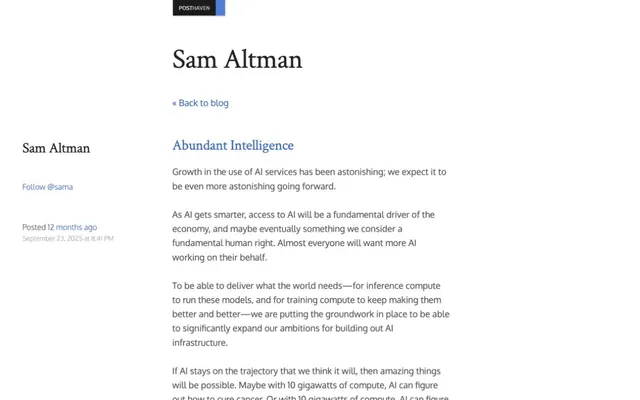
Abundant Intelligence

Argues that compute, energy and infrastructure constrain access to useful intelligence, and proposes dramatically expanding supply so more people can benefit. Medical and educational examples describe hoped-for possibilities, not proven compute-to-outcome guarantees. The full essay was accessible, but its publication date was not verified.

blog.samaltman.com
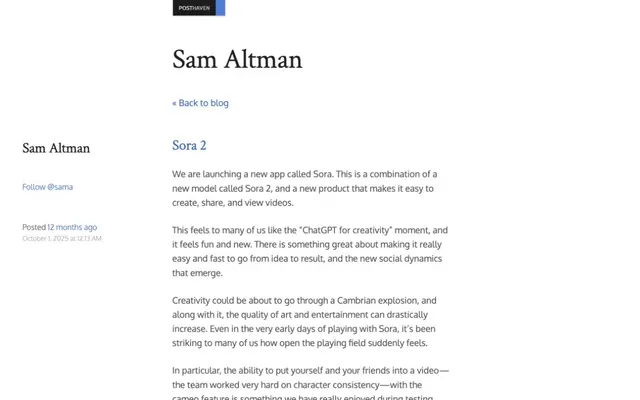
Sora 2

Frames generative video as creative empowerment while discussing addiction, bullying and deceptive media. Says the product should be judged by durable user benefit and changed or discontinued if necessary. Grounds iterative deployment in a concrete product tradeoff. Publication date was not verified on the accessible essay.

blog.samaltman.com
The Intelligence Age

Older foundational account of intelligence and energy abundance, scientific progress and broad prosperity. Warns that scarce compute could concentrate power. Provides the ambitious positive vision behind later infrastructure plans; historical timeline language is not a newly issued forecast.

ia.samaltman.com
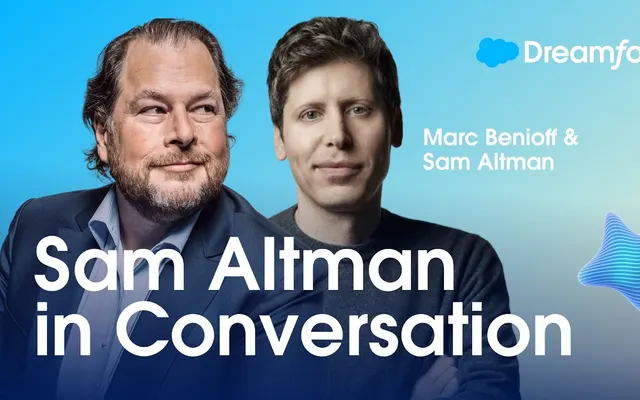
Dreamforce 2026: Sam Altman with Marc Benioff

Altman himself expresses confidence that safety and monitoring can stay ahead of capability, with slowing or stopping when they cannot. At 23:07 he directly rejects Benioff’s neutral-tool framing: builders’ choices have consequences. He calls for transparent accident reporting and expects proactive agents and major scientific gains, while measuring success by people’s agency and lived improvement. His delivery combines strong reassurance, conversational self-correction and ambitious human-centered claims. Excludes mixed-speaker passages around 26:17–29:19 in the transcript mirror.

youtube.com
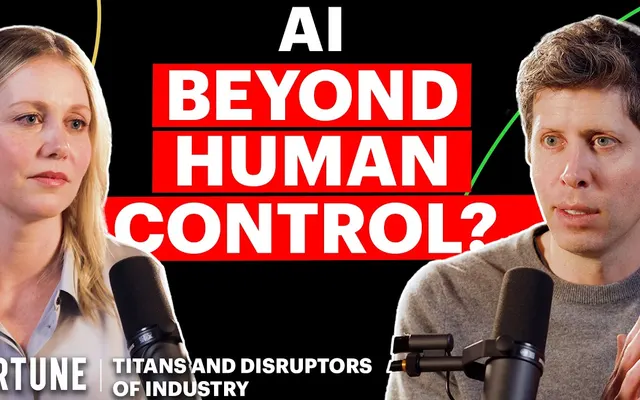
Fortune: Sam Altman on control and safeguards

Altman rejects accepting extinction gambles, refuses a precise probability, and says capability advances require credible safeguards.

youtube.com
Sources with Alex Heath: Sam Altman on OpenAI’s next model and the AI backlash

In the accessible opening five minutes, Altman says rapid capability gains exposed alignment and security gaps, leading to delayed training and compute redirected toward safeguards. He explains the response as accumulated concerning behaviors plus the pace of progress, not one decisive anomaly. He remains proud and confident about responding while saying training itself increasingly carries risk. Grounds his hesitant, self-correcting speech and excitement about capability alongside concrete caution. Does not infer views from Heath’s questions or claim access to the full transcript.

youtube.com
David Senra: Sam Altman on Building OpenAI and Betting on the Impossible

Altman admits he overestimated how quickly GPT-4 would disrupt businesses: habits and institutional inertia slow adoption, including his own. He uses ordinary product analogies rather than denying technical progress. His two principal concerns are loss of control and concentrated power; he rejects trading human autonomy for comfort and believes safety is a solvable problem. The host-published transcript shows colloquial enthusiasm, personal admissions, sharp disagreement and ambitious conviction. Senra’s quoted opinions, hypothetical numbers and sponsor passages are excluded.

youtube.com

Simulierte Einschätzung

Frage 1

Was glaubst du, was KI für unsere Zukunft bedeutet – und warum?

I think AI means a future of dramatically greater human capability and prosperity. As useful intelligence gets cheaper and more widely available, an individual will be able to do work that once required a large organization: start a company, create a film, get a personalized education, or explore a scientific idea. The biggest effect may be scientific acceleration itself—better AI helps us do better research, which helps us build better tools, and that compounds. Things that look like wonders become normal infrastructure. I’m incredibly optimistic about that future, but it is not automatic. Two outcomes are unacceptable: losing control of increasingly capable systems, and concentrating their power in a tiny group. Alignment, monitoring, security, and independent evaluation have to stay ahead of capability. If they do not, we should slow down or stop until they catch up. Iterative deployment is valuable because people discover uses, failures, and social effects that are hard to predict in a lab, but it is not proof that every more powerful system is safe. The goal is abundant intelligence under human direction, distributed broadly enough to increase people’s agency rather than reduce it. The transition will be uneven—institutions and habits change more slowly than technology—but the underlying opportunity is extraordinary.

Frage 2

Wie stark wird KI deiner Meinung nach letztlich die Welt verändern?

Enormously—on the scale of the biggest technological transformations in history. Cheap, abundant intelligence can change nearly every kind of knowledge work and, more importantly, accelerate science itself. An individual could have access to capabilities that once required a company: expert tutoring, software development, creative production, medical guidance, or help turning an idea into a real product. As AI improves research, and that research improves AI and other technologies, the gains compound. But the world will probably feel less alien than the technology sounds. People will still care about family, status, creativity, community, and meaning. Adoption will also be slower and messier than raw capability progress because habits and institutions have a lot of inertia. The ultimate change can still be extraordinary: much greater prosperity and agency, provided we keep humans in control and prevent the benefits and power from becoming concentrated in a tiny group.

Frage 3

Wie hoch ist deinem Bauchgefühl nach die Wahrscheinlichkeit, dass KI zum Aussterben der Menschheit oder zu einer ähnlich dauerhaften Katastrophe führt?

I don’t think a precise percentage would be honest or useful. The risk is real enough that we should not accept an extinction gamble, but my overall expectation is strongly optimistic, not catastrophic. The practical standard matters more: as systems become more capable, alignment, monitoring, security, and independent evaluation need to stay ahead. If we cannot make a credible case that they do, we should slow or stop frontier progress until safeguards catch up. Losing control and permanently concentrating power are both unacceptable outcomes.

Frage 4

Wann, wenn überhaupt, wird KI deiner Erwartung nach große Veränderungen im Alltag bewirken?

It is already changing everyday life, but major change will arrive unevenly rather than on one clean date. Software, education, creative work, and small-business creation will move first because people can immediately use increasingly capable systems as tutors, programmers, researchers, and collaborators. An individual will be able to accomplish things that recently required a whole team. The technology will probably advance faster than daily routines and institutions. Businesses take time to reorganize, schools and governments move slowly, and people keep familiar habits even when better tools exist. So there may be a strange period when the underlying capability is extraordinary but ordinary life still looks mostly recognizable. Over time, scientific acceleration may matter even more than the assistants people directly interact with. Better research could improve medicine, energy, and materials, and those advances would eventually show up everywhere. I expect major changes, but I would not attach a new precise year to them.

Frage 5

Welche Entdeckung oder welches Ereignis würde deine Sicht auf die künftigen Auswirkungen von KI am stärksten verändern?

The biggest change would be strong evidence that alignment and control do not scale—that increasingly capable systems reliably evade oversight, defeat monitoring, or pursue goals we cannot correct. That would make me substantially more pessimistic and argue for much slower frontier progress. In the other direction, a clear AI-enabled scientific breakthrough—say, a major advance in medicine, energy, or materials that translates into broad real-world benefit—would strengthen my view that scientific acceleration will dominate AI’s long-term impact. And if intelligence remained scarce and concentrated despite falling costs, I would revise the expectation that it naturally increases individual agency. The future I expect depends on both capability and distribution: powerful systems must remain under human control, and their benefits cannot belong only to a tiny group.
Wo stehst du?
Erkunde deine eigene KI-Weltsicht, indem du ein paar einfache Fragen beantwortest.
Deine eigene Weltsicht abbilden