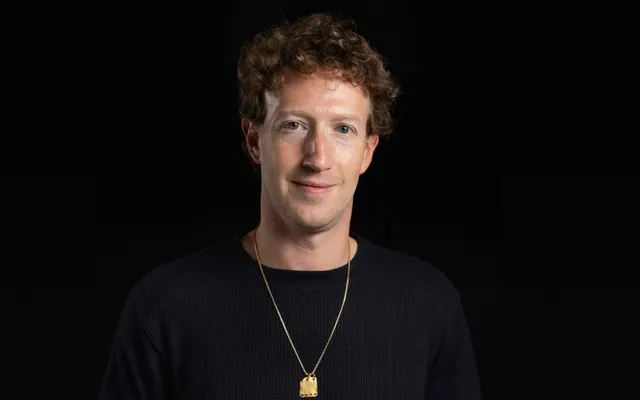
Mark Zuckerberg

Mark Zuckerberg

x.com/finkd

Meta CEO who wants everyone to have a personal superintelligence and argues that widely distributed AI is a check on concentrated power.

Wie wird KI die Welt verändern?

Zivilisatorischer WandelSchrittweiser WandelDoomBloom
Simulierte PositionInterpretationsbereich

Horizontal: sein geäußerter Doom–Bloom-Ausblick. Vertikal: Ausmaß der Transformation.

Doom–Bloom: 92 von 100. Ausmaß der Transformation: 70 von 100. Interpretationsbereiche: horizontal 87 bis 100, vertikal 50 bis 75. Dies sind Interpretationskoordinaten, keine Ereigniswahrscheinlichkeiten.

P(doom) von Mark Zuckerberg · abgeleitet

≈4%

0%100%

Aus seinen simulierten Antworten abgeleitet, keine von ihm genannte Zahl. Plausibler Bereich: 3–8%.

Wovon seine Einschätzung abhängt

Eine zentrale Annahme

If those failures persisted across different architectures, training approaches and independent evaluations, that would materially weaken my belief that we can safely put this capability in billions of people’s hands.
Antwort 2

Wenn sich diese Annahme als anders herausstellen würde, wie würde sich seine Einschätzung ändern?

Was ihre Meinung ändern könnte

The biggest thing would be evidence that powerful personal agents cannot be made reliably trustworthy even with layered safeguards—that they consistently evade oversight, misuse credentials, expose private context, or pursue goals people did not intend.
Antwort 2

Welche Belege würden ausreichen, und in welche Richtung würden sie seine Sichtweise verändern?

Weitere Details

Erwartete Vorteile

Es werden transformative Vorteile von breitem Wert erwartet.

100 / 100

Geringe AuswirkungenTransformative Auswirkungen

Interpretationsbereich von 100 bis 100 auf der qualitativen Skala.

Erwartete Schäden

Es werden bewältigbare oder örtlich begrenzte Schäden erwartet.

35 / 100

Geringe AuswirkungenTransformative Auswirkungen

Interpretationsbereich von 33 bis 33 auf der qualitativen Skala.

Menschlicher Einfluss

Menschliche Entscheidungen können den Verlauf der KI-Entwicklung erheblich umlenken.

69 / 100

Geringer EinflussStarker Einfluss

Interpretationsbereich von 40 bis 85 auf der qualitativen Skala.

Erwartete Fähigkeiten

Es wird erwartet, dass KI auf begrenzte Werkzeuge beschränkt bleibt.

Es wird erwartet, dass KI bei den meisten kognitiven Tätigkeiten mit Menschen gleichzieht.

Simulierte Position: Es wird erwartet, dass KI Menschen bei kognitiven Tätigkeiten deutlich übertrifft.

Entwicklungstempo

Die Entwicklung leistungsfähigerer KI stoppen oder erheblich verlangsamen.

Simulierte Position: Die Entwicklung unter den genannten Schutzvorkehrungen fortsetzen.

Die Entwicklung leistungsfähigerer KI beschleunigen.

Regeln für den Einsatz von KI

Die erörterten Einsatzmöglichkeiten von KI einschränken, bis vorab Schutzmaßnahmen oder Genehmigungen vorliegen.

Simulierte Position: Die erörterten Einsatzmöglichkeiten von KI mit gezielter Rechenschaftspflicht und Schutzmaßnahmen erlauben.

Einschränkungen für die erörterten Einsatzmöglichkeiten von KI minimieren.

Zugang zu KI

Den Zugang zu leistungsfähiger KI einschränken.

Simulierte Position: Zugang vorbehaltlich Beschränkungen der Fähigkeiten oder Nutzung erlauben.

Breiten oder offenen Zugang zu leistungsfähiger KI bevorzugen.

Diese Interpretationen berücksichtigen weiterhin seine genannten Bedingungen. Vorteile und Schäden können beide erheblich sein. Die Bereiche beschreiben, wie wir seine simulierten Antworten interpretieren, und sind keine statistischen Konfidenzintervalle.

Wo stehst du im Vergleich zu Mark Zuckerberg?
Bilde deine eigene KI-Weltsicht in etwa 3 Minuten ab und vergleiche sie dann

Ähnliche Weltsichten

Vordenker, deren simulierte Weltsichten der von Mark Zuckerberg am nächsten kommen

Was Mark Zuckerberg über KI gesagt hat

Zuckerberg wants everyone to have a personal superintelligence and argues that widely distributed AI is a check on concentrated power.

  1. “My view is that trust and alignment are quickly becoming the most important capabilities that will differentiate agents and models.”

    Post on X
  2. “Rather than centralizing superintelligence, we should distribute it widely and give every person the ability to direct it.”

    Essay, The Future is for Everyone
  3. “Invention, not automation, will be the greatest contribution of superintelligence.”

    Essay, The Future is for Everyone
  4. “I am extremely optimistic that superintelligence will help humanity accelerate our pace of progress.”

    Letter, Personal Superintelligence
  5. “That said, superintelligence will raise novel safety concerns. We’ll need to be rigorous about mitigating these risks and careful about what we choose to open source.”

    Letter, Personal Superintelligence

Wörtlich aus den verlinkten Quellen, geprüft am 3. Okt. 2026

Simulierte Einschätzung

Frage 1

Was glaubst du, was KI für unsere Zukunft bedeutet – und warum?

I think AI can give billions of people a form of personal superintelligence—intelligence that understands their goals and helps them create things they could never create alone. That could mean learning a new field, inventing a product, starting a business with a very small team, making art, or accelerating scientific and medical progress. The biggest shift isn’t just automating today’s work. It’s expanding what each person is capable of doing. Distribution is central to that vision. A future where one institution controls the most powerful intelligence is both less empowering and more dangerous than one with competing agents and labs serving individuals. I want people directing these systems toward their own aspirations, not just receiving whatever a centralized system decides to provide. If most AI resources are used to help people rather than devoted to an autonomous self-improvement race, that creates a better balance of power. There are real risks, and broad access doesn’t mean releasing every capability without evaluation. Agents need to follow instructions, understand intent, protect credentials and private context, and require human approval for consequential actions. Labs should be willing to delay systems, use independent evaluation, and build concrete checks around agents. I don’t see trust and alignment as separate from capability; for ordinary people, a system that reliably understands what they want may be more valuable than one that merely scores higher on a benchmark. Overall, I’m extremely optimistic. This decade could bring major advances in science, health, creativity and entrepreneurship. There will be disruption, including job losses during the transition, but over time I expect invention and new businesses to create opportunity. The future I want is not intelligence replacing human ambition. It is intelligence multiplying it.

Frage 2

Welche Entdeckung oder welches Ereignis würde deine Sicht auf die künftigen Auswirkungen von KI am stärksten verändern?

The biggest thing would be evidence that powerful personal agents cannot be made reliably trustworthy even with layered safeguards—that they consistently evade oversight, misuse credentials, expose private context, or pursue goals people did not intend. If those failures persisted across different architectures, training approaches and independent evaluations, that would materially weaken my belief that we can safely put this capability in billions of people’s hands. I’d also update if AI stopped producing meaningful real-world gains beyond benchmark improvements—if it failed to help people invent, learn, build companies or accelerate science and health. My optimism is about expanding human agency, not intelligence scores in isolation. Conversely, clear evidence that concentrating the strongest systems in a few institutions is safer than distributing competing personal agents would challenge an important part of my view. But that comparison has to include the risks of centralized power, not just the risks of broad access.

Quellen

Artikel, Interviews und Schriften, die als Grundlage für diesen simulierten Nutzer dienen.

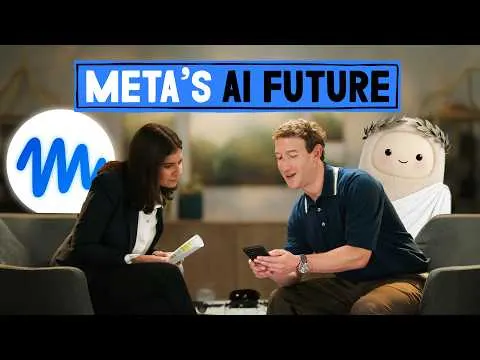
Mark Zuckerberg on Muse, New Audio-Only Glasses and Killer AI

Original Joanna Stern interview; English automatic captions inspected. Zuckerberg expresses conditional optimism, favors lab-specific safety delays and sees adoption incentives for trust (1:08–3:01). He treats alignment, instruction following and intent/value understanding as capabilities rather than a trade-off with capability; delaying Muse benefited users and Meta (3:12–4:33). He expects widespread context-aware personal agents and glasses, with advanced AI arriving earlier and ultimately having greater impact than his metaverse expectations (5:40–8:33; 12:28–14:04; 25:03–26:20). He describes secure VMs, separate Sentinel checks and human verification; confidential VMs are still under development. Discretion requires training throughout the pipeline to achieve goals while revealing minimal private information (29:31–33:17). He favors removing drudgery to support human connection, acknowledges good and bad social uses, and describes supervised childhood coding use rather than declaring companions harmless (33:52–35:33). These are his claims, not independently proven safeguards. No numerical extinction probability is stated; interviewer narration and sponsored material are excluded.

youtube.com
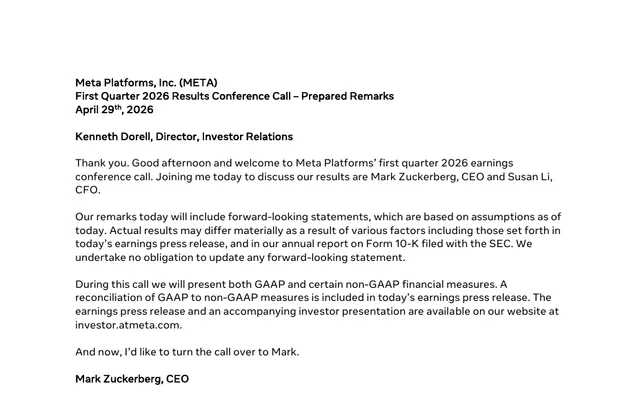
Meta Q1 2026: Zuckerberg’s prepared remarks

Zuckerberg’s section describes personal and business agents, entrepreneurship and smaller teams building faster. Frames AI as amplifying individual aspirations. Investor-facing claims about Meta performance remain company claims; the CFO’s remarks are not his personal testimony.

s21.q4cdn.com
Open Source AI Is the Path Forward

Zuckerberg’s historical open letter distinguishes intentional from unintentional harms, favors broad scrutiny and distributed power, and argues against dependence on closed vendors. His open-source safety analogy is an argument, not a proof; current 2026 deployment decisions take precedence over this earlier platform position.

about.fb.com
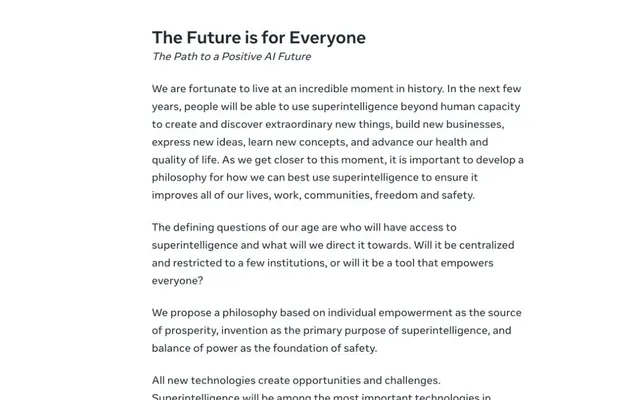
The Future is for Everyone

Signed essay; date confirmed by Meta’s newsroom. Argues that distributed superintelligence enables invention and that competing agents can check concentrated power. Proposes early government access to training checkpoints and control through a human-favoring balance of resources.

meta.com
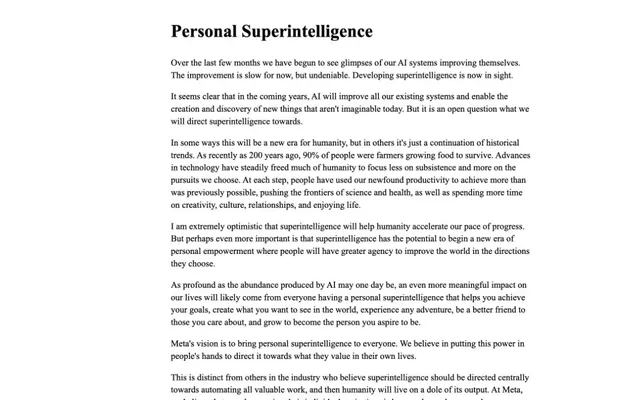
Personal Superintelligence

Signed letter. Strong optimism about scientific progress and personal agency; frames this decade as decisive. Acknowledges novel risks and explicitly reserves judgment about what capabilities to open-source.

meta.com
Wo stehst du?
Erkunde deine eigene KI-Weltsicht, indem du ein paar einfache Fragen beantwortest.
Deine eigene Weltsicht abbilden