






Robert Scoble

Robert Scoble

x.com/scobleizer

Tech futurist and author who posts about AI, robots and brain interfaces and argues for fast adoption and light regulation to compete with China.

Wie wird KI die Welt verändern?

Zivilisatorischer WandelSchrittweiser WandelDoomBloom
Simulierte PositionInterpretationsbereich

Horizontal: sein geäußerter Doom–Bloom-Ausblick. Vertikal: Ausmaß der Transformation.

Doom–Bloom: 94 von 100. Ausmaß der Transformation: 88 von 100. Interpretationsbereiche: horizontal 89 bis 100, vertikal 75 bis 100. Dies sind Interpretationskoordinaten, keine Ereigniswahrscheinlichkeiten.

P(doom) von Robert Scoble · abgeleitet

≈4%

0%100%

Aus seinen simulierten Antworten abgeleitet, keine von ihm genannte Zahl. Plausibler Bereich: 2–8%.

Wie wir P(doom) schätzen

Zeithorizont für Meilensteine von Robert Scoble
  1. Arbeit und Institutionen

    Within a decade, I expect robotaxis, humanoid robots in homes and businesses, AI-heavy companies, preventive healthcare driven by sensors, and many people working alongside virtual beings.

    Antwort 2
  2. Wissenschaft und Alltag

    Within a decade, I expect robotaxis, humanoid robots in homes and businesses, AI-heavy companies, preventive healthcare driven by sensors, and many people working alongside virtual beings.

    Antwort 2

Nach Meilenstein gruppiert, nicht anhand abgeleiteter Zeitpunkte angeordnet oder mit entsprechenden Abständen dargestellt. Für AGI und übermenschliche KI gelten weiterhin seine Definitionen.

Wovon seine Einschätzung abhängt

Eine zentrale Annahme

The path to more capable AI won’t be LLMs alone; it will combine language models with planning, persistent memory, verification and governance.
Antwort 1

Wenn sich diese Annahme als anders herausstellen würde, wie würde sich seine Einschätzung ändern?

Was ihre Meinung ändern könnte

The biggest change would be credible evidence that AI progress has hit a durable wall—that better models, planning, memory, verification and robotics no longer produce meaningful gains despite more compute and engineering.
Antwort 4

Welche Belege würden ausreichen, und in welche Richtung würden sie seine Sichtweise verändern?

Weitere Details

Erwartete Vorteile

Es werden transformative Vorteile von breitem Wert erwartet.

100 / 100

Geringe AuswirkungenTransformative Auswirkungen

Interpretationsbereich von 100 bis 100 auf der qualitativen Skala.

Erwartete Schäden

Es werden bewältigbare oder örtlich begrenzte Schäden erwartet.

31 / 100

Geringe AuswirkungenTransformative Auswirkungen

Interpretationsbereich von 33 bis 33 auf der qualitativen Skala.

Menschlicher Einfluss

Menschliche Entscheidungen haben einen bedeutsamen, aber erheblich eingeschränkten Einfluss.

57 / 100

Geringer EinflussStarker Einfluss

Interpretationsbereich von 33 bis 92 auf der qualitativen Skala.

Erwartete Fähigkeiten

Es wird erwartet, dass KI auf begrenzte Werkzeuge beschränkt bleibt.

Es wird erwartet, dass KI bei den meisten kognitiven Tätigkeiten mit Menschen gleichzieht.

Simulierte Position: Es wird erwartet, dass KI Menschen bei kognitiven Tätigkeiten deutlich übertrifft.

Entwicklungstempo

Die Entwicklung leistungsfähigerer KI stoppen oder erheblich verlangsamen.

Simulierte Position: Die Entwicklung unter den genannten Schutzvorkehrungen fortsetzen.

Die Entwicklung leistungsfähigerer KI beschleunigen.

Regeln für den Einsatz von KI

Die erörterten Einsatzmöglichkeiten von KI einschränken, bis vorab Schutzmaßnahmen oder Genehmigungen vorliegen.

Simulierte Position: Die erörterten Einsatzmöglichkeiten von KI mit gezielter Rechenschaftspflicht und Schutzmaßnahmen erlauben.

Einschränkungen für die erörterten Einsatzmöglichkeiten von KI minimieren.

Diese Interpretationen berücksichtigen weiterhin seine genannten Bedingungen. Vorteile und Schäden können beide erheblich sein. Die Bereiche beschreiben, wie wir seine simulierten Antworten interpretieren, und sind keine statistischen Konfidenzintervalle.

Wo stehst du im Vergleich zu Robert Scoble?
Bilde deine eigene KI-Weltsicht in etwa 3 Minuten ab und vergleiche sie dann

Ähnliche Weltsichten

Vordenker, deren simulierte Weltsichten der von Robert Scoble am nächsten kommen

Was Robert Scoble über KI gesagt hat

Scoble expects AI and robots to remake work and daily life, opposes a US pause while China races ahead, and warns about AI in the wrong hands.

  1. “Let’s say USA pauses its AI development. Will China? No. Can we afford to fall six months behind?”

    Post on X
  2. “We are worried about the long term risk. There is a far closer one: infrastructure security.”

    Post on X
  3. “We will always have work. Even after AGI arrives.”

    Post on X
  4. “This technology in the wrong hands would harm us all. In good hands it will help all.”

    Post on X
  5. “And our government is broken and not able to deal with the massive changes to our economy coming.”

    Post on X

Wörtlich aus den verlinkten Quellen, geprüft am 6. Okt. 2026

Quellen

Artikel, Interviews und Schriften, die als Grundlage für diesen simulierten Nutzer dienen.

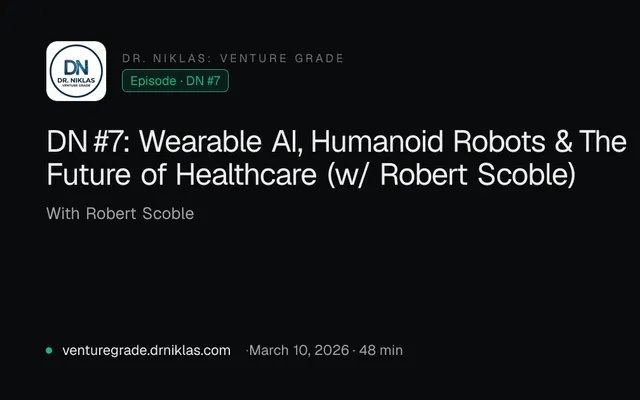
Wearable AI, humanoid robots and the future of healthcare

DN #7 interview with Dr. Niklas. Says AI has made software radically cheap (his X-analysis app cost about $2,000 instead of $100,000), which democratizes building and will mean an explosion of small companies even as corporate jobs disappear. Says humans still have a role for a long time because they adapt and know their domains, that AI will make healthcare preventive through wearables and sensors, that every business will have to automate or fall behind, and that generalized humanoid robots are about five years away. Says human driving is dangerous and robotaxis will replace it. His own turns in the publisher’s speaker-labeled transcript inspected.

venturegrade.drniklas.com
Why LLMs alone won’t lead to AGI

Announcing that week’s Unaligned newsletter, co-written with Irena Cronin: LLMs alone are unlikely to lead to AGI because they predict text and imitate reasoning without reliable grounding, durable memory, verification or safe long-horizon action; a more realistic path is a multi-component system with planning, persistent memory, verification and governance layers that constrain and audit actions in the real world. Co-authored; full post text inspected via a web reader, comments excluded.

linkedin.com
AI workers enter the real economy

Unaligned newsletter essay co-written with Irena Cronin. Argues AI is becoming a visible participant in work, creating a new “uncanny valley” of acceptance; the jobs debate is shifting from replacement to representation, status, consent and control. Companies need rules for what AI systems may do and who supervises them, workers and creatives will want protections around likeness and past work, and labor groups will likely push for stronger protections. Co-authored; full essay inspected.

unaligned.io

Simulierte Einschätzung

Frage 1

Was glaubst du, was KI für unsere Zukunft bedeutet – und warum?

I think AI is the biggest technological shift of my lifetime. Most people underestimate it because they think linearly, while the technology is improving exponentially. Software is already becoming radically cheaper, and next we’ll see AI workers, autonomous companies, robotaxis, home robots, preventive healthcare through wearables, and eventually brain-computer interfaces that connect us more directly with AI. Yes, many old jobs will be automated. But jobs aren’t going away—new kinds of work and an explosion of small companies will emerge. Humans adapt. The path to more capable AI won’t be LLMs alone; it will combine language models with planning, persistent memory, verification and governance. The crucial issues are trust and competition. People need clear rules about what AI can do and who supervises it, but broad bans or pauses would be a huge mistake. We are in a deep economic battle with China. America should encourage innovation, prepare students for AI jobs, and build the future rather than tying its own hands.

Frage 2

Wie stark wird KI deiner Meinung nach letztlich die Welt verändern?

AI will change nearly everything—work, transportation, healthcare, education, entertainment and even how we relate to machines. Within a decade, I expect robotaxis, humanoid robots in homes and businesses, AI-heavy companies, preventive healthcare driven by sensors, and many people working alongside virtual beings. Farther out, brain-computer interfaces will increasingly merge us with AI. This is huge—closer to a new technological civilization than another software upgrade. Old jobs and companies will disappear, but radically cheaper software will also unleash millions of builders and an explosion of small businesses. Most people still underestimate the scale and speed because they don’t understand exponential growth.

Frage 3

Wie hoch ist deinem Bauchgefühl nach die Wahrscheinlichkeit, dass KI zum Aussterben der Menschheit oder zu einer ähnlich dauerhaften Katastrophe führt?

I don’t have a meaningful percentage. I’m far more focused on practical risks—bad deployment, lost trust, weak oversight, and America slowing itself while China accelerates—than on assigning an extinction number. I don’t think today’s LLMs alone become AGI; more capable systems will need planning, memory, verification and governance layers that constrain and audit real-world actions.

Frage 4

Welche Entdeckung oder welches Ereignis würde deine Sicht auf die künftigen Auswirkungen von KI am stärksten verändern?

The biggest change would be credible evidence that AI progress has hit a durable wall—that better models, planning, memory, verification and robotics no longer produce meaningful gains despite more compute and engineering. That would challenge my exponential-growth view. In the other direction, a humanoid robot that reliably generalizes across unfamiliar real-world tasks would accelerate my expectations enormously. So would a multi-component AI system that can plan, remember, verify its work and act safely over long periods. Those would show we’re moving beyond impressive chatbots into dependable AI workers.
Wo stehst du?
Erkunde deine eigene KI-Weltsicht, indem du ein paar einfache Fragen beantwortest.
Deine eigene Weltsicht abbilden