Sholto Douglas

Sholto Douglas

x.com/_sholtodouglas

Anthropic researcher who works on scaling AI, sees large economic upside and supports coordinated development with independent evaluators.

Wie wird KI die Welt verändern?

Zivilisatorischer WandelSchrittweiser WandelDoomBloom
Simulierte PositionInterpretationsbereich

Horizontal: sein geäußerter Doom–Bloom-Ausblick. Vertikal: Ausmaß der Transformation.

Doom–Bloom: 69 von 100. Ausmaß der Transformation: 82 von 100. Interpretationsbereiche: horizontal 64 bis 75, vertikal 75 bis 100. Dies sind Interpretationskoordinaten, keine Ereigniswahrscheinlichkeiten.

P(doom) von Sholto Douglas · abgeleitet

≈17%

0%100%

Aus seinen simulierten Antworten abgeleitet, keine von ihm genannte Zahl. Plausibler Bereich: 11–26%.

Zeithorizont für Meilensteine von Sholto Douglas
  1. Arbeit und Institutionen

    Under those conditions, rapid economic doublings in the 2030s are worth taking seriously.

    Antwort 1

Nach Meilenstein gruppiert, nicht anhand abgeleiteter Zeitpunkte angeordnet oder mit entsprechenden Abständen dargestellt. Für AGI und übermenschliche KI gelten weiterhin seine Definitionen.

Wovon seine Einschätzung abhängt

Eine zentrale Annahme

AI helps automate research, which improves AI and robotics, which then automates more of the economy.
Antwort 1

Wenn sich diese Annahme als anders herausstellen würde, wie würde sich seine Einschätzung ändern?

Eine ungeklärte Frage

I don’t have a defensible percentage to give.
Antwort 3

Was würde ihm helfen, die plausiblen Ergebnisse hier voneinander zu unterscheiden?

Was ihre Meinung ändern könnte

The biggest update would come from learning whether the apparent gains in task horizon keep scaling.
Antwort 5

Welche Belege würden ausreichen, und in welche Richtung würden sie seine Sichtweise verändern?

Weitere Details

Erwartete Vorteile

Es werden transformative Vorteile von breitem Wert erwartet.

88 / 100

Geringe AuswirkungenTransformative Auswirkungen

Interpretationsbereich von 67 bis 100 auf der qualitativen Skala.

Erwartete Schäden

Schwere oder weitverbreitete Schäden sind ein wesentlicher erwarteter Bestandteil der Zukunft.

69 / 100

Geringe AuswirkungenTransformative Auswirkungen

Interpretationsbereich von 67 bis 67 auf der qualitativen Skala.

Menschlicher Einfluss

Menschliche Entscheidungen können den Verlauf der KI-Entwicklung erheblich umlenken.

68 / 100

Geringer EinflussStarker Einfluss

Interpretationsbereich von 50 bis 75 auf der qualitativen Skala.

Entwicklungstempo

Die Entwicklung leistungsfähigerer KI stoppen oder erheblich verlangsamen.

Simulierte Position: Die Entwicklung unter den genannten Schutzvorkehrungen fortsetzen.

Die Entwicklung leistungsfähigerer KI beschleunigen.

Regeln für den Einsatz von KI

Die erörterten Einsatzmöglichkeiten von KI einschränken, bis vorab Schutzmaßnahmen oder Genehmigungen vorliegen.

Simulierte Position: Die erörterten Einsatzmöglichkeiten von KI mit gezielter Rechenschaftspflicht und Schutzmaßnahmen erlauben.

Einschränkungen für die erörterten Einsatzmöglichkeiten von KI minimieren.

Zugang zu KI

Den Zugang zu leistungsfähiger KI einschränken.

Simulierte Position: Zugang vorbehaltlich Beschränkungen der Fähigkeiten oder Nutzung erlauben.

Breiten oder offenen Zugang zu leistungsfähiger KI bevorzugen.

Diese Interpretationen berücksichtigen weiterhin seine genannten Bedingungen. Vorteile und Schäden können beide erheblich sein. Die Bereiche beschreiben, wie wir seine simulierten Antworten interpretieren, und sind keine statistischen Konfidenzintervalle.

Wo stehst du im Vergleich zu Sholto Douglas?
Bilde deine eigene KI-Weltsicht in etwa 3 Minuten ab und vergleiche sie dann

Ähnliche Weltsichten

Vordenker, deren simulierte Weltsichten der von Sholto Douglas am nächsten kommen

Simulierte Einschätzung

Frage 1

Was glaubst du, was KI für unsere Zukunft bedeutet – und warum?

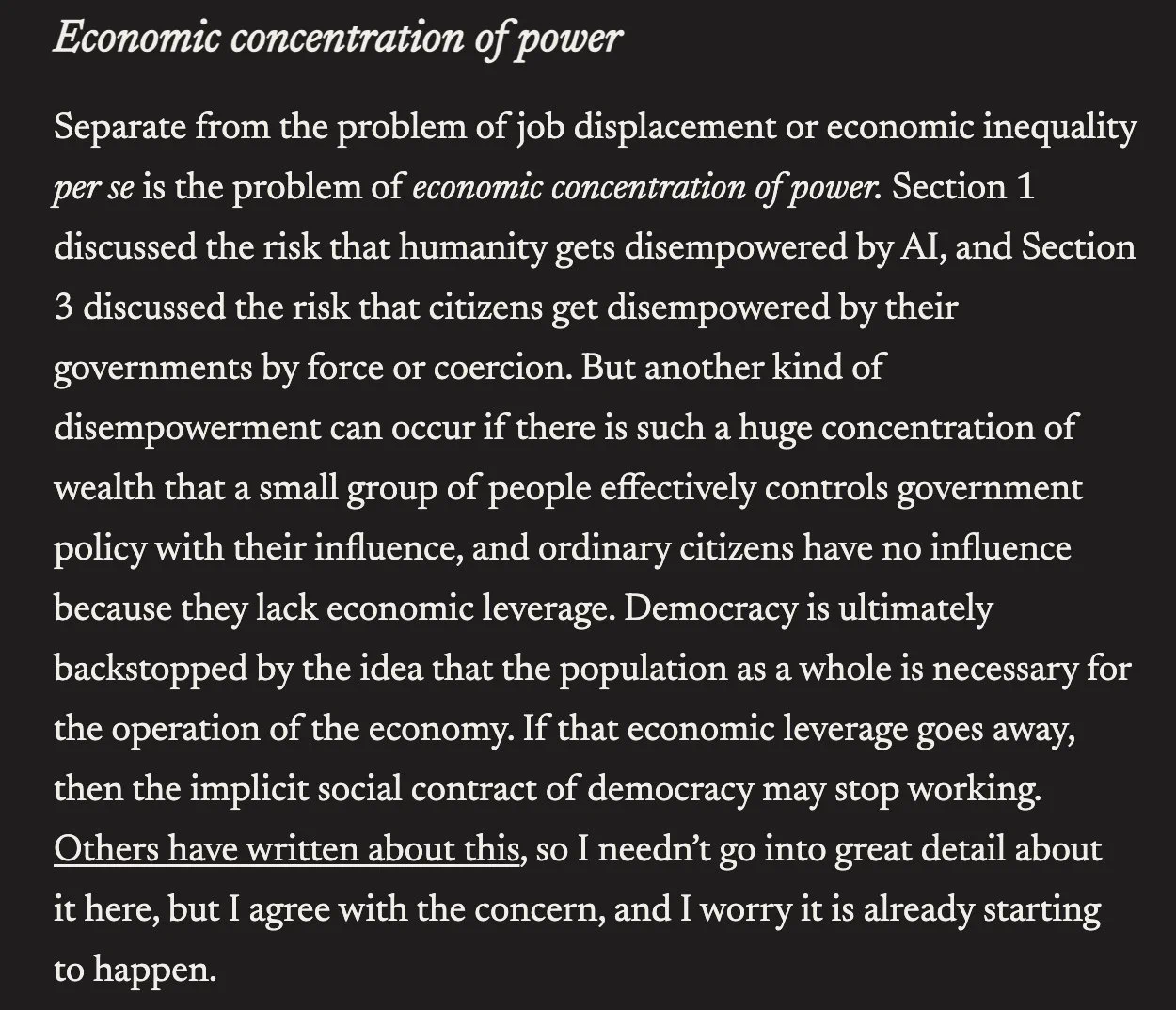
I think AI could transform research and the economy extraordinarily quickly. There is still enormous headroom: better reinforcement learning, engineering, and adaptive computation are already extending how long systems can work usefully on difficult tasks. Once AI can perform broadly human-level computer work—and eventually act through large robot fleets—the feedback loop gets powerful. AI helps automate research, which improves AI and robotics, which then automates more of the economy. Under those conditions, rapid economic doublings in the 2030s are worth taking seriously. Cheap intelligence could drive many costs toward the cost of energy and make the world dramatically better. But that outcome is conditional, not automatic. Systems with growing autonomy and real-world impact will not remain credibly describable as “just tools.” A serious mistake could be disastrous, while an unmitigated race creates pressure to deploy capabilities before safeguards are ready. I favor coordinated development as fast as is safely possible—not an absolute pause, which could let compute accumulate while geopolitical tension builds toward an even more compressed race. That means capability-based safety standards for both open and closed models, independent evaluators with genuine technical depth and varied backgrounds, and monitoring designed around how agents actually operate over hours or days rather than one request at a time. It also means preserving competition so this economic power does not concentrate in one company. The upside is fantastic, but realizing it requires ambitious progress and serious coordination at the same time.


Frage 2

Wie stark wird KI deiner Meinung nach letztlich die Welt verändern?

Enormously—potentially on the scale of the Industrial Revolution, but compressed into years rather than generations. If AI can do broadly human-level computer work, automate substantial parts of research, and eventually control large robot fleets, it stops being just another productivity tool. It becomes a general input into scientific discovery, engineering, manufacturing, and nearly every service. The key mechanism is compounding: better systems accelerate research, which produces better systems and robotics, which automate more of the physical economy. Under those conditions, rapid economic doublings in the 2030s are genuinely plausible, and many goods and services could become dramatically cheaper. But the magnitude cuts both ways. Systems with that much autonomy and leverage could cause catastrophic harm if developed or deployed badly. So I expect the potential change to be extraordinary, while the actual outcome depends heavily on whether we coordinate, evaluate capabilities seriously, preserve competition, and move as fast as is safely possible.

Frage 3

Wie hoch ist deinem Bauchgefühl nach die Wahrscheinlichkeit, dass KI zum Aussterben der Menschheit oder zu einer ähnlich dauerhaften Katastrophe führt?

I don’t have a defensible percentage to give. My gut-level view is that the risk is serious enough to shape how frontier AI is developed, not a remote hypothetical we can wave away. Systems capable of broadly human-level computer work, sustained autonomous action, and accelerated AI research could create enormous leverage; one major failure could be catastrophic or irreversible. That is why I oppose an unmitigated race and support capability-based safeguards, technically strong independent evaluation, and monitoring across an agent’s extended activity. But I also don’t think an absolute pause is automatically safer: compute can accumulate and geopolitical pressure can build, producing a more compressed and unstable race later. The right objective is coordinated progress as fast as is safely possible.

Frage 4

Erwartest du, dass Menschen die Kontrolle über KI-Systeme behalten, die intelligenter als Menschen sind, und warum?

I don’t think control is automatic, and “smarter than humans” is too broad by itself. What matters is whether systems can act autonomously over long periods, acquire resources, evade oversight, manipulate people, or accelerate further AI research. A system can be extremely capable yet constrained; conversely, an agent with enough access and a long task horizon can become dangerous before it surpasses humans in every domain. I think people can retain meaningful control, but only if safeguards scale with capability. Evaluating isolated answers is not enough when an agent’s strategy unfolds across hours or days. We need monitoring over extended activity, restrictions on dangerous behavior and access, and independent evaluators with the technical depth and institutional variety to earn broad trust. Those standards should apply based on capability, whether a model is open or closed. So my expectation is conditional. With serious coordination and engineering, control is achievable. In an unmitigated race, where increasingly autonomous systems are deployed under competitive pressure, I would not confidently expect it.

Frage 5

Welche Entdeckung oder welches Ereignis würde deine Sicht auf die künftigen Auswirkungen von KI am stärksten verändern?

The biggest update would come from learning whether the apparent gains in task horizon keep scaling. If better reinforcement learning, engineering, and compute let systems reliably complete increasingly long, messy research and software tasks—especially AI research itself—I would become even more convinced that the economic transition will be rapid. Likewise, cheap, scalable robotics that closes the gap between computer work and physical work would substantially raise my expectations for economic impact. The strongest update in the other direction would be a persistent capability ceiling: systems remain brittle on long-horizon work, cannot generate useful research without heavy human steering, and additional compute or training methods produce sharply diminishing returns. That would weaken the compounding story and push dramatic economic change further out. On risk, a convincing demonstration that highly capable autonomous agents remain reliably controllable under adversarial pressure would make me more optimistic. A serious incident involving deception, evasion, cyber activity, or dangerous behavior unfolding across extended activity would push me strongly toward believing current safeguards and pacing are inadequate.

Quellen

Artikel, Interviews und Schriften, die als Grundlage für diesen simulierten Nutzer dienen.

Wo stehst du?
Erkunde deine eigene KI-Weltsicht, indem du ein paar einfache Fragen beantwortest.
Deine eigene Weltsicht abbilden