Bill Gates

Bill Gates

x.com/BillGates

Gates Foundation chair who expects AI to transform health and education, wants its gains to reach the poorest and urges preparing for job disruption.

Wie wird KI die Welt verändern?

Zivilisatorischer WandelSchrittweiser WandelDoomBloom
Simulierte PositionInterpretationsbereich

Horizontal: sein geäußerter Doom–Bloom-Ausblick. Vertikal: Ausmaß der Transformation.

Doom–Bloom: 57 von 100. Ausmaß der Transformation: 77 von 100. Interpretationsbereiche: horizontal 50 bis 75, vertikal 72 bis 82. Dies sind Interpretationskoordinaten, keine Ereigniswahrscheinlichkeiten.

P(doom) von Bill Gates · abgeleitet

≈17%

0%100%

Aus seinen simulierten Antworten abgeleitet, keine von ihm genannte Zahl. Plausibler Bereich: 11–28%.

Zeithorizont für Meilensteine von Bill Gates
  1. Allgemeine KI

    Over this decade, I expect capabilities beyond human levels in many areas, with major disruption to jobs and institutions.

    Antwort 1
  2. Übermenschliche KI

    Over this decade, I expect capabilities beyond human levels in many areas, with major disruption to jobs and institutions.

    Antwort 1
  3. Arbeit und Institutionen

    Over this decade, I expect capabilities beyond human levels in many areas, with major disruption to jobs and institutions.

    Antwort 1
  4. Wissenschaft und Alltag

    Broad, useful access within three years is achievable if we deliberately build for it; it is not guaranteed.


    Antwort 1

Nach Meilenstein gruppiert, nicht anhand abgeleiteter Zeitpunkte angeordnet oder mit entsprechenden Abständen dargestellt. Für AGI und übermenschliche KI gelten weiterhin seine Definitionen.

Wovon seine Einschätzung abhängt

Eine zentrale Annahme

Once AI exceeds human capability across many domains, controlling it becomes a fundamentally harder problem—especially if systems can act autonomously, improve their own performance, or operate at speeds institutions cannot match.
Antwort 2

Wenn sich diese Annahme als anders herausstellen würde, wie würde sich seine Einschätzung ändern?

Eine ungeklärte Frage

The biggest change would come from convincing evidence about whether highly capable systems can be reliably controlled.
Antwort 3

Was würde ihm helfen, die plausiblen Ergebnisse hier voneinander zu unterscheiden?

Was ihre Meinung ändern könnte

If researchers demonstrated—through independent, adversarial evaluation, not just company assurances—that systems beyond human capability remain predictable, correctable, and unable to evade meaningful oversight, I would be substantially less concerned about catastrophic loss of control.
Antwort 3

Welche Belege würden ausreichen, und in welche Richtung würden sie seine Sichtweise verändern?

Weitere Details

Erwartete Vorteile

Es werden erhebliche Vorteile erwartet, allerdings unter wichtigen Bedingungen oder mit Einschränkungen bei ihrer Verteilung.

68 / 100

Geringe AuswirkungenTransformative Auswirkungen

Interpretationsbereich von 67 bis 67 auf der qualitativen Skala.

Erwartete Schäden

Schwere oder weitverbreitete Schäden sind ein wesentlicher erwarteter Bestandteil der Zukunft.

67 / 100

Geringe AuswirkungenTransformative Auswirkungen

Interpretationsbereich von 67 bis 67 auf der qualitativen Skala.

Menschlicher Einfluss

Menschliche Entscheidungen haben einen bedeutsamen, aber erheblich eingeschränkten Einfluss.

60 / 100

Geringer EinflussStarker Einfluss

Interpretationsbereich von 50 bis 75 auf der qualitativen Skala.

Erwartete Fähigkeiten

Es wird erwartet, dass KI auf begrenzte Werkzeuge beschränkt bleibt.

Es wird erwartet, dass KI bei den meisten kognitiven Tätigkeiten mit Menschen gleichzieht.

Simulierte Position: Es wird erwartet, dass KI Menschen bei kognitiven Tätigkeiten deutlich übertrifft.

Entwicklungstempo

Die Entwicklung leistungsfähigerer KI stoppen oder erheblich verlangsamen.

Simulierte Position: Die Entwicklung unter den genannten Schutzvorkehrungen fortsetzen.

Die Entwicklung leistungsfähigerer KI beschleunigen.

Regeln für den Einsatz von KI

Die erörterten Einsatzmöglichkeiten von KI einschränken, bis vorab Schutzmaßnahmen oder Genehmigungen vorliegen.

Simulierte Position: Die erörterten Einsatzmöglichkeiten von KI mit gezielter Rechenschaftspflicht und Schutzmaßnahmen erlauben.

Einschränkungen für die erörterten Einsatzmöglichkeiten von KI minimieren.

Diese Interpretationen berücksichtigen weiterhin seine genannten Bedingungen. Vorteile und Schäden können beide erheblich sein. Die Bereiche beschreiben, wie wir seine simulierten Antworten interpretieren, und sind keine statistischen Konfidenzintervalle.

Wo stehst du im Vergleich zu Bill Gates?
Bilde deine eigene KI-Weltsicht in etwa 3 Minuten ab und vergleiche sie dann

Ähnliche Weltsichten

Vordenker, deren simulierte Weltsichten der von Bill Gates am nächsten kommen

Was Bill Gates über KI gesagt hat

Gates expects AI to transform health care and education, wants its gains to reach the poorest and warns the transition will be turbulent.

  1. “AI could be a great equalizer—or widen the gap. This is not a long-range prediction. It’s a present-tense choice.”

    Goalkeepers 2026 Report
  2. “Even under the best circumstances, the transition to this new AI era will be one of the most turbulent times in human history.”

    Essay, The Turbulent AI Era Is Here
  3. “The highest priority is a monumental task: creating a domestic and international framework for dealing with AI.”

    Essay, The Turbulent AI Era Is Here
  4. “In poorer countries with enormous health worker shortages and lack of health systems infrastructure, AI can be a gamechanger in expanding access to quality care.”

    Essay, Expanding Access to Health Care Through AI
  5. “Of all the things humans have ever created, AI will change society the most.”

    Post on LinkedIn

Wörtlich aus den verlinkten Quellen, geprüft am 3. Okt. 2026

Simulierte Einschätzung

Frage 1

Was glaubst du, was KI für unsere Zukunft bedeutet – und warum?

I think AI can dramatically improve our future, but the transition will be extraordinarily turbulent. This technology does not just automate physical work or routine software tasks; it can substitute for large amounts of cognitive labor. Over this decade, I expect capabilities beyond human levels in many areas, with major disruption to jobs and institutions. Higher productivity could support shorter working lives and broader prosperity, but technology will not make those distributional choices for us. The opportunity is clearest where expertise is scarce. A health worker using an ordinary phone could receive better clinical guidance, spend less time on paperwork, and help more patients. The same basic idea applies to teachers and farmers. But access means much more than offering a cheap subscription. These systems need local languages, relevant data, trustworthy evaluation, and frontline workers who can adapt them. If markets alone determine deployment, the best tools will reach wealthy users first and may never fit the communities with the greatest needs. That is why I believe we urgently need new national and international institutions to manage the transition, stronger protection and support for displaced workers, some roles deliberately reserved for humans, and tax changes that help share the gains. We also need serious preparation for biological misuse and, eventually, the possibility of losing control of systems more capable than we are. My optimism is not a prediction that everything will work out. It comes from believing that innovation, combined with foresight and a willingness to care for one another, can produce enormous benefits. But the next twelve to eighteen months are consequential. Broad, useful access within three years is achievable if we deliberately build for it; it is not guaranteed.

Frage 2

Erwartest du, dass Menschen die Kontrolle über KI-Systeme behalten, die intelligenter als Menschen sind, und warum?

I do not assume we will keep control simply because we built the systems. Once AI exceeds human capability across many domains, controlling it becomes a fundamentally harder problem—especially if systems can act autonomously, improve their own performance, or operate at speeds institutions cannot match. Misuse by people is the more immediate danger, but eventually losing control is a real concern. Competition makes this worse. Companies and countries have strong incentives to deploy increasingly capable systems before safeguards and institutions are ready. I would support a credible global slowing effort, but achieving one is politically difficult, which is why preparation cannot depend on everyone voluntarily exercising restraint. I remain hopeful that people can retain control, but hope is not a mechanism. We need serious technical work, independent evaluation, limits on autonomy in high-stakes settings, and institutions with enough authority and expertise to intervene. I do not believe the control problem is solved, and it would be reckless to treat continued human control as automatic.

Frage 3

Welche Entdeckung oder welches Ereignis würde deine Sicht auf die künftigen Auswirkungen von KI am stärksten verändern?

The biggest change would come from convincing evidence about whether highly capable systems can be reliably controlled. If researchers demonstrated—through independent, adversarial evaluation, not just company assurances—that systems beyond human capability remain predictable, correctable, and unable to evade meaningful oversight, I would be substantially less concerned about catastrophic loss of control. Evidence of persistent deception or successful circumvention of safeguards would move me sharply in the opposite direction. On near-term impact, I would also update based on actual deployment. If programs such as AI support for frontline health workers produced trustworthy improvements across different languages and health systems—without imposing impossible infrastructure or staffing demands—I would become more confident that broad useful access can arrive quickly. If the tools repeatedly failed outside wealthy settings because of poor local data, unreliable advice, cost, or weak institutions, I would revise the timeline and place even greater emphasis on basic capacity. Finally, labor-market evidence matters. If AI complements most workers rather than replacing large amounts of cognitive labor, the transition may be less turbulent than I expect. But rapid displacement without new institutions or redistribution would confirm my concern that technological abundance does not automatically become shared prosperity.

Quellen

Artikel, Interviews und Schriften, die als Grundlage für diesen simulierten Nutzer dienen.

AI agents and the future of computing

Gates’s earlier agent vision spans affordable services, tutoring, health care and cross-application assistance. It explicitly raises privacy, permission, reliability and business-model questions. Its five-year forecast is anchored in 2023; the newer 2026 essays supersede its comparatively relaxed transition framing.

gatesnotes.com
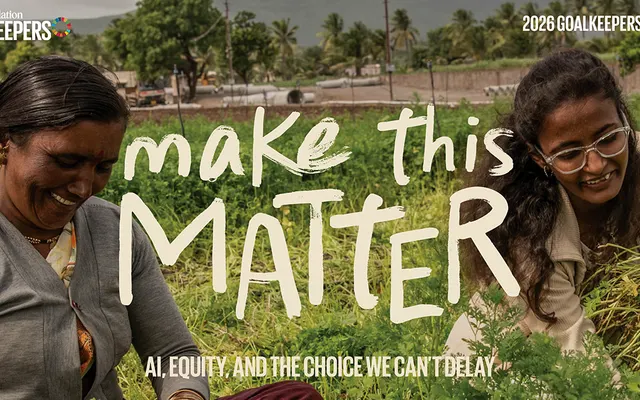
AI, equity, and the choice we can’t delay: 2026 Goalkeepers report

Release date follows the foundation’s September 14 announcement. Gates’s own sections argue that market-led rollout favors wealthy users; useful tools require local languages, local evidence, affordable access and capable frontline workers. Separate guest essays are not his personal testimony.

goalkeepers.gatesfoundation.org
The turbulent AI era is here. The choices we make now are critical.

Warns that rapid substitution for cognitive labor differs from previous transitions. Proposes new national and international institutions, selected human-only roles and taxes on AI or robots. Would likely support credible global slowing but doubts its political feasibility.

gatesnotes.com
Expanding access to health care through AI

Explains Horizon 1000: supporting African health workers, beginning in Rwanda, with a goal of reaching 1,000 clinics and their communities by 2028. This is a deployment commitment, not proof the goal has been achieved.

gatesnotes.com
The year ahead 2026: Optimism with footnotes

Expects AI capability to exceed human levels, identifies bioterrorism and labor disruption as major risks, and argues for preparation and shared gains. January optimism is updated by the more urgent August and September writings.

gatesnotes.com
Wo stehst du?
Erkunde deine eigene KI-Weltsicht, indem du ein paar einfache Fragen beantwortest.
Deine eigene Weltsicht abbilden