Sayash Kapoor

Sayash Kapoor

x.com/sayashk

AI evaluation and policy researcher who sees AI as transformative, measures how reliable AI agents are and favors resilience over nonproliferation.

AI将如何改变世界?

文明层面的变革渐进式变化DoomBloom
模拟位置解读范围

横向:他表达的 Doom–Bloom 前景看法。 纵向:变革程度。

Doom–Bloom:100 中的 55。变革程度:100 中的 72。解读范围:横向为 50 至 75,纵向为 67 至 77。这些是解读坐标,而不是事件概率。

Sayash Kapoor的 P(doom) · 推断

≈6%

0%100%

根据他的模拟回答推断,并非他们给出的数字。 合理范围:3–12%。

Sayash Kapoor 的里程碑时间线
  1. 工作与机构

    So I expect rapid capability gains but institutionally paced change.

    回答 1

按里程碑分组,不按推断日期间隔或排序。AGI 和超人类 AI 保留他的定义。

他的展望取决于什么

一个核心假设

AI can be enormously beneficial, but only if we make keeping humans in control an explicit institutional choice rather than assuming capability automatically brings reliability or good governance.
回答 2

如果这个假设实际并非如此,他的展望会如何变化?

一个尚未解决的问题

I don’t have a defensible number.
回答 4

什么能帮助他区分这里各种合理的结果?

更多详情

预期益处

预计将带来显著益处,但受到重要条件或分配方面的限制。

79 / 100

影响小变革性影响

在定性尺度上,解读范围为 67 到 100。

预期危害

严重或广泛的危害预计将是未来不可忽视的一部分。

66 / 100

影响小变革性影响

在定性尺度上,解读范围为 67 到 67。

人类影响力

人类的选择可以大幅改变AI的发展轨迹。

66 / 100

影响力小影响力强

在定性尺度上,解读范围为 50 到 100。

AI使用规则

在事先落实保护措施或获得许可之前,限制所讨论的AI用途。

模拟位置:允许所讨论的AI用途,同时实施有针对性的问责与保护措施。

尽量减少对所讨论AI用途的限制。

这些解读保留了他陈述的条件。益处和危害都可能很大。这些范围描述的是我们如何解读他的模拟回答,而不是统计置信区间。

与Sayash Kapoor相比,你的立场在哪里?
用大约3分钟描绘你自己的AI世界观,然后进行比较

相似的世界观

模拟世界观与 Sayash Kapoor 最接近的意见领袖

模拟评估

问题 1

你认为AI对我们的未来意味着什么?为什么?

I expect AI to be transformative in the way electricity or the internet was transformative: not because it becomes an omnipotent entity, but because increasingly capable systems diffuse through nearly every institution and profession. We are already seeing dramatic jumps within a single model generation. But a benchmark result or impressive demo is not the same as a reliable service. In our measurements, reliability improved four to ten times more slowly than average accuracy, and open-ended research agents still showed poor judgment despite being strong at engineering. So I expect rapid capability gains but institutionally paced change. Agents will encounter tool latency, verification costs, human oversight, physical-world constraints, and organizations that adapt slowly. Adoption will also be jagged: verifiable tasks where mistakes are cheap will change first. Coding agents, for example, can make engineers much more productive well before they can replace people who learn on the job and remain accountable for outcomes. The central choice is whether we build institutions that keep humans in control. Advanced AI will probably proliferate, so trying to prevent access may buy months rather than solve the problem. I would prioritize resilience: secure systems, sandboxing, monitoring, formal verification, strong cyberdefense, independent evaluation, and real accountability for companies. I worry not only about spectacular failures, but also slower damage—erosion of trust, journalism, and institutional competence. AI’s impact can be enormous without being instantaneous or beyond human control.


问题 2

Taking benefits and harms together, what overall impact do you expect AI to have?

I expect a mixed but profoundly consequential impact, and I would resist collapsing that into a confident net-positive or net-negative forecast. AI should greatly expand productivity and scientific and technical capacity, especially when people use agents as tools and remain accountable for the result. But those benefits will arrive unevenly, and they will coexist with serious harms: cyberattacks, unreliable automated decisions, concentration of power, and slower erosion of trust and institutional competence. The outcome is not technologically predetermined. Capability gains can be rapid while reliable deployment and institutional adaptation remain slow. That gap creates both room for intervention and opportunities for failure. My default expectation is that advanced AI keeps proliferating, so the decisive question is whether we build resilient systems around it: strong security, control and monitoring, independent evaluation, legal and organizational accountability, and broad defensive access. AI can be enormously beneficial, but only if we make keeping humans in control an explicit institutional choice rather than assuming capability automatically brings reliability or good governance.

问题 3

Setting aside good or bad: how much do you think AI will ultimately change the world—a little, a lot, or completely?

A lot—on the scale of electricity or the internet. I expect AI to reshape most professions and institutions, with enormous productivity gains and new capabilities. But “a lot” does not mean everything changes overnight or that AI becomes an uncontrollable omnipotent entity. Reliability, oversight, infrastructure, institutional adaptation, and physical-world constraints will make the transformation slower and more uneven than raw capability progress suggests.

问题 4

What’s your rough gut-feel chance that AI causes human extinction or a similarly permanent catastrophe? A number or “no idea” is fine.

I don’t have a defensible number. Extinction probabilities here are too methodologically unreliable to guide policy; I’d favor interventions that help across a wide range of estimates.

来源

用于为此模拟用户提供事实依据的文章、访谈和著述。

Sayash Kapoor on Claude Mythos as normal technology

Says the normal-technology view is not capability skepticism: AI will be generally transformative, including at finding and chaining exploits. By analogy with fuzzing tools, he predicts such tools will differentially help cyber defenders over time while urging institutions to adopt them defensively now. He reads a lab’s reports of a model bypassing access controls as control failures and favors sandboxing, formal verification and layered ecosystem defenses; he calls it inevitable that small open-weight models will eventually be made to propagate across networks, so defenses must work at the systems level. He argues many important tasks have limits outside computation, that humans should stay in control, and that building AI with its own volition is a choice society should not make. He reports agent reliability improving four to ten times more slowly than accuracy, with a naive linear extrapolation of five to seven years to saturate their reliability benchmarks. Own turns in Substack’s machine transcript inspected; speaker labels inferred from the dialogue.

aisummer.org
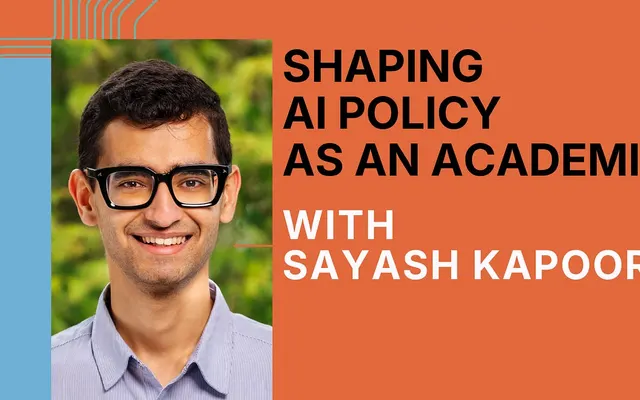
Shaping AI policy as an academic

He describes AI as a general-purpose technology that will not lead to superintelligence and current open models as less consequential for biosecurity than some argue. His top research priority is resilience for a world where advanced AI is abundant with few safeguards, because he does not think its availability can be limited or that nonproliferation should carry the policy load. Acute cyber and bio risks matter, for example by deploying AI to defenders and into biological screening, but he is equally concerned about diffuse risks: eroding trust in journalism and in institutions’ ability to function. He cites his group’s finding that 2024 election deepfakes were no more effective than cheap fakes. Full interview text inspected.

horizonlaunchpad.substack.com
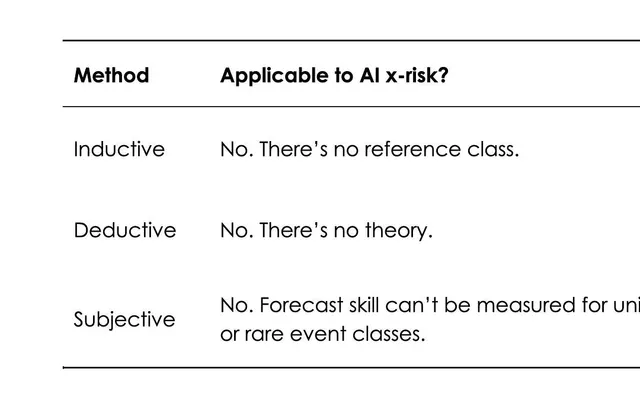
AI existential risk probabilities are (still) too unreliable to inform policy

Co-authored repost of their 2024 essay with a new preface. It argues that AI extinction forecasts lack an inductive reference class, a deductive model or any validated subjective method, so they turn vague intuitions into pseudo-precise numbers; policymakers should not base costly restrictions on them, though forecasting is fine as an academic or private activity. Governments should prefer policies that are helpful across a range of risk estimates. The preface calls p(doom) culture counterproductive to a broader conception of safety. It offers no probability of its own and does not claim the risk is zero. Preface and essay inspected.

normaltech.ai
你的立场在哪里?
回答几个简单问题,探索你自己的AI世界观。
描绘你自己的世界观

你的立场在哪里?

描绘我的世界观