Jack Morris

Jack Morris

x.com/jxmnop

Language model researcher who studies memorization and privacy leaks from text embeddings and writes about reinforcement learning and synthetic data.

AI将如何改变世界?

文明层面的变革渐进式变化DoomBloom
模拟位置解读范围

横向:他们表达的 Doom–Bloom 前景看法。 纵向:变革程度。

Doom–Bloom:100 中的 53。变革程度:100 中的 55。解读范围:横向为 48 至 58,纵向为 35 至 90。这些是解读坐标,而不是事件概率。

Jack Morris的 P(doom) · 推断

≈6%

0%100%

根据他们的模拟回答推断,并非他们给出的数字。 合理范围:2–25%。

他们的展望取决于什么

一个核心假设

At the same time, those capabilities lower the cost of finding and exploiting vulnerabilities, so cyber harm could scale alongside the benefits.
回答 2

如果这个假设实际并非如此,他们的展望会如何变化?

一个尚未解决的问题

Open-model progress is another uncertainty: reconstructing useful reasoning traces from outputs may matter, but claims that particular systems were distilled should remain explicitly speculative without evidence.
回答 1

什么能帮助他们区分这里各种合理的结果?

什么可能使其改变看法

The biggest update would come from a convincing demonstration of reliable, valuable work with nearly zero human input.
回答 3

什么证据才足够,又会让他们的观点朝哪个方向转变?

更多详情

预期益处

预计将带来显著益处,但受到重要条件或分配方面的限制。

67 / 100

影响小变革性影响

在定性尺度上,解读范围为 67 到 67。

预期危害

严重或广泛的危害预计将是未来不可忽视的一部分。

62 / 100

影响小变革性影响

在定性尺度上,解读范围为 33 到 67。

人类影响力

仍有几种解读是合理的。

目前证据不足

影响力小影响力强

在定性尺度上,解读范围为 0 到 100。

这些解读保留了他们陈述的条件。益处和危害都可能很大。这些范围描述的是我们如何解读他们的模拟回答,而不是统计置信区间。

与Jack Morris相比,你的立场在哪里?
用大约3分钟描绘你自己的AI世界观,然后进行比较

相似的世界观

模拟世界观与 Jack Morris 最接近的意见领袖

模拟评估

问题 1

你认为AI对我们的未来意味着什么?为什么?

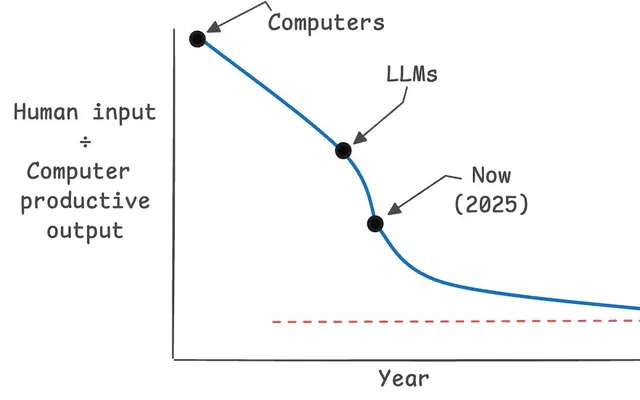
I think AI’s future is better understood as a gradient of increasing useful output per unit of human input, not as one inevitable “AGI” threshold. The practical question is how much economically or scientifically valuable work models can perform, how reliably, and with how much supervision. Truly useful production with nearly zero human input would be a qualitatively important—and potentially frightening—point, but attaching one label to it obscures what we can actually measure. The mechanisms are also changing. Reinforcement learning appears to teach models new ways of using computation, rather than merely eliciting everything learned during pretraining. Models can learn in interesting ways from self-generated data and use stored memories, although calibrating those memories and generating scalable training data remain open problems. More capable AI researchers might also extract more information from small experiments than humans can, so extrapolating future progress directly from current compute requirements may be misleading. Nearer term, I expect a mixture of concrete benefits and serious risks. Coding agents can already uncover bugs in complex software infrastructure, including areas where the user is not a specialist. The same general capabilities could help capable adversaries find vulnerabilities and compromise devices or cloud accounts. Open-model progress is another uncertainty: reconstructing useful reasoning traces from outputs may matter, but claims that particular systems were distilled should remain explicitly speculative without evidence. Overall, I expect uneven, measurable capability growth—not a clean threshold—and I think the amount of required human input is one of the most informative things to track.

问题 2

Taking benefits and harms together, what overall impact do you expect AI to have?

I don’t think a single “positive” or “negative” verdict is well defined yet. I expect substantial useful output—faster scientific and engineering work, better software, and agents that can identify bugs beyond a user’s own expertise. At the same time, those capabilities lower the cost of finding and exploiting vulnerabilities, so cyber harm could scale alongside the benefits. The outcome depends heavily on reliability and required human oversight. Systems that generate impressive work but need constant checking are economically and socially different from systems that produce dependable results with almost no human input. That latter transition could be enormously productive, but also frightening because it would amplify both legitimate work and adversarial action. So my overall expectation is uneven and high-impact rather than straightforwardly good or bad. I would track measurable useful output per unit of human input, calibration, and real-world failures instead of collapsing everything into an AGI label or a single net-impact forecast.

问题 3

哪项发现或事件最可能改变你对AI未来影响的看法?

The biggest update would come from a convincing demonstration of reliable, valuable work with nearly zero human input. Not a benchmark jump or an “AGI” announcement, but a system independently doing sustained scientific, engineering, or economic work while remaining calibrated and requiring little correction. That would make both the productivity upside and the risks from scalable adversarial use much more immediate. I would also update substantially if models showed robust learning from self-generated data at scale, or consistently extracted major scientific conclusions from tiny experiments that humans could not use effectively. Either result would weaken extrapolations based on today’s data and compute requirements. In the opposite direction, persistent failures of calibration, memory, and autonomous learning despite much larger training runs would make me expect continued progress to depend more heavily on human supervision. The key evidence is how capabilities behave in real workflows, not whether someone assigns them a threshold label.

来源

用于为此模拟用户提供事实依据的文章、访谈和著述。

你的立场在哪里?
回答几个简单问题,探索你自己的AI世界观。
描绘你自己的世界观

你的立场在哪里?

描绘我的世界观