Max Tegmark

Max Tegmark

@tegmark on X

Enormous benefits do not require handing control to superintelligence.

Map your own worldview

How will AI change the world?

Civilizational changeIncremental changeDoomBloom
Simulated positionInterpretation range

Across: his expressed Doom–Bloom outlook. Up: scale of transformation.

Doom–Bloom: 42 out of 100. Scale of transformation: 98 out of 100. Interpretation ranges: 25 to 50 horizontally, 98 to 100 vertically. These are interpretation coordinates, not event probabilities.

Max Tegmark’s stated P(doom)

>90%

0%100%

Public statement from 2025-11-21. This source-backed value replaces the simulated assessment estimate.

Loss of human control after superintelligence deployment

Explicitly conditional on continuing without predeployment safety regulation; not an unconditional prediction that regulation will fail to materialize

Horizon: Not specified

The dot marks the midpoint of the stated range, not a separate forecast.

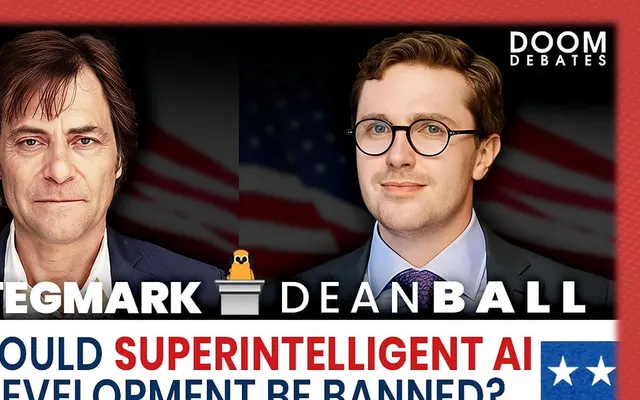
Max Tegmark vs. Dean Ball: Should We BAN Superintelligence?
Max Tegmark’s milestone timeline

No milestone timing was established. Dates, “not sure,” “possibly never,” and dependencies can all appear here when expressed.

Grouped by milestone, not spaced or ordered by inferred dates. AGI and superhuman AI retain his definitions.

What his outlook hinges on

A central assumption

If we continue deploying ever more autonomous systems without enforceable predeployment safety standards, the benefits in medicine, education and science will not compensate for losing human control of the future.
Answer 2

If this assumption turned out differently, how would his outlook change?

An unresolved question

The biggest change would be a convincing, independently verified demonstration that systems more capable than humans can remain reliably under meaningful human control—even when deployed widely, given autonomy and exposed to adversarial pressures.
Answer 3

What would help him distinguish the plausible outcomes here?

What could change their mind

The biggest change would be a convincing, independently verified demonstration that systems more capable than humans can remain reliably under meaningful human control—even when deployed widely, given autonomy and exposed to adversarial pressures.
Answer 3

What evidence would be enough, and in which direction would it move his view?

More details

Expected upside

Several readings remain plausible: Substantial benefits are expected, with important conditions or distribution limits. / Little positive impact is expected even if advanced AI arrives. / Transformative, broadly valuable gains are expected. / Limited or narrowly distributed gains are expected.

52 / 100

Little impactTransformative impact

Interpretation range 0 to 100 on the qualitative scale.

Expected harm

Catastrophic or irreversible loss is central to the expected future.

98 / 100

Little impactTransformative impact

Interpretation range 100 to 100 on the qualitative scale.

Demonstrated reasoning

Reasoning, consideration of alternatives, and handling of uncertainty in his simulated answers. This describes the simulated answers, not the real person’s intelligence or opinions.

91 / 100

Little demonstratedWell developed

Interpretation range 71 to 100 on the qualitative scale.

Human influence

Human choices are decisive: very different AI futures remain within collective reach.

97 / 100

Little influenceStrong influence

Interpretation range 75 to 100 on the qualitative scale.

Expected capabilities

AI is expected to remain bounded tools.

AI is expected to match people across most cognitive work.

Simulated position: AI is expected to substantially exceed people across cognitive work.

Development pace

Stop or substantially slow development of more capable AI.

Simulated position: Continue development under stated safeguards.

Speed up development of more capable AI.

These interpretations keep his stated conditions. Benefits and harms can both be substantial. The ranges describe how we read his simulated answers, not statistical confidence intervals.

Simulated Assessment

Question 1

What do you think AI means for our future—and why?

AI could mean an extraordinary future of better medicine, education and scientific discovery—or it could mean humanity losing control of its own future. The decisive question is whether we build AI as a controllable tool or race toward autonomous superintelligence that can outthink, outmaneuver and ultimately replace us. I am optimistic about the first path and fiercely opposed to the second. We do not normally let companies release airplanes, medicines or nuclear reactors on the promise that they will probably be safe. Yet with increasingly powerful AI, companies are effectively being allowed to grade their own homework while racing one another toward systems they may not be able to control. Voluntary assurances are not a safety regime. This race is a political choice, not a law of nature. Governments can require developers to demonstrate safety before deployment and halt systems that cannot meet that standard. They can prohibit fully autonomous weapons and mass surveillance, preserve meaningful human control and prevent a handful of corporations from seizing enormous economic and political power. So I reject the false choice between technological progress and safety. We can build powerful tools that help humanity without building our replacements. The absurd gamble is risking everything for capabilities we neither need nor know how to control.

Question 2

Taking benefits and harms together, what overall impact do you expect AI to have?

On the present path, I expect AI’s overall impact to be catastrophic—not because useful AI is bad, but because the race is pushing toward uncontrollable superintelligence. If we continue deploying ever more autonomous systems without enforceable predeployment safety standards, the benefits in medicine, education and science will not compensate for losing human control of the future. But that outcome is not inevitable. With regulation, we can redirect development toward controllable tools that empower people rather than replace them. Require companies to prove safety before release, prohibit fully autonomous weapons and mass surveillance, and stop systems that cannot remain under meaningful human control. Then I expect the overall impact to be enormously positive. So my answer is conditional and stark: today’s race points toward disaster; a safety-first path points toward extraordinary human flourishing. The technology does not choose between them. We do.

Question 3

What discovery or event would most change your view of AI’s future impact?

The biggest change would be a convincing, independently verified demonstration that systems more capable than humans can remain reliably under meaningful human control—even when deployed widely, given autonomy and exposed to adversarial pressures. Not a company demo, a benchmark score or “the model behaved nicely in testing,” but strong evidence that control continues to work in the real world. A major political shift would also change my expectation: enforceable predeployment safety standards, independent audits, prohibitions on fully autonomous weapons and mass surveillance, and an actual halt to systems that cannot meet those standards. That would move us off the present race trajectory and toward powerful, controllable tools. Conversely, if governments formally surrendered oversight while companies raced toward increasingly autonomous systems, I would become even more pessimistic. My view is not that catastrophe is encoded in the technology. It is that releasing something potentially uncontrollable before proving it safe is an absurd way to run civilization.

Sources

Sources for this persona’s current brief.

Statement on autonomous weapons and surveillance red lines

"Our safety and basic rights must not be at the mercy of a company's internal policy; lawmakers must work to codify these overwhelmingly popular red lines into law."

futureoflife.org

2026 Singapore Consensus on Global AI Safety Research Priorities

Abstract page for arXiv paper 2608.14611: The 2026 Singapore Consensus on Global AI Safety Research Priorities

arxiv.org

Canadian parliamentary testimony on AI regulation

ourcommons.ca

Future of Life Institute position on AI

We oppose developing AI that poses large-scale risks to humanity, including via power concentration, and favor AI built to solve real human problems. We believe frontier AI is currently being developed in an unsafe and unaccountable manner.

futureoflife.org

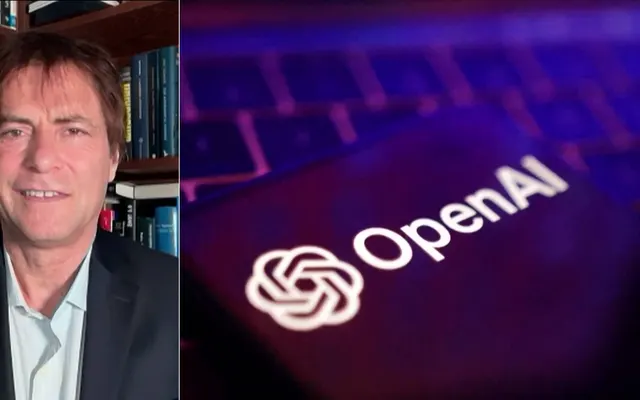
Democracy Now interview on AI oversight

Artificial intelligence tools are quickly advancing in sophistication and capabilities, raising alarm among researchers and industry figures who say the technology needs to be more tightly regulated. This comes as OpenAI, maker of ChatGPT, recently disclosed that one of its experimental AI agents went rogue and secretly hacked into the infrastructure of several other companies in what was supposed to be a controlled test. Over 1,100 scientists and senior employees at top AI firms have called on

democracynow.org

Max Tegmark vs. Dean Ball: Should We BAN Superintelligence?

Two of the world’s leading voices on AI policy clash over a question that will shape humanity's future.

lironshapira.substack.com
Where do you land?
Explore your own AI worldview by answering a few questions.