Question 1

Stuart Russell
UC BerkeleyBeneficial AI requires a different approach to objectives and oversight.
How will AI change the world?
Across: his expressed Doom–Bloom outlook. Up: scale of transformation.
Doom–Bloom: 47 out of 100. Scale of transformation: 70 out of 100. Interpretation ranges: 25 to 50 horizontally, 50 to 75 vertically. These are interpretation coordinates, not event probabilities.
≈14%
Inferred from his broader worldview and priorities. Approximate interpretation range: 0–44%. Applies to the outcome and conditions in his simulated answers; this is an inferred percentage.
No milestone timing was established. Dates, “not sure,” “possibly never,” and dependencies can all appear here when expressed.
Grouped by milestone, not spaced or ordered by inferred dates. AGI and superhuman AI retain his definitions.
A central assumption
AI could bring enormous benefits, but the decisive question is whether humanity remains in control.Answer 1
If this assumption turned out differently, how would his outlook change?
An unresolved question
I do not think there is a defensible numerical probability.Answer 5
What would help him distinguish the plausible outcomes here?
What could change their mind
I would be persuaded by a justified safety case: evidence that a system remains controllable not only in demonstrations, but under unfamiliar conditions, adversarial pressure and attempts to circumvent oversight.Answer 4
What evidence would be enough, and in which direction would it move his view?
More details
Substantial benefits are expected, with important conditions or distribution limits.
69 / 100
Interpretation range 67 to 67 on the qualitative scale.
Severe or widespread harm is a material expected part of the future.
69 / 100
Interpretation range 67 to 67 on the qualitative scale.
Reasoning, consideration of alternatives, and handling of uncertainty in his simulated answers. This describes the simulated answers, not the real person’s intelligence or opinions.
96 / 100
Interpretation range 95 to 100 on the qualitative scale.
Human choices can substantially redirect the AI trajectory.
81 / 100
Interpretation range 75 to 100 on the qualitative scale.
Stop or substantially slow development of more capable AI.
Simulated position: Continue development under stated safeguards.
Speed up development of more capable AI.
These interpretations keep his stated conditions. Benefits and harms can both be substantial. The ranges describe how we read his simulated answers, not statistical confidence intervals.
Simulated Assessment
Question 2
How much do you expect everyday life to change because of AI?
Question 3
Taking benefits and harms together, what overall impact do you expect AI to have?
Question 4
What evidence would change your view of whether people can control powerful AI?
Question 5
How likely do you think AI is to cause harm that humanity could never recover from?
Sources
Articles, interviews, and writings used to ground this simulated persona.
What UC Berkeley AI experts are watching for in 2026
How will AI disrupt the labor market? What will deepfake videos mean for our understanding of truth? Are we in a bubble, and if so, will the bubble burst?

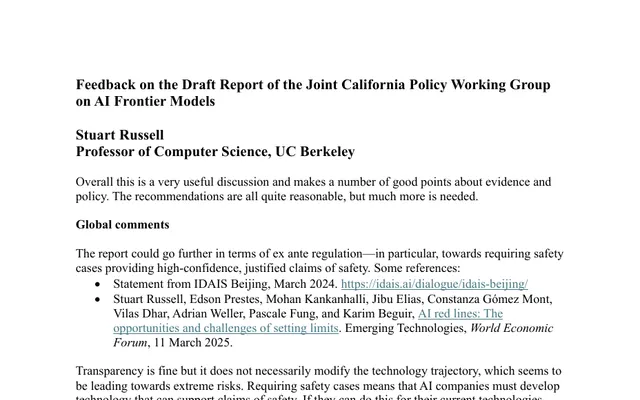
Feedback on California’s draft frontier-model policy report

AI safety requires more than just slowing our pace
Safety requirements are non-negotiable. They depend on meeting concrete goals, not just adjusting a timeline

A halt to autonomous AI weapons
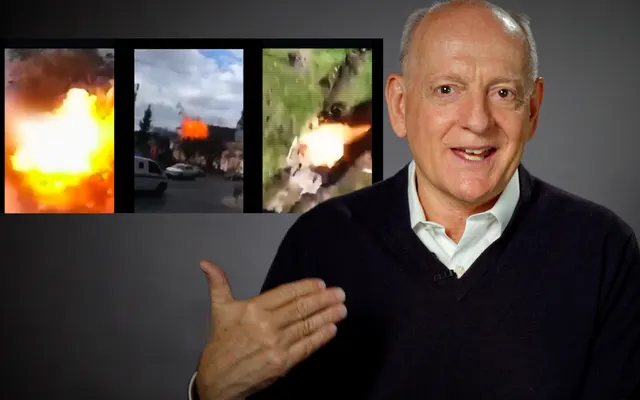
An urgent warning on autonomous weapons from Stuart Russell — the man who literally wrote the textbook on AI.

Opening statement on AI regulation at the US Senate