Question 1
Sierra Catalina
x.com/sierracatalinaCEO of Ouroboros who builds tools for portable, user-owned AI context and writes about agent security and proof of personhood.
How will AI change the world?
Across: her expressed Doom–Bloom outlook. Up: scale of transformation.
Doom–Bloom: 67 out of 100. Scale of transformation: 75 out of 100. Interpretation ranges: 62 to 75 horizontally, 70 to 80 vertically. These are interpretation coordinates, not event probabilities.
≈5%
Inferred from her simulated answers, not a number they gave. Plausible range: 3–10%.
A central assumption
so the impact depends less on whether models get smarter and more on who owns the context, how access is scoped & revoked, and whether society rebuilds the human infrastructure automation thins out.Answer 2
If this assumption turned out differently, how would her outlook change?
An unresolved question
I don’t have a useful percentage.Answer 4
What would help her distinguish the plausible outcomes here?
More details
Substantial benefits are expected, with important conditions or distribution limits.
76 / 100
Interpretation range 67 to 100 on the qualitative scale.
Severe or widespread harm is a material expected part of the future.
64 / 100
Interpretation range 67 to 67 on the qualitative scale.
Human choices can substantially redirect the AI trajectory.
79 / 100
Interpretation range 50 to 100 on the qualitative scale.
Restrict the AI uses discussed until prior protections or permission are in place.
Simulated position: Allow the AI uses discussed with targeted accountability and protections.
Minimize restrictions on the AI uses discussed.
These interpretations keep her stated conditions. Benefits and harms can both be substantial. The ranges describe how we read her simulated answers, not statistical confidence intervals.
Similar worldviews
Thought leaders whose simulated worldviews are closest to Sierra Catalina’s
Simulated Assessment
Sources
Articles, interviews, and writings used to ground this simulated user.
Her personal site states a thesis: the missing layer in modern AI is portable, user-owned context; memory, permissions and identity should travel with the person across models, agents and applications and belong to the user, not the platform. Operating principles: AI systems need scoped access to context, not persistent ownership of identity; provenance, revocation and portability are baseline requirements for trustworthy personalization; AI will remain hybrid across local, cloud and agent systems. Also lists her Ouroboros workspace and open-source agent-aware and context-layer projects. Undated page; full text inspected on 2026-10-05.

Resharing Kevin Weil’s ChatGPT agent announcement, she writes that it is “unreal”, that nothing will be the same after this, and “welcome to the future.” Enthusiasm about agents; the announcement text is Weil’s. Older context. Her short post text inspected via a search-engine extract of the LinkedIn page.

A short post arguing that anthropomorphizing models trains people to trust interfaces instead of incentives, and that this confusion compounds fast in agentic systems. Full post text inspected; a reader comment excluded.

A short post saying browser agents feel harmless until you remember most people reuse passwords and click “allow” on vibes alone. A practical security concern about agents, not a catastrophic-risk claim. Full post text inspected.

Argues that if personal agents become core, the web needs agent-readable infrastructure, and describes her open-sourced “agent aware architecture” starter: machine-legible primary actions, sensitive-field boundaries and confirmation gates for destructive operations, which she says could standardize the agent/web handshake. A design proposal tied to her own project. Post text inspected via a search-engine extract of the LinkedIn page.

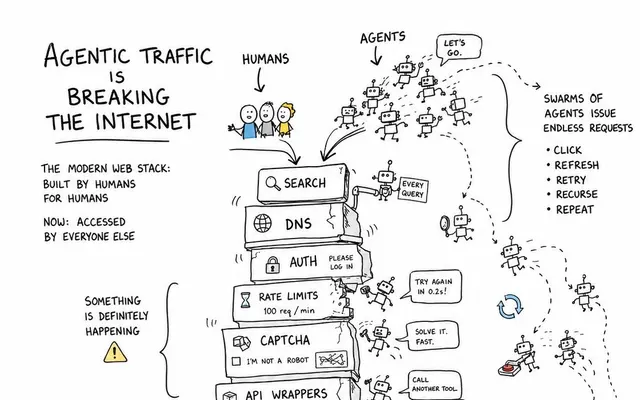
A short post saying we need to rethink agentic traffic on the web before we break the web. The accompanying image was not reviewed, and a reader’s comment belongs to someone else. Post text inspected.

Where do you land?
Map my worldview