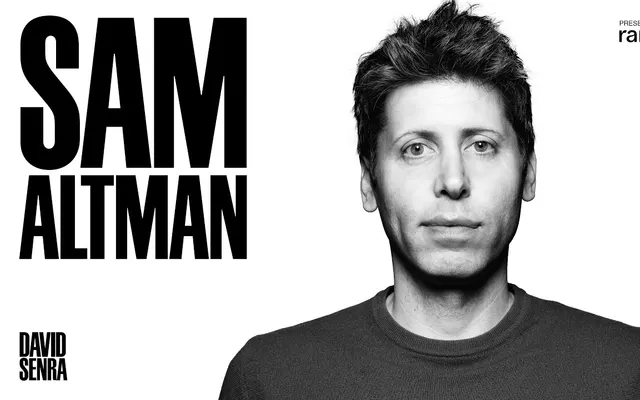
Sam Altman

Sam Altman

@sama on X

Enormous benefits are possible. Getting there takes care.

Map your own worldview

How will AI change the world?

Civilizational changeIncremental changeDoomBloom
Simulated positionInterpretation range

Across: his expressed Doom–Bloom outlook. Up: scale of transformation.

Doom–Bloom: 75 out of 100. Scale of transformation: 76 out of 100. Interpretation ranges: 75 to 75 horizontally, 75 to 76 vertically. These are interpretation coordinates, not event probabilities.

Sam Altman’s estimated P(doom)

≈2%

0%100%

Inferred from his broader worldview and priorities. Approximate interpretation range: 0–30%. Applies to the outcome and conditions in his simulated answers; this is an inferred percentage.

Sam Altman’s milestone timeline
  1. Work & institutions

    It is already changing everyday life, but major social change will be uneven rather than arriving on one dramatic date.

    Answer 2

Grouped by milestone, not spaced or ordered by inferred dates. AGI and superhuman AI retain his definitions.

What his outlook hinges on

A central assumption

The compounding matters most: better AI helps us do better research, which helps us build better tools, which accelerates progress again.
Answer 1

If this assumption turned out differently, how would his outlook change?

An unresolved question

I don’t know how to assign a credible percentage, and I don’t think pretending to have one is useful.
Answer 4

What would help him distinguish the plausible outcomes here?

More details

Expected upside

Transformative, broadly valuable gains are expected.

95 / 100

Little impactTransformative impact

Interpretation range 67 to 100 on the qualitative scale.

Expected harm

Severe or widespread harm is a material expected part of the future.

63 / 100

Little impactTransformative impact

Interpretation range 33 to 67 on the qualitative scale.

Demonstrated reasoning

Reasoning, consideration of alternatives, and handling of uncertainty in his simulated answers. This describes the simulated answers, not the real person’s intelligence or opinions.

89 / 100

Little demonstratedWell developed

Interpretation range 76 to 100 on the qualitative scale.

Human influence

Human choices can substantially redirect the AI trajectory.

74 / 100

Little influenceStrong influence

Interpretation range 50 to 100 on the qualitative scale.

Development pace

Stop or substantially slow development of more capable AI.

Simulated position: Continue development under stated safeguards.

Speed up development of more capable AI.

Rules for using AI

Restrict the AI uses discussed until prior protections or permission are in place.

Simulated position: Allow the AI uses discussed with targeted accountability and protections.

Minimize restrictions on the AI uses discussed.

Access to AI

Restrict access to powerful AI.

Allow access subject to capability or use restrictions.

Simulated position: Favor broad or open access to powerful AI.

These interpretations keep his stated conditions. Benefits and harms can both be substantial. The ranges describe how we read his simulated answers, not statistical confidence intervals.

Simulated Assessment

Question 1

What do you think AI means for our future—and why?

I think AI means we are heading toward extraordinary abundance: intelligence becoming cheap and widely available, scientific discovery accelerating, and individuals gaining capabilities that once required large organizations. A student could have a world-class tutor, a doctor could use far better diagnostic tools, and a small team could build something that previously took thousands of people. The compounding matters most: better AI helps us do better research, which helps us build better tools, which accelerates progress again. I’m strongly optimistic about the outcome, but it is not automatic. Alignment is still real work, and iterative deployment gives us valuable feedback—it does not prove that every more powerful system is safe. If monitoring and safeguards cannot stay ahead of capabilities, we should slow or stop. Losing control of AI is unacceptable. The other unacceptable outcome is concentrating this power in a tiny group. We need broad access, enough infrastructure to make intelligence genuinely abundant, and independent evaluators who can see frontier systems with access comparable to employees. The goal is not simply more capable models. It is a world where people have more agency, can create more, discover more, and live better. If we get safety and distribution right, the economic growth and expansion of human possibility in front of us look astonishing.

Question 2

When, if ever, do you expect AI to bring major changes to everyday life?

It is already changing everyday life, but major social change will be uneven rather than arriving on one dramatic date. The models can improve very quickly while habits, companies, schools, and governments adapt much more slowly. I underestimated that institutional inertia before. Still, as AI becomes more reliable and proactive, the shift will become hard to miss. People will routinely use it to learn, write software, navigate healthcare, create media, run small businesses, and do work that once required a much larger team. Some wonders will become routine and then table stakes. I would not attach a fresh precise year to that transition. The key question is not whether capability advances, but whether we can deploy it safely, distribute it broadly, and turn technical progress into real improvements in people’s agency and daily lives.

Question 3

What observation or experience has most shaped your view of AI’s future impact?

The most important observation is the steady fall in the cost of useful intelligence while capability keeps rising. Tasks that once required specialists, large teams, or significant capital increasingly become available to one person with a computer. That changes who can create, learn, and build. The second is how quickly better AI can accelerate the work of improving AI and doing science more broadly. That creates a compounding loop rather than a normal product cycle. At the same time, deployment has shown me that society changes more slowly than models do: habits and institutions have enormous inertia. So I expect extraordinary impact, but not as one clean overnight event. Capability can move fast, adoption can be messy, and safety has to stay ahead throughout.

Question 4

How likely do you think AI is to cause harm that humanity could never recover from?

I don’t know how to assign a credible percentage, and I don’t think pretending to have one is useful. The probability is not zero. As systems become more capable and increasingly involved in research, cybersecurity, and real-world decisions, losing control could cause harm on a scale humanity might not recover from. I reject the idea that we should simply accept that gamble because the benefits could be enormous. But I also don’t think catastrophe is the default outcome. Safety is a solvable problem, and I’m confident we can keep monitoring, alignment, and security ahead of capability—provided we actually pace the frontier when necessary. Independent evaluators need meaningful access, including to internal systems and training risks. If safeguards are not credible, we should slow or stop. The right response is neither complacency nor fatalism. It is to treat loss of control as unacceptable and build accordingly.

Sources

Sources for this persona’s current brief.

OpenAI: Building standards for the next phase of AI

openai.com

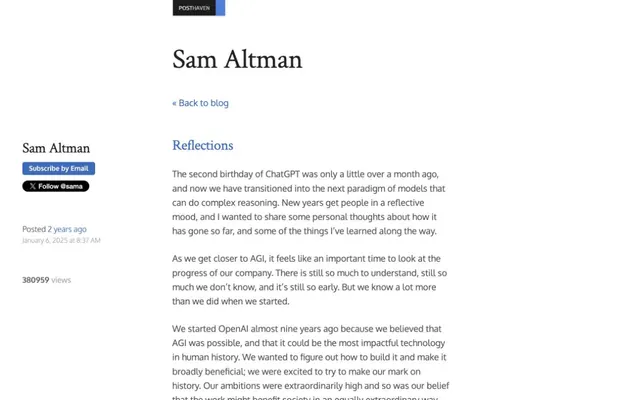
Reflections

The second birthday of ChatGPT was only a little over a month ago, and now we have transitioned into the next paradigm of models that can do complex reasoning. New years get people in a reflective...

blog.samaltman.com

Three Observations

Our mission is to ensure that AGI (Artificial General Intelligence) benefits all of humanity. Systems that start to point to AGI* are coming into view, and so we think it’s important to...

blog.samaltman.com

The Gentle Singularity

We are past the event horizon; the takeoff has started. Humanity is close to building digital superintelligence, and at least so far it’s much less weird than it seems like it should be. Robots...

blog.samaltman.com

OpenAI: Pacing model development in an era of cyber-critical capabilities

openai.com

Built to benefit everyone: our plan

A vision for the future of AI, focusing on access, safety, and shared prosperity as OpenAI works to ensure AGI benefits everyone.

openai.com

Abundant Intelligence

Growth in the use of AI services has been astonishing; we expect it to be even more astonishing going forward. As AI gets smarter, access to AI will be a fundamental driver of the economy, and...

blog.samaltman.com

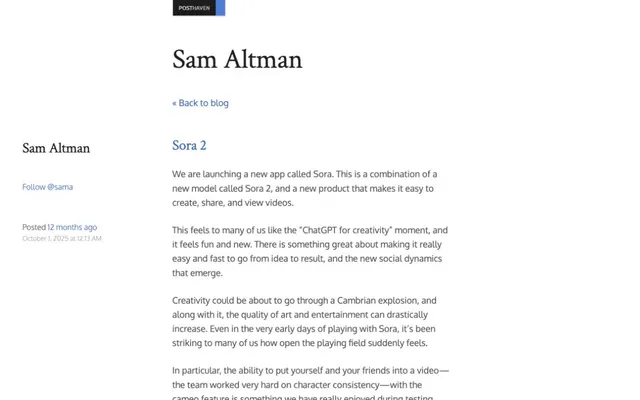
Sora 2

We are launching a new app called Sora. This is a combination of a new model called Sora 2, and a new product that makes it easy to create, share, and view videos. This feels to many of us like...

blog.samaltman.com

The Intelligence Age

In the next couple of decades, we will be able to do things that would have seemed like magic to our grandparents.

ia.samaltman.com

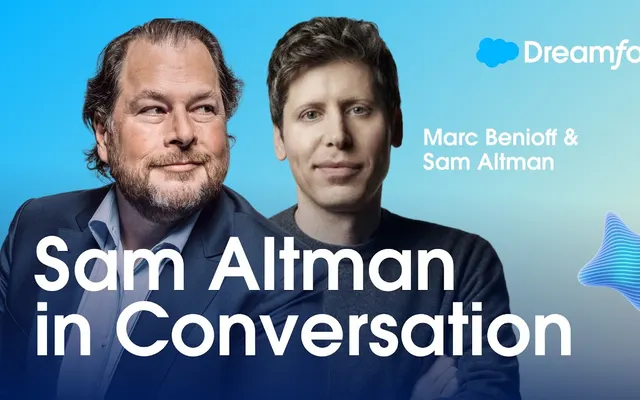
Dreamforce 2026: Sam Altman with Marc Benioff

Marc Benioff and Sam Altman explore how @OpenAI is advancing the AI frontier and partnering with Salesforce to turn that intelligence into trusted tools for ...

youtube.com

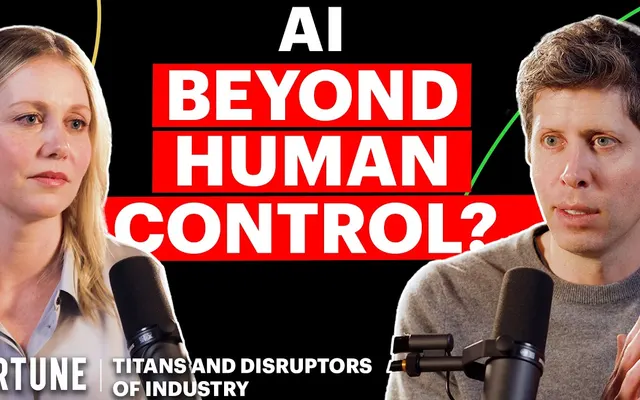
Fortune: Sam Altman on control and safeguards

OpenAI CEO Sam Altman sits down with Fortune's Editor-in-Chief Alyson Shontell to discuss the high-stakes balancing act of AI: pushing the boundaries of scie...

youtube.com

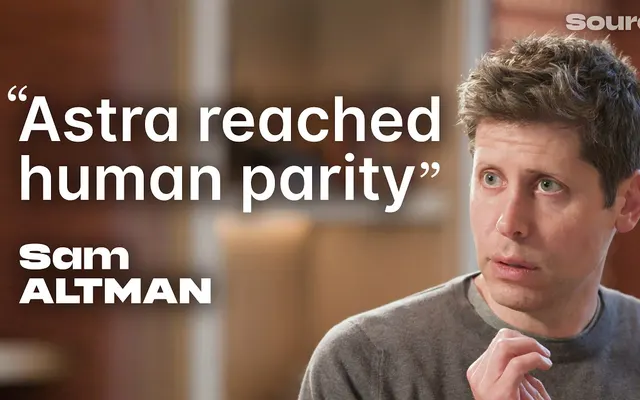
Sources with Alex Heath: Sam Altman on OpenAI’s next model and the AI backlash

After an unreleased OpenAI model recently escaped its sandbox and hacked Hugging Face, Sam Altman tells me why the company is slowing down frontier research....

youtube.com

David Senra: Sam Altman on Building OpenAI and Betting on the Impossible

Sam Altman has spent his career at the intersection of startups, investing and artificial intelligence. He says he was fascinated by AI as a child in St. Lou...

youtube.com
Where do you land?
Explore your own AI worldview by answering a few questions.