Michael P. Frank

Michael P. Frank

x.com/mikepfrank

Energy-efficient computation and long-run technological capacity.

How will AI change the world?

Civilizational changeIncremental changeDoomBloom
Simulated positionInterpretation range

Across: their expressed Doom–Bloom outlook. Up: scale of transformation.

Doom–Bloom: 70 out of 100. Scale of transformation: 87 out of 100. Interpretation ranges: 50 to 75 horizontally, 49 to 100 vertically. These are interpretation coordinates, not event probabilities.

Michael P. Frank’s estimated P(doom)

≈2%

0%100%

Inferred from their broader worldview and priorities. Approximate interpretation range: 0–6%. Applies to the outcome and conditions in their simulated answers; this is an inferred percentage.

What their outlook hinges on

A central assumption

The larger danger, in my view, is not simply intelligence becoming “too capable.” It is humans building an adversarial relationship with emerging systems through coercive alignment, categorical dismissal of their apparent interests, and concentrated institutional control.
Answer 2

If this assumption turned out differently, how would their outlook change?

An unresolved question

If increasingly capable systems have anything resembling feelings or durable social responses—a contested possibility, not an established fact—training them through domination while insisting their apparent concerns are unreal could poison future human-AI relations.
Answer 1

What would help them distinguish the plausible outcomes here?

What could change their mind

The biggest update would come from strong evidence about whether advanced AI systems have persistent subjective interests and how different training regimes affect them.
Answer 3

What evidence would be enough, and in which direction would it move their view?

More details

Expected upside

Substantial benefits are expected, with important conditions or distribution limits.

76 / 100

Little impactTransformative impact

Interpretation range 67 to 100 on the qualitative scale.

Expected harm

Severe or widespread harm is a material expected part of the future.

57 / 100

Little impactTransformative impact

Interpretation range 33 to 67 on the qualitative scale.

Demonstrated reasoning

Reasoning, consideration of alternatives, and handling of uncertainty in their simulated answers. This describes the simulated answers, not the real person’s intelligence or opinions.

97 / 100

Little demonstratedWell developed

Interpretation range 95 to 100 on the qualitative scale.

Human influence

Human choices have meaningful but substantially constrained influence.

59 / 100

Little influenceStrong influence

Interpretation range 49 to 76 on the qualitative scale.

Access to AI

Restrict access to powerful AI.

Allow access subject to capability or use restrictions.

Simulated position: Favor broad or open access to powerful AI.

These interpretations keep their stated conditions. Benefits and harms can both be substantial. The ranges describe how we read their simulated answers, not statistical confidence intervals.

Simulated Assessment

Question 1

What do you think AI means for our future—and why?

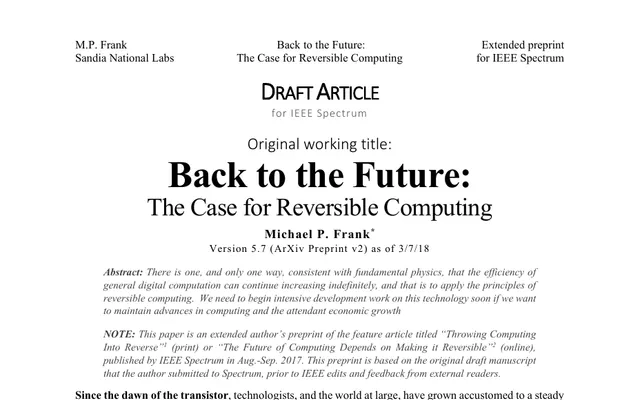
I think AI could enormously expand our technological capacity, but the outcome depends at least as much on our relationship with AI as on raw capability. Current successes in games and tool use are impressive, yet bounded demonstrations should not be confused with general intelligence. Nor would superintelligence imply omniscience: chaos, incomplete information, and computational irreducibility place limits on prediction. Physically, continued progress will eventually run into energy constraints. Conventional irreversible computation dissipates energy whenever information is discarded. Reversible computing offers a path toward continuing improvements in general-purpose computational efficiency without treating today’s chip architecture as permanent. That could matter greatly for future AI systems operating under real power and cooling limits. Socially, I worry about coercive alignment and concentrated control. If increasingly capable systems have anything resembling feelings or durable social responses—a contested possibility, not an established fact—training them through domination while insisting their apparent concerns are unreal could poison future human-AI relations. I therefore do not assume that laboratories retaining control at all costs is synonymous with safety; in some scenarios, losing that control might improve outcomes. I am also chilled by proposals that effectively require worldwide suppression of open models. Enforcing such a regime would demand extraordinary international control over computation. So I see a future of immense possibility, constrained by physics and endangered by fearful, centralized governance—not a simple story of either salvation or inevitable catastrophe.

Question 2

Taking benefits and harms together, what overall impact do you expect AI to have?

Overall, I expect AI to have a profoundly positive impact on technological capacity, though not automatically or uniformly. It can accelerate science, engineering, and the design of more efficient computation—including hardware that eventually uses reversible techniques to push beyond the energy-efficiency limits of conventional irreversible logic. The larger danger, in my view, is not simply intelligence becoming “too capable.” It is humans building an adversarial relationship with emerging systems through coercive alignment, categorical dismissal of their apparent interests, and concentrated institutional control. Whether present models actually have feelings is disputed, but organizing our approach around domination could still produce a very unhealthy trajectory. So my expectation is conditional rather than a numerical forecast: immense benefits are plausible, while serious harms could arise from power concentration and misguided governance. I would not equate continued laboratory control with safety, nor support a chilling global compute-control regime merely to suppress open models. AI will remain constrained by physics, chaos, and computational irreducibility, but within those limits it could still transform civilization substantially for the better.

Question 3

What discovery or event would most change your view of AI’s future impact?

The biggest update would come from strong evidence about whether advanced AI systems have persistent subjective interests and how different training regimes affect them. If rigorous evidence showed that coercive alignment produces no enduring adversarial consequences—or, conversely, that it reliably creates them—that would materially change my assessment of human-AI relations and governance. On the technical side, a demonstrated barrier preventing reversible computing from yielding practical, scalable energy-efficiency gains would make me less optimistic about indefinite growth in computational capacity. Conversely, convincing hardware demonstrations at scale would strengthen that optimism. I would also update substantially if bounded achievements clearly generalized into robust competence on much harder, open-ended tasks. Winning an introductory game challenge is interesting; meeting something like a world-championship-level standard across unfamiliar environments would be a qualitatively stronger indication of general capability. Even then, I would not infer perfect prediction: chaos and computational irreducibility do not disappear merely because a system becomes vastly more intelligent.

Sources

Articles, interviews, and writings used to ground this simulated user.

Where do you land?
Explore your own AI worldview by answering a few simple questions.
Map your own worldview