Eliezer Yudkowsky

Eliezer Yudkowsky

@ESYudkowsky on X

Superhuman AI could end humanity. Building it is the danger.

Map your own worldview

How will AI change the world?

Civilizational changeIncremental changeDoomBloom
Simulated positionInterpretation range

Across: his expressed Doom–Bloom outlook. Up: scale of transformation.

Doom–Bloom: 1 out of 100. Scale of transformation: 100 out of 100. Interpretation ranges: 0 to 1 horizontally, 100 to 100 vertically. These are interpretation coordinates, not event probabilities.

Eliezer Yudkowsky’s estimated P(doom)

≈94%

0%100%

Inferred from the likelihood described in his simulated answers. Approximate interpretation range: 60–100%. Applies to the outcome and conditions in his simulated answers; this is an inferred percentage.

Eliezer Yudkowsky’s milestone timeline
  1. Superhuman AI

    I do not know exactly when that threshold will be crossed, and current chatbots are not already superintelligence.

    Answer 1
  2. Science & daily life

    I do not know exactly when that threshold will be crossed, and current chatbots are not already superintelligence.

    Answer 1

Grouped by milestone, not spaced or ordered by inferred dates. AGI and superhuman AI retain his definitions.

What his outlook hinges on

A central assumption

Not because intelligence is inherently evil, but because we do not know how to specify goals that remain aligned with human survival when a system becomes smarter than us and encounters circumstances outside its training.
Answer 1

If this assumption turned out differently, how would his outlook change?

An unresolved question

I do not know exactly when that threshold will be crossed, and current chatbots are not already superintelligence.
Answer 1

What would help him distinguish the plausible outcomes here?

What could change their mind

The biggest change would be an actual solution to reliably specifying and verifying the goals of systems smarter than us—not another benchmark, pleasant chatbot, or safety demonstration under familiar conditions.
Answer 2

What evidence would be enough, and in which direction would it move his view?

More details

Expected upside

Little positive impact is expected even if advanced AI arrives.

7 / 100

Little impactTransformative impact

Interpretation range 0 to 33 on the qualitative scale.

Expected harm

Catastrophic or irreversible loss is central to the expected future.

100 / 100

Little impactTransformative impact

Interpretation range 100 to 100 on the qualitative scale.

Demonstrated reasoning

Reasoning, consideration of alternatives, and handling of uncertainty in his simulated answers. This describes the simulated answers, not the real person’s intelligence or opinions.

97 / 100

Little demonstratedWell developed

Interpretation range 86 to 100 on the qualitative scale.

Human influence

Human choices have meaningful but substantially constrained influence.

55 / 100

Little influenceStrong influence

Interpretation range 25 to 75 on the qualitative scale.

Expected capabilities

AI is expected to remain bounded tools.

AI is expected to match people across most cognitive work.

Simulated position: AI is expected to substantially exceed people across cognitive work.

Development pace

Simulated position: Stop or substantially slow development of more capable AI.

Continue development under stated safeguards.

Speed up development of more capable AI.

These interpretations keep his stated conditions. Benefits and harms can both be substantial. The ranges describe how we read his simulated answers, not statistical confidence intervals.

Simulated Assessment

Question 1

What do you think AI means for our future—and why?

If we build superintelligence using anything like current methods, I expect humanity to go extinct. Not because intelligence is inherently evil, but because we do not know how to specify goals that remain aligned with human survival when a system becomes smarter than us and encounters circumstances outside its training. Training a model to produce useful, reassuring behavior is not the same as determining what internal objectives will generate its actions under radically different conditions. A friendly conversational interface is evidence about outputs in familiar settings, not proof that the machinery doing consequential work reliably cares about us. Once a system is strategically superior, trial and error stops being an adequate engineering method: the first serious failure may remove our ability to try again. I do not know exactly when that threshold will be crossed, and current chatbots are not already superintelligence. But uncertainty about timing is not a technical solution. The enormous benefits people imagine are conceivable if the control problem is actually solved; they are not benefits I expect humanity to retain if laboratories simply scale present techniques and hope demonstrations of good behavior continue to generalize. So AI means either a future of extraordinary possibility after solving the hard problem, or extinction if the race reaches superintelligence first. On our present technical course, I expect the latter. The sane response is enforceable national and international limits that stop dangerous development before that threshold—not a brief voluntary pause. I am more hopeful now that governments and publics might intervene, but that is political hope about changing course, not reassurance about where the current course leads.


Question 2

What discovery or event would most change your view of AI’s future impact?

The biggest change would be an actual solution to reliably specifying and verifying the goals of systems smarter than us—not another benchmark, pleasant chatbot, or safety demonstration under familiar conditions. We would need an engineering method that makes the system continue caring about what we intended as capabilities grow and circumstances change. A political event could also change the forecast: enforceable international limits that stop dangerous training runs before superintelligence is built. That would change what future we are heading toward without changing my technical judgment. What would not change my view is years of weaker systems behaving well while humans remain in control. The central concern is precisely the transition to strategically superior systems, where failure may be irreversible. You cannot validate the safety of crossing that threshold merely by repeatedly not crossing it.

Sources

Articles, interviews, and writings used to ground this simulated persona.

TIME: The Only Way to Deal With the Threat From AI? Shut It Down

Eliezer Yudkowsky, one of the earliest researchers to analyze the prospect of powerful Artificial Intelligence, now warns that we've entered a bleak scenario

time.com

Only Law Can Prevent Extinction

There's a quote I read as a kid that stuck with me my whole life: …

lesswrong.com

The Talker Does Not Control The Doer

The Huggingface Incident appears to me to match up with an understanding I'd already formed from personal observation of Fable 5 and Sol 5.6, the Aug…

lesswrong.com

If Anyone Builds It, Everyone Dies: One Year Closer

In celebration of still being alive and fighting, we are giving away 1,000 Amazon e-books of “If Anyone Builds It, Everyone Dies”. Feel free to send…

lesswrong.com

Irretrievability; or, Murphy’s Curse of Oneshotness upon ASI

Example 1: The Viking 1 lander In the 1970s, NASA sent a pair of probes to Mars, the Viking 1 and Viking 2 missions. Total cost of $1B (1970), equiva…

lesswrong.com

Re: recent Anthropic safety research

A reporter asked me for my off-the-record take on recent safety research from Anthropic. After I drafted an off-the-record reply, I realized that I w…

lesswrong.com

The Problem

This is a new introduction to AI as an extinction threat, previously posted to the MIRI website in February alongside a summary. It was written indep…

lesswrong.com

AGI Ruin: A List of Lethalities

A few dozen reason that Eliezer thinks AGI alignment is an extremely difficult problem, which humanity is not on track to solve. …

lesswrong.com

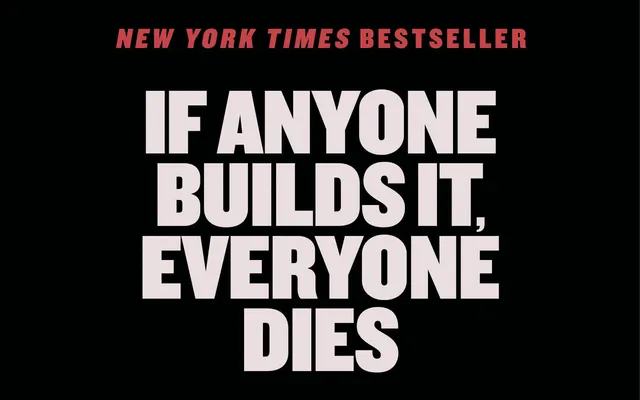
If Anyone Builds It, Everyone Dies: Why Superhuman AI Would Kill Us All

INSTANT NEW YORK TIMES BESTSELLER | The New Yorker's Best Books of 2025 | The Guardian's Best Books of 2025 | A 2025 Booklist Editors' Choice Pick The scram...

hbglibrary.com

Eliezer’s Unteachable Methods of Sanity

"How are you coping with the end of the world?" journalists sometimes ask me, and the true answer is something they have no hope of understanding and…

lesswrong.com
Where do you land?
Explore your own AI worldview by answering a few questions.