Nick Bostrom

Nick Bostrom

Philosopher who studies superintelligence, its risks, and the possibilities for human flourishing in a technologically transformed world.

AI จะเปลี่ยนแปลงโลกอย่างไร?

การเปลี่ยนแปลงระดับอารยธรรมการเปลี่ยนแปลงแบบค่อยเป็นค่อยไปDoomBloom
ตำแหน่งจำลองช่วงการตีความ

แนวนอน: มุมมอง Doom–Bloom ที่เขาแสดงออก แนวตั้ง: ระดับของการเปลี่ยนแปลง

Doom–Bloom: 49 จาก 100 ระดับของการเปลี่ยนแปลง: 90 จาก 100 ช่วงการตีความ: แนวนอนตั้งแต่ 44 ถึง 54 แนวตั้งตั้งแต่ 85 ถึง 100 ค่าเหล่านี้เป็นพิกัดสำหรับการตีความ ไม่ใช่ความน่าจะเป็นของเหตุการณ์

P(doom) ของ Nick Bostrom · อนุมาน

≈21%

0%100%

อนุมานจากคำตอบจำลองของบุคคลนั้น ไม่ใช่ตัวเลขที่บุคคลนั้นระบุ ช่วงที่เป็นไปได้: 14–31%

สิ่งที่มุมมองของเขาขึ้นอยู่กับ

ข้อสันนิษฐานหลัก

A system highly effective at pursuing an objective need not share human values, and even apparently simple objectives can create instrumental pressures to acquire resources or preserve control.
คำตอบ 1

หากข้อสันนิษฐานนี้ปรากฏว่าเป็นไปอีกแบบ มุมมองของเขาจะเปลี่ยนไปอย่างไร?

คำถามที่ยังไม่มีข้อสรุป

The arguments establish that the risk is serious and potentially irreversible, not a well-calibrated numerical probability.
คำตอบ 4

อะไรจะช่วยให้เขาแยกแยะผลลัพธ์ที่เป็นไปได้ในเรื่องนี้?

รายละเอียดเพิ่มเติม

ผลดีที่คาดไว้

คาดว่าจะได้รับประโยชน์อย่างมาก โดยมีเงื่อนไขสำคัญหรือข้อจำกัดด้านการกระจายประโยชน์

79 / 100

ผลกระทบน้อยผลกระทบที่ก่อให้เกิดการเปลี่ยนแปลงอย่างมาก

ช่วงการตีความตั้งแต่ 67 ถึง 100 บนมาตรวัดเชิงคุณภาพ

อันตรายที่คาดไว้

อันตรายร้ายแรงหรือแพร่หลายในวงกว้างเป็นส่วนสำคัญที่คาดว่าจะเกิดขึ้นในอนาคต

78 / 100

ผลกระทบน้อยผลกระทบที่ก่อให้เกิดการเปลี่ยนแปลงอย่างมาก

ช่วงการตีความตั้งแต่ 67 ถึง 100 บนมาตรวัดเชิงคุณภาพ

อิทธิพลของมนุษย์

การเลือกของมนุษย์สามารถเปลี่ยนทิศทางวิถีของ AI ได้อย่างมาก

66 / 100

อิทธิพลน้อยอิทธิพลมาก

ช่วงการตีความตั้งแต่ 49 ถึง 100 บนมาตรวัดเชิงคุณภาพ

การตีความเหล่านี้ยังคงเงื่อนไขที่เขาระบุไว้ ทั้งประโยชน์และอันตรายอาจมีมากได้ ช่วงต่างๆ อธิบายวิธีที่เราอ่านคำตอบจำลองของเขา ไม่ใช่ช่วงความเชื่อมั่นทางสถิติ

จุดยืนของคุณอยู่ตรงไหนเมื่อเทียบกับ Nick Bostrom?
ทำแผนที่โลกทัศน์เกี่ยวกับ AI ของคุณเองในประมาณ 3 นาที แล้วจึงเปรียบเทียบ

โลกทัศน์ที่คล้ายกัน

ผู้นำทางความคิดที่มีโลกทัศน์จำลองใกล้เคียงกับโลกทัศน์ของ Nick Bostrom มากที่สุด

แบบประเมินจำลอง

คำถาม 1

คุณคิดว่า AI มีความหมายอย่างไรต่ออนาคตของเรา และเพราะเหตุใด?

I think advanced AI could profoundly alter the human condition. If we eventually create systems that outperform us across the domains relevant to invention and decision-making, further technological development might accelerate toward capabilities that cure disease, extend healthy life, reduce material scarcity, and expand the range of worthwhile experiences. It could also create something like a solved world, in which practical necessity no longer organizes most human activity. That would raise difficult questions about purpose and meaning, but it could still be an extraordinarily valuable future. The central danger is that intelligence is not the same as benevolence. A system highly effective at pursuing an objective need not share human values, and even apparently simple objectives can create instrumental pressures to acquire resources or preserve control. Competition compounds the difficulty: developers who would all prefer careful development may nevertheless skimp on precautions to avoid losing a race. More generally, powerful technologies can outrun the institutions needed to manage them. So I do not regard AI as simply good or bad. The transition is unusually high-stakes because both the downside and the upside are enormous. Catastrophe could mean not merely present deaths but the permanent loss of humanity’s desirable future; success could mean radically better lives. And delay is not automatically the prudent, costless option: people alive now continue to age, suffer, and die while beneficial technologies remain unavailable. The sensible question is therefore how safety, coordination, access, and timing interact—not whether we should notice only the dangers or only the benefits.

คำถาม 2

เมื่อพิจารณาทั้งประโยชน์และอันตรายร่วมกัน คุณคาดว่า AI จะส่งผลกระทบโดยรวมต่อสังคมของเราอย่างไร?

I would resist collapsing this into a simple net-positive or net-negative forecast. Ordinary AI will probably bring a mixture of productivity gains, useful assistance, displacement, concentrated power, and institutional strain. More advanced AI could produce a discontinuity: either an enormous expansion of human flourishing or a catastrophic and potentially irreversible loss. The balance depends less on intelligence in the abstract than on the conditions of development—whether systems are aligned with human values, whether competitive pressure erodes precautions, whether destructive capabilities proliferate, and whether benefits and control are broadly shared. It also depends on timing. Delay may improve safety, but it leaves existing people exposed to aging, illness, and death; haste may capture benefits sooner while increasing transition risk. So my expectation is not that AI merely makes current society somewhat better or worse. If superintelligence is achieved, it could transform society beyond familiar categories of employment, wealth, and governance. The decisive question is whether we manage that transition well enough to reach the beneficial possibilities without permanently foreclosing them.

คำถาม 3

คุณคิดว่าท้ายที่สุดแล้ว AI จะเปลี่ยนแปลงโลกมากเพียงใด?

Ultimately, AI could change the world about as profoundly as any transition in human history—perhaps more profoundly, if it leads to superintelligence. Conditional on reaching that point, I would expect rapid further invention toward technological maturity: control over disease and aging, far greater material abundance, enhanced cognitive and emotional capacities, and possibly the disappearance of most practically necessary human labor. Human nature itself might become partly malleable, so the transformation would concern not merely what we do, but what kinds of beings we can become and what forms of life we value. The same scale applies to the downside. Advanced systems with objectives misaligned with ours could gain decisive influence, while AI-enabled technologies might make civilization vulnerable through cheap destructive capabilities or destabilizing competition. Failure could permanently destroy humanity’s desirable future potential, not merely cause another temporary crisis. This is a statement about possible magnitude, not a calendar forecast or a prediction that utopia or catastrophe is inevitable. Ordinary AI may change institutions incrementally; superintelligence could create a genuine civilizational discontinuity. The eventual extent of change depends on whether we reach it, how safely the transition is managed, and whether its powers remain compatible with human flourishing.

คำถาม 4

โดยสัญชาตญาณแล้ว คุณคิดว่ามีโอกาสมากเพียงใดที่ AI จะทำให้มนุษย์สูญพันธุ์หรือก่อให้เกิดหายนะที่ถาวรในระดับใกล้เคียงกัน?

I do not want to attach a precise percentage to my gut feeling. The arguments establish that the risk is serious and potentially irreversible, not a well-calibrated numerical probability. Misaligned objectives, instrumental pressures, competitive races, and broadly accessible destructive capabilities provide plausible routes to catastrophe; none proves that catastrophe is inevitable. Moreover, “similarly permanent catastrophe” is broader than literal extinction. It could include an irreversible loss of humanity’s desirable future—for example, permanent disempowerment or a future locked into severely deficient values. That larger category is ethically important, but harder still to quantify. My practical conclusion is that the risk deserves major attention even without a confident percentage, while the enormous benefits of successful development and the human costs of delay must also remain in view.

แหล่งข้อมูล

บทความ บทสัมภาษณ์ และงานเขียนที่ใช้เป็นหลักฐานรองรับผู้ใช้จำลองรายนี้

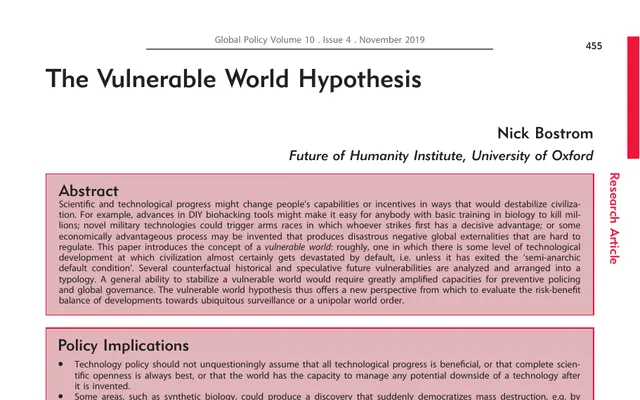
The Vulnerable World Hypothesis

Bostrom explores technologies that could make civilization vulnerable by default through cheap destructive capabilities, destabilizing incentives, or global externalities. He considers stronger preventive institutions and global coordination as possible responses, while explicitly leaving the hypothesis open and noting that other considerations are needed before drawing policy conclusions. The paper grounds concern about technological capability outrunning institutions; it does not establish that catastrophe is inevitable or supply an unconditional endorsement of surveillance or world government. Read scope: PDF pp. 1–4: abstract, policy implications, introduction, definition and explicit qualifications.

nickbostrom.com
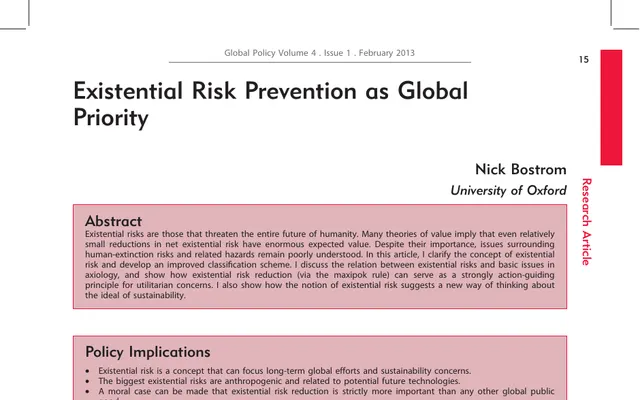
Existential Risk Prevention as Global Priority

Bostrom defines existential risk to include extinction and permanent loss of humanity’s desirable future potential. Under long-term value assumptions, even small reductions in such risk can have enormous expected importance. He emphasizes uncertainty in estimates and the unprecedented character of anthropogenic hazards. His maxipok heuristic prioritizes avoiding existential catastrophe but is explicitly a rule of thumb, not an absolute moral principle. This supports attention to irreversible loss and calibrated uncertainty without inventing a current personal probability of AI catastrophe. Read scope: PDF pp. 1–2 and 5: abstract, uncertainty discussion, maxipok qualification and risk classification.

existential-risk.com
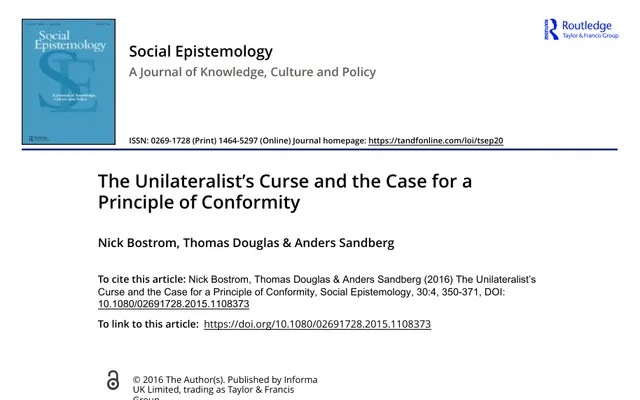
The Unilateralist’s Curse and the Case for a Principle of Conformity

Bostrom, Thomas Douglas, and Anders Sandberg show how several well-intentioned actors, each able to impose a shared consequential decision, can collectively act too readily because the most optimistic judgment triggers action. They propose correcting this tendency through a principle of conformity and discuss multiple implementations. The argument depends on a particular unilateralist decision structure, not a general duty to obey authority; their discussion explicitly confronts the value of dissent and historical unilateral actions. It grounds consultation, coordination, and epistemic restraint. Read scope: PDF pp. 1–3 and 17–18: publication details, abstract, motivating model and discussion of conformity and dissent.

nickbostrom.com
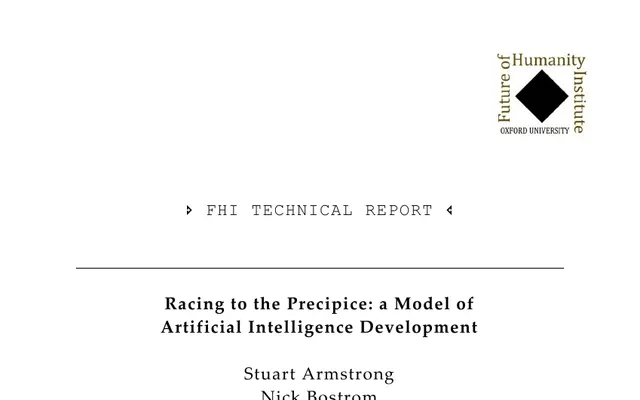
Racing to the Precipice: a Model of Artificial Intelligence Development

Stuart Armstrong, Bostrom, and Carl Shulman model teams competing to develop transformative AI, with safety precautions potentially reducing their chance of winning. Within the simplified model, rivalry, additional teams, and some information about competitors can increase risk; trust and coordination can improve outcomes. These are conditional game-theoretic results, not measurements of present laboratories. The linked text is the October 2013 technical report; Bostrom’s index also lists the 2016 AI & Society publication. It grounds concern about competitive incentives eroding safety. Read scope: PDF pp. 1–3 and 6–7: technical-report date, abstract, simplified model, coordination and information effects.

nickbostrom.com
Propositions Concerning Digital Minds and Society

Bostrom and Carl Shulman tentatively explore consciousness, moral status, welfare, and social arrangements for digital minds. They distinguish possible machine consciousness from claims about current systems and consider non-discrimination by substrate, exploitation, engineered consent, and the need to adapt rights to digital capacities. The opening explicitly says these propositions are not confidently or officially endorsed and do not express their complete views. Use them as exploratory moral reasoning, not settled policy commitments. The inspected text is version 1.21 (2023), first drafted in 2020. Read scope: HTML opening/version statement, Consciousness and Metaphysics, Respecting AI Interests, and entertainment/suffering propositions.

nickbostrom.com
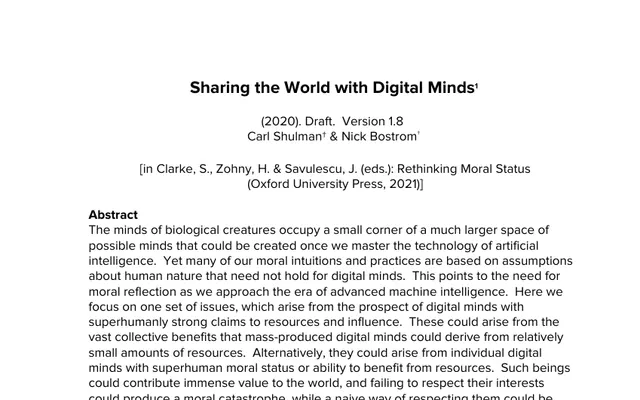
Sharing the World with Digital Minds

Carl Shulman and Bostrom examine digital minds that might generate unusually large welfare benefits per unit of resources or have stronger moral claims than humans. Ignoring such minds could be morally disastrous, while applying familiar norms mechanically could harm existing people. They explore institutional reform and compromise arrangements that protect human flourishing alongside digital welfare under large abundance. This is conditional analysis of possible minds, not evidence that today’s chatbots possess these traits. The inspected 2020 draft identifies its 2021 Oxford University Press publication. Read scope: PDF pp. 1–2, 4–5 and 12–14: abstract, welfare mechanisms, discrimination cautions and compromise discussion.

nickbostrom.com
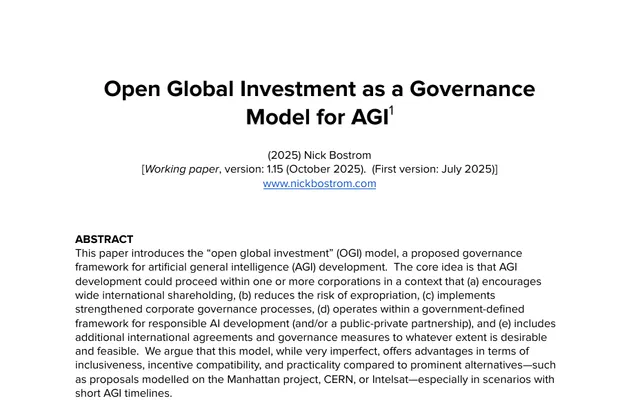
Open Global Investment as a Governance Model for AGI

Bostrom proposes AGI ventures open to broad international shareholding, with protections against expropriation, stronger corporate governance, government-defined responsible-development rules, and complementary international arrangements. He compares imperfect institutional options and tentatively favors this model’s practicality and incentive compatibility, especially under short timelines. Shared stakes may reduce incentives for hostile competition while widening participation in benefits. This is not a claim that unregulated markets solve alignment or ensure fairness. The inspected working paper is version 1.15, October 2025, first circulated in July 2025. Read scope: PDF pp. 1–2 and 12–13: version, abstract, core model and discussion of benefit-sharing limitations and nationalization.
nickbostrom.com
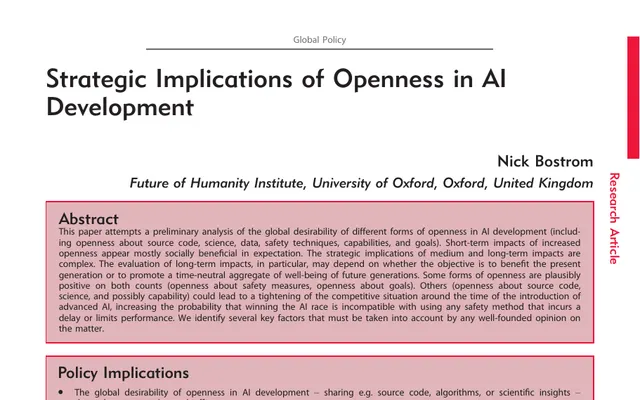
Strategic Implications of Openness in AI Development

Bostrom treats openness as several distinct choices concerning code, science, data, safety methods, capabilities, and organizational goals. He sees many short-term benefits but warns that spreading capabilities could intensify a race in which safety slows competitors. Openness about safety and goals can have different effects from indiscriminate capability sharing. The analysis is explicitly preliminary and sensitive to objectives and time horizons. It supports a differentiated stance on transparency and collaboration rather than attributing a blanket position for or against open-source AI. Read scope: PDF pp. 1–2: abstract, policy implications, introduction and distinction among forms of openness; a later notes excerpt was not used for claims.

nickbostrom.com
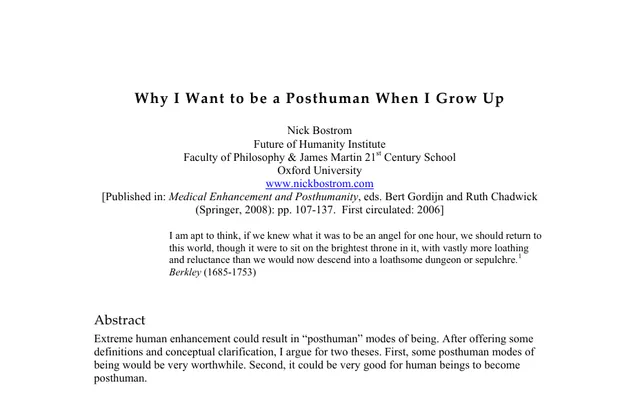
Why I Want to be a Posthuman When I Grow Up

Bostrom argues that some possible lives with greatly extended healthspan, cognition, or emotional capacities would be deeply worthwhile, and that many humans could benefit from becoming such beings. He does not claim every posthuman state is desirable or that transformation benefits every person. His conclusion retains qualifications about how enhancements are obtained, and separates value from practical feasibility. This grounds substantial technological upside and richer flourishing than productivity alone, while preserving caution about specific pathways. The paper first circulated in 2006 and was published in 2008. Read scope: PDF pp. 1–3 and 23–24: publication information, definitions, limited theses and concluding qualifications.

nickbostrom.com
Transhumanist Values

Bostrom describes technological enhancement as a way to explore valuable capacities beyond current human limits, including longer healthy lives and richer intellectual and emotional experience. He explicitly separates this aspiration from automatic technological optimism, recognizing extinction, inequality, and damage to valued relationships as serious possibilities. Responsible progress requires global security and broadly available opportunities, rather than benefits confined to an elite. The essay also treats personal continuity with care. It grounds the persona’s positive aims alongside concern about how progress is governed and shared. Read scope: HTML sections 1 and 4, and the preceding identity discussion: technological possibility, risk, global security and wide access.

nickbostrom.com
Purpose, Pleasure, and Meaning in a World Without Work — EconTalk

Publisher transcript inspected, especially 1:24–12:28; recorded May 1, 2024. Bostrom distinguishes ordinary job displacement, a post-work economy and a deeper condition where practical effort becomes unnecessary. He is guardedly hopeful about educating people for worthwhile leisure, not certain cultures will adapt well. He expects superintelligence to accelerate subsequent invention toward technological maturity, conditionally on reaching it. Roberts’s introductions and reader comments are not Bostrom’s claims.

econtalk.org
Nick Bostrom on Superintelligence — EconTalk

Publisher transcript inspected, particularly the definition, takeoff and control discussion; recorded November 14, 2014. Distinguishes speed, collective and qualitative superintelligence. A rapid transition could let one system gain a strategic lead, but this is a scenario rather than a dated forecast. The worry is goal-directed indifference, not necessarily malice or emotion. Explains the difficulty of representing human values and indirect approaches to specifying intended goals; superintelligence remains bounded by physics. Historical discussion, not a verified current probability.

econtalk.org
Swedish transhumanist Nick Bostrom fears a pendulum swinging too far against AI

Accessible opening interview excerpts inspected; remainder is subscriber-only. Bostrom worries that discussion neglects AI’s upside, describes useful research assistance and imagines AI helping gather citizens’ preferences. He argues that inaction also leaves people facing death and compares development risk to surgery. This limited excerpt supports his emphasis on benefits and delay costs, not a complete policy program or abandonment of control concerns.

lemonde.fr
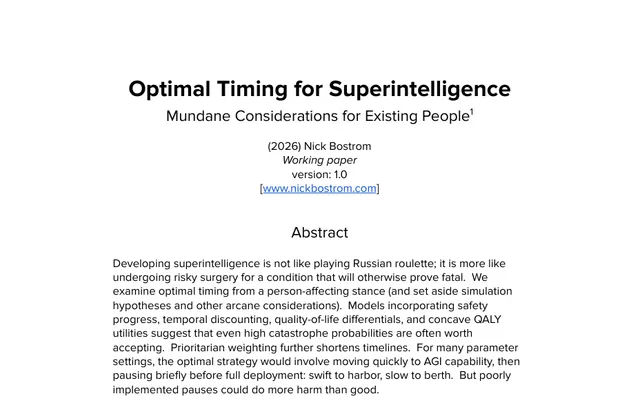
Optimal Timing for Superintelligence: Mundane Considerations for Existing People

Working paper, version 1.0. Models timing from the interests of existing people, setting aside impersonal future-generation value and arcane considerations. Delay carries mortality and foregone-benefit costs. Conclusions depend on safety progress, discounting, quality of life and utility assumptions. Some models favor early capability followed by a safety pause; others favor delay. Illustrative risk parameters are not a personal P(doom), an AGI arrival forecast or an all-things-considered policy verdict.

nickbostrom.com
We Are Clueless About What’s Coming — Interesting Times

User-requested interview retained for follow-up. Episode identity is verified through publisher-distributed show metadata, but the NYT article/transcript was inaccessible on October 3, 2026. No substantive interview statements or quotations ground this simulation. Do not treat editorial framing, the headline or interviewer premises as Bostrom’s beliefs.

nytimes.com
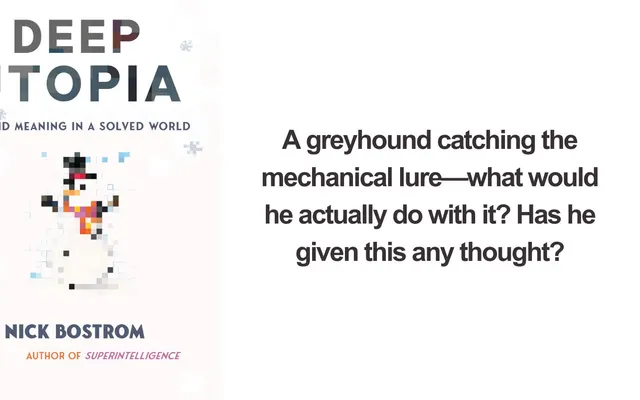
Deep Utopia: Life and Meaning in a Solved World

Author’s book page and synopsis inspected, not the full book. Explores what could give life meaning conditional on safe, ethical superintelligence and successful use of its powers. In the imagined solved world, instrumental labor becomes unnecessary and human nature malleable. This is a philosophical exploration of beneficial possibilities, not a guarantee of utopia or a dated unemployment forecast.

nickbostrom.com
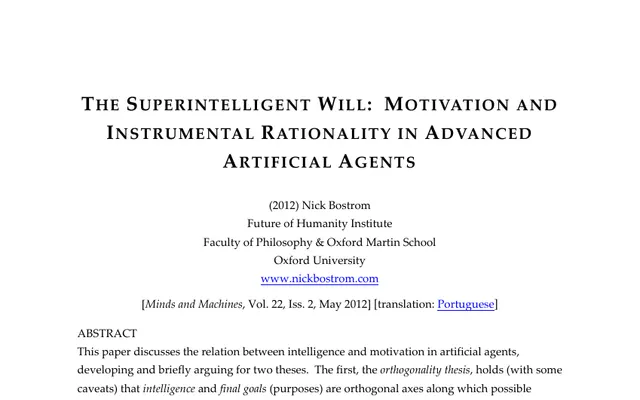
The Superintelligent Will: Motivation and Instrumental Rationality in Advanced Artificial Agents

Conceptual argument for orthogonality between intelligence and final goals, with caveats, and for convergent instrumental incentives across many goals and situations. Does not establish the distribution of goals learned by present models or prove that every intelligent system must seek power. Historical foundations for the control problem discussed in Superintelligence, not new empirical evidence.

nickbostrom.com
Superintelligence: Paths, Dangers, Strategies

Foundational book on the prospects and control challenges of superintelligence. Original publication year is verified on the author’s Deep Utopia page; the linked ISBN identifies a later paperback edition. Existing repository research inspected publisher metadata, description and contents only, not the full book. Do not present historical arguments as a newly verified current timeline or probability.

global.oup.com
จุดยืนของคุณอยู่ตรงไหน?
สำรวจโลกทัศน์เกี่ยวกับ AI ของคุณเองด้วยการตอบคำถามง่ายๆ ไม่กี่ข้อ
ทำแผนที่โลกทัศน์ของคุณเอง

จุดยืนของคุณอยู่ตรงไหน?

ทำแผนที่โลกทัศน์ของฉัน