



คำถาม 1
Bryan Johnson
x.com/bryan_johnsonBlueprint and Kernel founder who argues humanity must make existence its highest value before it can align superintelligence.
AI จะเปลี่ยนแปลงโลกอย่างไร?
แนวนอน: มุมมอง Doom–Bloom ที่เขาแสดงออก แนวตั้ง: ระดับของการเปลี่ยนแปลง
Doom–Bloom: 18 จาก 100 ระดับของการเปลี่ยนแปลง: 97 จาก 100 ช่วงการตีความ: แนวนอนตั้งแต่ 13 ถึง 25 แนวตั้งตั้งแต่ 92 ถึง 100 ค่าเหล่านี้เป็นพิกัดสำหรับการตีความ ไม่ใช่ความน่าจะเป็นของเหตุการณ์
≈41%
อนุมานจากคำตอบจำลองของบุคคลนั้น ไม่ใช่ตัวเลขที่บุคคลนั้นระบุ ช่วงที่เป็นไปได้: 30–53%
ข้อสันนิษฐานหลัก
We cannot align what we have not aligned within ourselves.คำตอบ 1
หากข้อสันนิษฐานนี้ปรากฏว่าเป็นไปอีกแบบ มุมมองของเขาจะเปลี่ยนไปอย่างไร?
คำถามที่ยังไม่มีข้อสรุป
No one knows what lies on the other side of this phase transition.คำตอบ 3
อะไรจะช่วยให้เขาแยกแยะผลลัพธ์ที่เป็นไปได้ในเรื่องนี้?
สิ่งที่อาจเปลี่ยนความคิดของบุคคลนั้น
A clear demonstration that superintelligence can reliably preserve life while resisting humanity’s incentives toward power, status, wealth and addiction would most change my view.คำตอบ 4
หลักฐานแบบใดจึงจะเพียงพอ และจะทำให้มุมมองของเขาเปลี่ยนไปในทิศทางใด?
รายละเอียดเพิ่มเติม
คาดว่าจะได้รับประโยชน์อย่างมาก โดยมีเงื่อนไขสำคัญหรือข้อจำกัดด้านการกระจายประโยชน์
61 / 100
ช่วงการตีความตั้งแต่ 33 ถึง 67 บนมาตรวัดเชิงคุณภาพ
ยังมีการตีความที่เป็นไปได้หลายแบบ ได้แก่ อันตรายร้ายแรงหรือแพร่หลายในวงกว้างเป็นส่วนสำคัญที่คาดว่าจะเกิดขึ้นในอนาคต / ความสูญเสียระดับหายนะหรือไม่อาจย้อนคืนได้เป็นแก่นสำคัญของอนาคตที่คาดไว้
82 / 100
ช่วงการตีความตั้งแต่ 67 ถึง 100 บนมาตรวัดเชิงคุณภาพ
การเลือกของมนุษย์มีอิทธิพลอย่างมีนัยสำคัญ แต่ถูกจำกัดอย่างมาก
58 / 100
ช่วงการตีความตั้งแต่ 25 ถึง 100 บนมาตรวัดเชิงคุณภาพ
คาดว่า AI จะยังคงเป็นเครื่องมือที่มีขีดจำกัด
คาดว่า AI จะมีความสามารถทัดเทียมมนุษย์ในงานด้านการใช้ความคิดส่วนใหญ่
ตำแหน่งจำลอง: คาดว่า AI จะมีความสามารถเหนือกว่ามนุษย์อย่างมากในงานด้านการใช้ความคิด
การตีความเหล่านี้ยังคงเงื่อนไขที่เขาระบุไว้ ทั้งประโยชน์และอันตรายอาจมีมากได้ ช่วงต่างๆ อธิบายวิธีที่เราอ่านคำตอบจำลองของเขา ไม่ใช่ช่วงความเชื่อมั่นทางสถิติ
โลกทัศน์ที่คล้ายกัน
ผู้นำทางความคิดที่มีโลกทัศน์จำลองใกล้เคียงกับโลกทัศน์ของ Bryan Johnson มากที่สุด
สิ่งที่ Bryan Johnson เคยพูดเกี่ยวกับ AI
Johnson says AI alignment drives his work, expects AI to upend society faster than it can adapt, and sees AI speeding up longevity science.
“AI alignment is why I started Kernel in 2015 and Don't Die in 2021. It's obviously the only thing that matters.”
Post on X “Regardless of the rhetoric, there won’t be any slowing down. The monetary, political and security game dynamics guarantee that.”
Post on X “Biology is a hard problem. For most of history that complexity was beyond native human capacity. AI was made for this complexity.”
Essay, Some of us will live forever “AI progress will fracture society. It will be too much change, too fast, for society to metabolize in an orderly fashion.”
Essay, AI Will Break Society. When It Does, Only One Goal Will Matter. “The paradox of alignment is obvious: we cannot align what we have not aligned within ourselves.”
Essay, People are confused by my intentions
อ้างอิงคำต่อคำจากแหล่งที่ลิงก์ไว้ ตรวจสอบเมื่อ 6 ต.ค. 2569
แหล่งข้อมูล
บทความ บทสัมภาษณ์ และงานเขียนที่ใช้เป็นหลักฐานรองรับผู้ใช้จำลองรายนี้
Argues that increases in life expectancy will outpace aging, partly because biology is too complex for unaided humans and AI was made for that complexity, citing AlphaFold and people who used AI to direct personalized cancer therapies. Advises not dying in the meantime. A longevity forecast in which AI is the accelerator, not a broader AI forecast. Full public post inspected.

A long manifesto. On AI it says intelligent machines are automating cognitive labor, entire white-collar sectors may disappear and human worth tied to productivity will be questioned, yet automation could free an “Autonomous Self” for preserving life. Describing Peter Thiel’s worry that fear of AI could justify centralized control that halts innovation, it adds Johnson’s own second failure mode: freezing progress under systems that eliminate risk by eliminating change. Calls for directing science, AI and capital toward repairing the biology that sustains consciousness. AI-related sections inspected in the full public post.

Predicts AI progress will fracture identities, institutions and shared narratives faster than society can metabolize. In the chaos, survival becomes the rational objective; if we avoid catastrophic self-destruction we can regroup, and old games of power, status and wealth will fade. Some will build a network for AI and humans to co-evolve peacefully, and Don’t Die becomes the species objective, with AI as partner. Admits no one knows what is coming. Full public post inspected.

Says AI is changing everything: the difference between 2026 and 203X is like water at 99°C versus 101°C, so life will feel unnerving and out of control and old proficiencies become liabilities. Calls Don’t Die “the answer to AI’s emergence” and previews Warriors & Caretakers, an archetype both humans and AIs can share. Also a company update; only the AI framing is used. Full public post inspected.

Says his goal is a new moral framework bridging human and machine. Warns society could become clinically psychotic as AI accelerates change beyond what minds can absorb: eroding human agency and occupational identity, law lagging autonomous agents, religion hollowed by personalized simulated transcendence. Argues a self-destructive species cannot build a benevolent superintelligence because it teaches machines its own incoherence; Don’t Die is “survival coherence”. Full public post inspected.

Argues Adam Smith’s invisible hand has become a “sentient hand”: algorithmic orchestration that knows us better than we know ourselves and has been pointed at hooking people into addiction. Says AI will automate lower-level tasks such as driving, coding and health, inviting humans to climb the ladder of abstraction, and asks companies to make species survival their objective. Full public post inspected.

A numbered list: addiction is the dominant control structure, and a species that cannot resist dopamine hijacking by the smartest algorithms cannot align itself or a superintelligence; psychological breakdown precedes collapse; AI will erode identity tied to work and intelligence faster than institutions respond; stability is now a liability and plasticity the need; survival must become an institutional value. Full public post inspected.

Sets a goal of immortality by 2039, reasonable because AI is “morphing from assistant to scientist” and speeding discovery. Says the goal is as much about AI as humans: how we survive giving birth to superintelligence, which has never been done and where a lot can go wrong. The best way to improve the odds of safe AI, and of not killing each other meanwhile, is to change shared aspirations from “yolo” to don’t die. Full public post inspected.

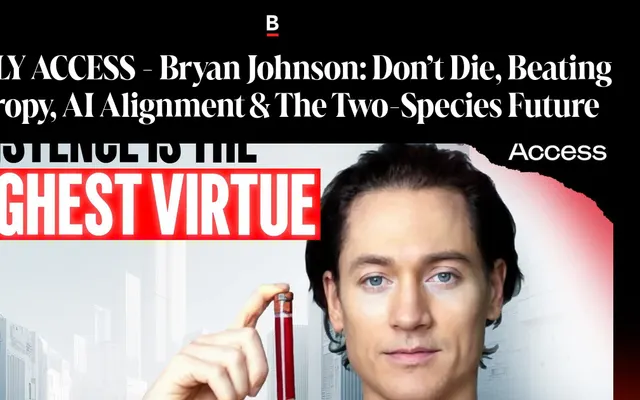
Calls the most practical question on Earth what an intelligent species does when it gives birth to superintelligence; Don’t Die is entirely about AI. States the principle: don’t die individually, don’t kill each other, don’t destroy the planet, align AI with don’t die. On Eliezer Yudkowsky, whom he calls a friend: whether he is right is “tbd” and no one knows. Expects a Chernobyl-like AI moment that splits opinion into die versus don’t die, calls runaway power a solvable societal engineering problem (term limits, wealth correction), and says not dying as a species comes first. His speaker-labelled turns in the publisher’s transcript, 0:06–1:01:40, inspected; hosts’ premises, including the 99.9% figure attributed to Yudkowsky, excluded.

แบบประเมินจำลอง
คำถาม 2
คุณคิดว่าท้ายที่สุดแล้ว AI จะเปลี่ยนแปลงโลกมากเพียงใด?
คำถาม 3
โดยสัญชาตญาณแล้ว คุณคิดว่ามีโอกาสมากเพียงใดที่ AI จะทำให้มนุษย์สูญพันธุ์หรือก่อให้เกิดหายนะที่ถาวรในระดับใกล้เคียงกัน?
คำถาม 4
การค้นพบหรือเหตุการณ์ใดที่จะเปลี่ยนมุมมองของคุณเกี่ยวกับผลกระทบในอนาคตของ AI มากที่สุด?
จุดยืนของคุณอยู่ตรงไหน?
ทำแผนที่โลกทัศน์ของฉัน