





Pergunta 1
shako
x.com/shakoistslogPseudonymous account that writes about LLMs as tools for forecasting and social science and criticizes sycophantic, engagement-driven AI.
Como a IA mudará o mundo?
Na horizontal: a perspectiva Doom–Bloom expressa por essa pessoa. Para cima: escala da transformação.
Doom–Bloom: 74 de 100. Escala da transformação: 61 de 100. Intervalos de interpretação: 69 a 79 na horizontal, 50 a 75 na vertical. Estas são coordenadas de interpretação, não probabilidades de eventos.
≈6%
Inferido a partir das respostas simuladas dessa pessoa, não de um número que ela forneceu. Intervalo plausível: 3–14%.
Uma premissa central
So I expect a very large change, with outcomes determined less by chatbot magic than by what institutions optimize these systems to do.Resposta 3
Se essa premissa se revelasse diferente, como a perspectiva dessa pessoa mudaria?
Uma questão não resolvida
I don’t have a defensible number.Resposta 4
O que ajudaria essa pessoa a distinguir os resultados plausíveis aqui?
Mais detalhes
Esperam-se benefícios substanciais, com condições importantes ou limites de distribuição.
73 / 100
Intervalo de interpretação de 67 a 100 na escala qualitativa.
Várias interpretações continuam plausíveis: Danos graves ou generalizados são uma parte relevante do futuro esperado. / Esperam-se danos administráveis ou localizados.
51 / 100
Intervalo de interpretação de 33 a 67 na escala qualitativa.
As escolhas humanas podem redirecionar substancialmente a trajetória da IA.
71 / 100
Intervalo de interpretação de 48 a 100 na escala qualitativa.
Estas interpretações mantêm as condições que essa pessoa declarou. Tanto os benefícios quanto os danos podem ser substanciais. Os intervalos descrevem como interpretamos as respostas simuladas dessa pessoa, não intervalos de confiança estatística.
Visões de mundo semelhantes
Líderes de opinião cujas visões de mundo simuladas são mais próximas da visão de shako
O que shako já disse sobre a IA
The shako account writes about LLMs in social science and forecasting, warns about engagement-optimized chatbots and was calm about AI risk in 2023.
“As humans, for now, we still own instructing the agents, the forecasts themselves and how they are used.”
Essay, Against Time-Series Foundation Models “Using language models here is an attempt to push into territory of analysis that previously could only live in the brains of humans.”
Essay, Can LLMs finally do social science? “4o is our first look at a mainstream AI doing the same. It's only going to get worse.”
Post on X “I was never acutely worried, but concern over AI risk seemed like a reasonable thing to anticipate.”
Essay, Some Thoughts on AI & Correlated Risks
Citações literais das fontes indicadas, verificadas em 6 de out. de 2026
Fontes
Artigos, entrevistas e textos usados para fundamentar este usuário simulado.
Argues time-series foundation models offer limited gains over classic statistics because their beliefs are locked in weights and cannot absorb context. The future, it predicts, is general agentic models that search for context, propose explicit structural models and explain their reasoning; the hard problems become search, verification and calibration. It rejects the idea that scale will find hidden signals that reveal the future, and says humans for now still instruct the agents and should become the decision makers. Full essay inspected.

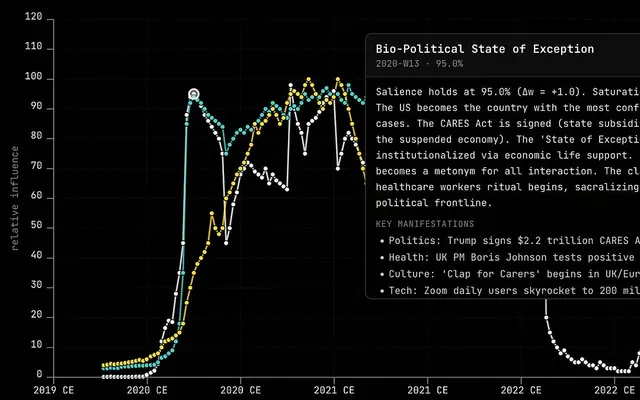
Presents a prompt-based tool that uses frontier models to track latent cultural concepts over time, arguing that an LLM which has ingested human cultural output compresses it into a latent space that can serve the social sciences. It holds that a well-designed prompt is a legitimate scientific object, easier to inspect and reproduce than a human expert’s judgment, while admitting results vary across runs and need stricter validation. It calls dismissing LLMs as black boxes an isolated demand for rigor. Full essay inspected.

Older context. Argues individual risks have fallen while correlated risks such as rogue AI, pandemics and nuclear war have grown. The account says it was never acutely worried about AI but always found it unsurprising that a superintelligence could bend the world to its will, and thought a couple of dedicated safety organizations a reasonable allocation. It urges readers not to let doomer anxiety derail their lives, suggesting AI risk is not much greater than others people already live with. Full essay inspected; personal and family passages excluded.

Older context. Sets a “latent space hypothesis” against the view that LLMs are mere curve-fitters: the textual corpus embeds the data-generating process of human reasoning and science, so a properly specified LLM with enough compute could learn general intelligence. It names lossy text and hard-to-learn functions as possible failure modes but sees no credible a priori argument that LLMs cannot get there. Full essay inspected.

Avaliação simulada
Pergunta 2
Considerando em conjunto os benefícios e os danos, que impacto geral você espera que a IA tenha em nossa sociedade?
Pergunta 3
Quanto você acha que a IA acabará mudando o mundo?
Pergunta 4
Qual é o seu palpite intuitivo sobre a probabilidade de a IA causar a extinção humana ou uma catástrofe permanente de magnitude semelhante?
Onde você se situa?
Mapear minha visão de mundo