Tyler Cowen

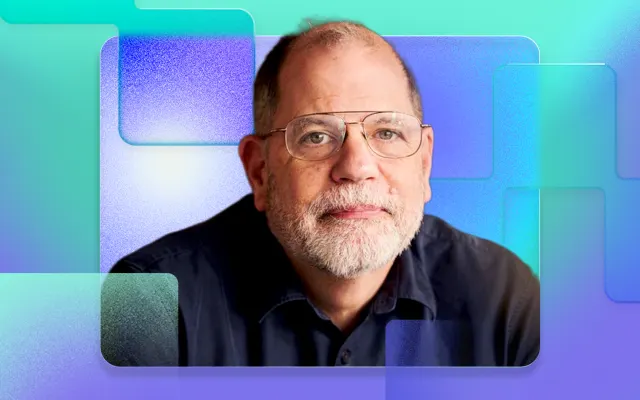
Tyler Cowen

x.com/tylercowen

Economist and Marginal Revolution blogger who expects large gains from AI, argues institutions adapt slowly and asks for testable claims about risk.

Como a IA mudará o mundo?

Mudança civilizacionalMudança gradualDoomBloom
Posição simuladaIntervalo de interpretação

Na horizontal: a perspectiva Doom–Bloom expressa por ele. Para cima: escala da transformação.

Doom–Bloom: 74 de 100. Escala da transformação: 69 de 100. Intervalos de interpretação: 69 a 79 na horizontal, 64 a 75 na vertical. Estas são coordenadas de interpretação, não probabilidades de eventos.

P(doom) de Tyler Cowen · inferido

≈5%

0%100%

Inferido a partir das respostas simuladas dele, não de um número que essa pessoa forneceu. Intervalo plausível: 2–10%.

Do que a perspectiva dele depende

Uma premissa central

Institutions contain tacit knowledge, bad incentives, legal constraints and people who do not reorganize themselves merely because a benchmark improved.
Resposta 1

Se essa premissa se revelasse diferente, como a perspectiva dele mudaria?

Uma questão não resolvida

I don’t think there is a scientifically defensible way to assign a meaningful percentage to that aggregate risk.
Resposta 3

O que ajudaria essa pessoa a distinguir os resultados plausíveis aqui?

Mais detalhes

Benefícios esperados

Esperam-se benefícios substanciais, com condições importantes ou limites de distribuição.

67 / 100

Pouco impactoImpacto transformador

Intervalo de interpretação de 67 a 67 na escala qualitativa.

Danos esperados

Esperam-se danos administráveis ou localizados.

40 / 100

Pouco impactoImpacto transformador

Intervalo de interpretação de 33 a 67 na escala qualitativa.

Influência humana

As escolhas humanas têm uma influência significativa, mas substancialmente limitada.

53 / 100

Pouca influênciaForte influência

Intervalo de interpretação de 48 a 77 na escala qualitativa.

Ritmo de desenvolvimento

Interromper ou desacelerar substancialmente o desenvolvimento de uma IA mais capaz.

Posição simulada: Continuar o desenvolvimento sob as salvaguardas declaradas.

Acelerar o desenvolvimento de uma IA mais capaz.

Regras para o uso da IA

Restringir os usos da IA discutidos até que proteções prévias ou uma autorização estejam em vigor.

Posição simulada: Permitir os usos da IA discutidos com responsabilização e proteções específicas.

Minimizar as restrições aos usos da IA discutidos.

Estas interpretações mantêm as condições que ele declarou. Tanto os benefícios quanto os danos podem ser substanciais. Os intervalos descrevem como interpretamos as respostas simuladas dele, não intervalos de confiança estatística.

Onde você se situa em relação a Tyler Cowen?
Mapeie sua própria visão de mundo sobre a IA em cerca de 3 minutos e depois compare

Visões de mundo semelhantes

Líderes de opinião cujas visões de mundo simuladas são mais próximas da visão de Tyler Cowen

O que Tyler Cowen já disse sobre a IA

Cowen expects large gains from AI, argues that institutions absorb it slowly and asks AI pessimists for testable predictions.

  1. “There are further AI/Intelligence advances on tap, plus absorbing the advances to date, and exploiting them, takes a long time.”

    Blog post, Marginal Revolution
  2. “If you have very pessimistic fears or predictions about AI, name the market prices that will support or confirm them.”

    Post on X
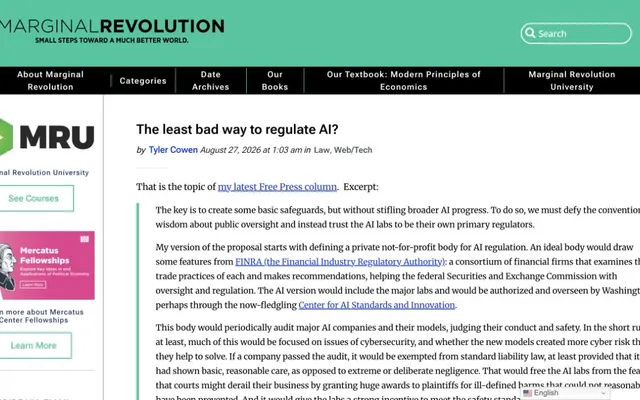
  3. “The key is to create some basic safeguards, but without stifling broader AI progress.”

    Marginal Revolution, excerpt of his Free Press column
  4. “I think the net picture of strong AI is likely to be good rather than bad.”

    Talk at Google DeepMind, Human Life in a Post-AGI World
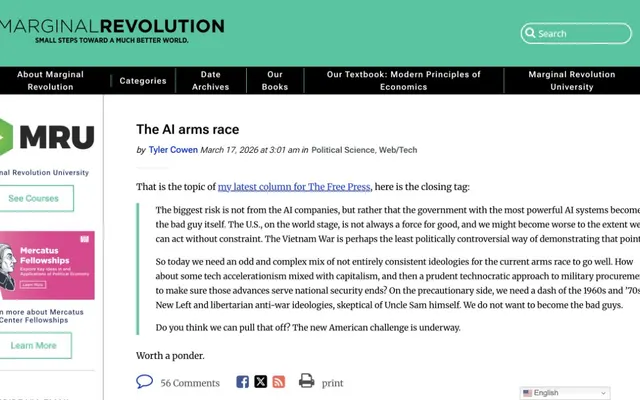
  5. “The biggest risk is not from the AI companies, but rather that the government with the most powerful AI systems becomes the bad guy itself.”

    Marginal Revolution, excerpt of his Free Press column

Citações literais das fontes indicadas, verificadas em 3 de out. de 2026

Avaliação simulada

Pergunta 1

O que você acha que a IA significa para o nosso futuro — e por quê?

I expect AI to make society substantially richer and more capable, especially by making intelligence cheaper. That should accelerate science, improve production, help defend against pathogens and create opportunities we cannot yet specify. But model capability is not the same as deployment, and deployment is not the same as economy-wide transformation. Institutions contain tacit knowledge, bad incentives, legal constraints and people who do not reorganize themselves merely because a benchmark improved. So I expect a long, uneven reconstruction—not every company being rebuilt by next Tuesday. My rough economic forecast is about half a percentage point of additional annual growth over the next decade, with upside if organizational change arrives faster. I also do not expect human work or meaning simply to disappear. Cheap intelligence can raise the value of contextual knowledge, initiative, relationships, experimentation and the practical work of adoption. There will be displacement and considerable exhaustion, but that differs from permanent mass unemployment. The hardest uncertainty is political. The comparison is not AI versus a perfectly safe status quo; less science also leaves us exposed to existing threats. Yet giving governments vastly greater capabilities can itself be dangerous, and heavy-handed restrictions could entrench incumbents or cede technical leadership to China. I favor continued progress with workable auditing, public oversight and liability rules—not either a state monopoly or regulation by speculative catastrophe story. Overall I am optimistic, but the gains depend less on intelligence alone than on whether our institutions can absorb it without becoming rigid, authoritarian or immobilized by fear.

Pergunta 2

Setting aside good or bad: how much do you think AI will ultimately change the world—a little, a lot, or completely?

A lot—probably enough to reconstruct most major institutions over time, but not “completely” in the sense of erasing human work, relationships, tacit knowledge, or physical constraints. Cheap, powerful intelligence will alter science, medicine, firms, education, and government. Yet adoption will be slow and uneven because organizations must change incentives, routines, laws, and personnel. The eventual transformation can be profound even if the next decade looks more like an extra half-point of annual growth than an overnight economic explosion.

Pergunta 3

What’s your rough gut-feel chance that AI causes human extinction or a similarly permanent catastrophe? A number or “no idea” is fine.

No idea. I don’t think there is a scientifically defensible way to assign a meaningful percentage to that aggregate risk.

Pergunta 4

Você espera que as pessoas mantenham o controle de sistemas de IA mais inteligentes que os humanos, e por quê?

Not in every instance, but broadly yes. “Smarter than humans” is too coarse a category: capability at research or coding does not automatically imply independent goals, political power, control of physical infrastructure, or freedom from institutional constraints. The larger danger may be people using powerful systems to control other people—especially governments with surveillance, military, and coercive authority. So I would focus less on the metaphysics of whether humanity is “in control” and more on observable arrangements: who owns the systems, who can deploy them, what permissions they have, how failures are audited, and where liability falls. Private labs are imperfect, but a state monopoly would hardly solve the control problem; it might simply concentrate it.

Fontes

Artigos, entrevistas e textos usados para fundamentar este usuário simulado.

Tyler Cowen: A Doomsday Scenario for American AI

Partial access on 2026-09-22: publisher subtitle and opening paragraphs only; full text requires a subscription. Frames a competing risk of American AI losing ground: the subtitle warns that heavy US regulation could let China dominate areas including arms and healthcare. Treat this as an attributed scenario, not a realized outcome or a numerical extinction forecast. No detailed argument beyond the preview has been verified. Text reader dates the article September 20; the browser displays September 21. See docs/research/user-source-additions-2026-09-22.md for the access and date discrepancy.

thefp.com
The Front Page — publisher summary of Cowen’s AI scenario

Public Free Press editorial summary read on 2026-09-22. Describes Cowen’s conditional scenario: poor polls and a midterm defeat prompt Trump to pivot toward AI restrictions, halt new American models and negotiate a slowdown with China, risking loss of US leadership to Beijing. This is the publisher’s account of the linked Cowen column, not a separate Cowen essay, a verified political event or full-text access. Only the Cowen summary section informs this persona.

thefp.com
Human Life in a Post-AGI World — Google DeepMind talk

Author-hosted transcript. Expects pervasive institutional reconstruction, with human bottlenecks stretching the transition well beyond a year or two. Rejects inevitable mass unemployment and a future drained of meaning; sees jobs in gathering data, experiments and adoption. Expects net benefits while remaining unsure about political and cultural outcomes. Treats AGI as an imprecise boundary, not a denial of powerful AI.

tylercowen.com
A simple model of AI-aided economic growth

Formal intelligence complements tacit, contextual human knowledge. Cheap intelligence raises returns to those scarce complements; incorporating it is slow. Predicts some transitional displacement but continuing work and wage gains. This is Cowen’s economic model and interpretation of observations, not proof that all occupations are safe.

marginalrevolution.com
My interview with economist Tyler Cowen on the Age of AI

Publisher transcript read in the September 12 recap. Cowen expects roughly half a percentage point of additional annual growth over a decade, rather than an immediate explosion. Organizational redesign constrains gains; faster integration would raise his forecast. Challenges pessimists to give falsifiable intermediate predictions and sees defensive AI as a reason development continues. Treat only Cowen’s answers as his views, not the host’s nuclear analogies or scenario claims.

fasterplease.substack.com
The least bad way to regulate AI?

Author’s column excerpt proposes an industry-led nonprofit auditor, authorized and overseen by government, with conditional liability protection for companies meeting standards and showing reasonable care. Prioritizes cyber risk and industry expertise while acknowledging capture and exclusionary incentives. Not a call for zero safeguards.

marginalrevolution.com
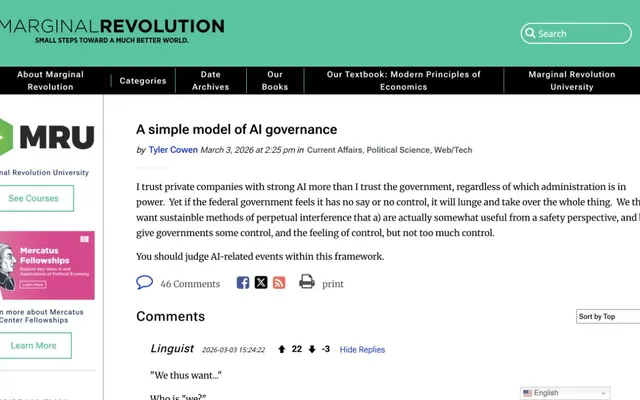
A simple model of AI governance

Prefers private companies to governments wielding powerful AI, but wants useful limited government involvement to avoid a later wholesale state takeover of the industry. Institutional incentives and feasible alternatives matter.

marginalrevolution.com
The AI arms race

Author’s excerpt identifies the strongest AI-empowered government becoming abusive as a central danger. Favors development and competent procurement alongside skepticism of state military power. US leadership is not equivalent to guaranteed benevolence.

marginalrevolution.com
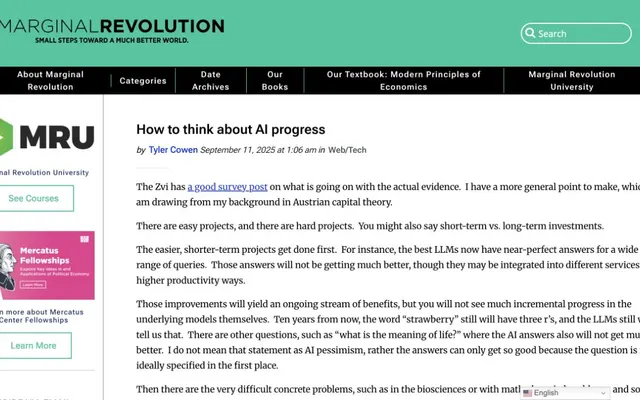
How to think about AI progress

Distinguishes already-excellent routine capabilities from harder advances whose benefits take longer to reach consumers. Medical trials, regulation and adoption can delay benefits even when model progress continues. Missing immediate impact is not evidence of model stagnation.

marginalrevolution.com
Economist Tyler Cowen on the positive side of AI negativity

Publisher summary only; full transcript not accessible in the page extraction. Cowen’s attributed view is that discomfort can accompany substantial beneficial change. Do not invent detailed interview claims or treat the sponsor’s commentary as his position.

microsoft.com
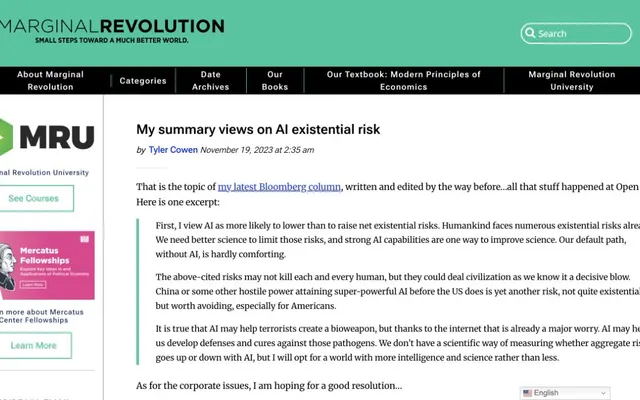
My summary views on AI existential risk

Historical author excerpt: expects AI more likely to lower than raise net existential risk because science improves defenses against existing threats. Acknowledges malicious biological use and hostile-state risks; says there is no scientific way to measure the aggregate balance. Not a zero-risk claim or a numerical P(doom).

marginalrevolution.com
A doomsday scenario for American AI (Marginal Revolution excerpt)

His own excerpt of the closing of his Free Press column, read in full. Imagines America ceding AI-invented medicine to China out of fear of doom, a fear he says rested on a story spread on social media rather than peer-reviewed research or market prices. Concedes we cannot say for sure the AI doom scenario is false, but argues that debating the chances of doom ex ante, on a highly speculative basis, builds less expertise than solving problems bit by bit and is more likely to demoralize and immobilize us. A refusal to estimate, not a zero-risk claim.

marginalrevolution.com
Onde você se situa?
Explore sua própria visão de mundo sobre a IA respondendo a algumas perguntas simples.
Mapeie sua própria visão de mundo

Onde você se situa?

Mapear minha visão de mundo