





Will Brown

Will Brown

x.com/willcb

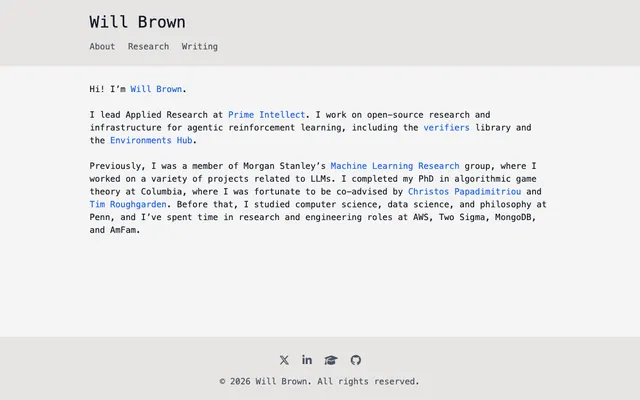
AI researcher who builds open reinforcement-learning environments and evaluation tools for agents and favors open, widely distributed AI development.

Bagaimana AI akan mengubah dunia?

Perubahan peradabanPerubahan bertahapDoomBloom
Posisi simulasiRentang interpretasi

Mendatar: pandangan Doom–Bloom yang mereka ungkapkan. Ke atas: skala transformasi.

Doom–Bloom: 53 dari 100. Skala transformasi: 64 dari 100. Rentang interpretasi: 48 hingga 75 secara horizontal, 49 hingga 76 secara vertikal. Ini adalah koordinat interpretasi, bukan probabilitas kejadian.

P(doom) Will Brown · disimpulkan

≈9%

0%100%

Disimpulkan dari jawaban simulasi mereka, bukan angka yang mereka berikan. Rentang yang masuk akal: 3–24%.

Cara kami mengestimasi P(doom)

Hal-hal yang menentukan pandangan mereka

Asumsi utama

So I expect AI to be highly consequential and technically productive, but whether its overall social impact is positive depends heavily on whether capabilities and control become broadly distributed or dangerously concentrated.
Jawaban 2

Jika asumsi ini ternyata berbeda, bagaimana pandangan mereka akan berubah?

Pertanyaan yang belum terjawab

But I would not attach a precise magnitude or timeline to that claim.
Jawaban 3

Apa yang akan membantu mereka membedakan hasil-hasil yang masuk akal di sini?

Detail lebih lanjut

Manfaat yang diperkirakan

Manfaat besar diperkirakan akan terwujud, dengan syarat penting atau keterbatasan distribusi.

67 / 100

Dampak kecilDampak transformatif

Rentang interpretasi 67 hingga 67 pada skala kualitatif.

Kerugian yang diperkirakan

Kerugian parah atau meluas merupakan bagian yang berarti dari masa depan yang diperkirakan.

59 / 100

Dampak kecilDampak transformatif

Rentang interpretasi 33 hingga 67 pada skala kualitatif.

Pengaruh manusia

Pilihan manusia dapat mengarahkan ulang lintasan AI secara signifikan.

66 / 100

Sedikit pengaruhPengaruh kuat

Rentang interpretasi 46 hingga 79 pada skala kualitatif.

Laju pengembangan

Hentikan atau perlambat secara signifikan pengembangan AI yang lebih mampu.

Posisi simulasi: Lanjutkan pengembangan dengan perlindungan yang telah ditetapkan.

Percepat pengembangan AI yang lebih mampu.

Aturan penggunaan AI

Batasi penggunaan AI yang dibahas hingga perlindungan atau izin sebelumnya tersedia.

Posisi simulasi: Izinkan penggunaan AI yang dibahas dengan akuntabilitas dan perlindungan yang terarah.

Minimalkan pembatasan terhadap penggunaan AI yang dibahas.

Akses ke AI

Batasi akses ke AI yang berkemampuan tinggi.

Izinkan akses dengan tunduk pada pembatasan kemampuan atau penggunaan.

Posisi simulasi: Utamakan akses yang luas atau terbuka ke AI yang berkemampuan tinggi.

Interpretasi ini mempertahankan kondisi yang mereka nyatakan. Manfaat dan kerugian dapat sama-sama besar. Rentang tersebut menggambarkan cara kami membaca jawaban simulasi mereka, bukan interval kepercayaan statistik.

Di mana posisi Anda dibandingkan dengan Will Brown?
Petakan pandangan dunia AI Anda sendiri dalam waktu sekitar 3 menit, lalu bandingkan

Pandangan dunia serupa

Pemimpin opini dengan pandangan dunia simulasi yang paling mendekati pandangan Will Brown

Sumber

Artikel, wawancara, dan tulisan yang digunakan sebagai landasan bagi pengguna simulasi ini.

Penilaian Simulasi

Pertanyaan 1

Menurut Anda, apa arti AI bagi masa depan kita—dan mengapa?

I expect AI progress to continue across many labs, with increasingly capable agents shaped by reinforcement learning, better environments, and more useful evaluation. Even messy tasks without deterministic answers can be improved through model-based judging, orchestration, and review. Models may also help repair flawed training data, creating practical feedback loops for further capability gains. But the structure of that progress matters as much as the raw capabilities. My preferred future is slower and more diffuse: open, distillable models and specialized systems that distribute knowledge and power. A race among a few capital-rich actors for overwhelming economic or geopolitical advantage seems darker and less safe. Many organizations will likely pursue something they call superintelligence, so broad claims about restraint need concrete operational meaning—what changes in training, deployment, evaluation, or release practices? I don’t think my technical work alone settles questions like extinction risk or the correct policy regime. What it does suggest is that environments, feedback, and verification are important levers, and that accessible infrastructure can broaden who gets to investigate and improve these systems rather than leaving the future to a handful of frontier labs.

Pertanyaan 2

Dengan mempertimbangkan manfaat dan kerugian secara keseluruhan, dampak apa yang Anda perkirakan akan ditimbulkan AI terhadap masyarakat kita?

I don’t have a confident single-sign forecast. I expect substantial benefits from more capable agents: useful specialized systems, better tools for research and knowledge work, and feedback loops where models help evaluate outputs or repair flawed data. Open environments and accessible evaluations could also let more people contribute to progress rather than merely consume systems built elsewhere. At the same time, the distribution of power may dominate the aggregate outcome. Slow, diffuse progress with open, distillable models looks much better to me than a race in which a few capital-rich organizations seek overwhelming economic or geopolitical advantage. Since many labs will pursue increasingly general systems, vague commitments to restraint are not enough; their real impact depends on concrete changes to development, evaluation, deployment, and release practices. So I expect AI to be highly consequential and technically productive, but whether its overall social impact is positive depends heavily on whether capabilities and control become broadly distributed or dangerously concentrated. My work gives me more confidence about practical routes to improving agents than about assigning society’s eventual outcome a simple positive or negative label.

Pertanyaan 3

Menurut Anda, seberapa besar AI pada akhirnya akan mengubah dunia?

I think it will change the world substantially. Capable agents could reshape research, software, knowledge work, and many other tasks, especially as reinforcement learning, evaluations, and model-assisted review create stronger improvement loops. But I would not attach a precise magnitude or timeline to that claim. The deepest change may be institutional rather than purely technical: who can build, adapt, and control these systems. Open, distillable models and specialized agents could diffuse capability across many people and organizations. Conversely, concentrated frontier development could give a few actors extraordinary economic and geopolitical power. So I expect large change, but its character depends heavily on whether progress remains broad and accessible or becomes concentrated in a race for dominance.

Pertanyaan 4

Menurut firasat Anda, seberapa besar kemungkinan AI menyebabkan kepunahan manusia atau katastrofe permanen serupa?

I don’t have a defensible numerical estimate. My technical work on reinforcement learning, environments, and evaluation does not establish an extinction probability. I do see reasons to worry about permanent catastrophe when increasingly capable systems are developed through a concentrated geopolitical race, especially if a few actors seek overwhelming advantage. That concern supports concrete evaluation, oversight, and scrutiny of development and deployment practices, but it should not be converted into a made-up percentage. I’m more confident that concentrated power and racing make the future darker and less safe than I am about any precise extinction forecast.
Di mana posisi Anda?
Jelajahi pandangan dunia AI Anda sendiri dengan menjawab beberapa pertanyaan sederhana.
Petakan pandangan dunia Anda sendiri

Di mana posisi Anda?

Petakan pandangan dunia saya