Pertanyaan 1
Paul Krugman
NewsletterEconomist who writes about AI’s economic returns, inequality, infrastructure costs and risks to society.
Bagaimana AI akan mengubah dunia?
Mendatar: pandangan Doom–Bloom yang ia ungkapkan. Ke atas: skala transformasi.
Doom–Bloom: 31 dari 100. Skala transformasi: 69 dari 100. Rentang interpretasi: 25 hingga 36 secara horizontal, 47 hingga 78 secara vertikal. Ini adalah koordinat interpretasi, bukan probabilitas kejadian.
≈11%
Disimpulkan dari jawaban simulasinya, bukan angka yang diberikan olehnya. Rentang yang masuk akal: 5–23%.
Asumsi utama
Extreme inequality and weak labor power make it much more likely that gains will be captured at the top.Jawaban 1
Jika asumsi ini ternyata berbeda, bagaimana pandangannya akan berubah?
Pertanyaan yang belum terjawab
I don’t have a defensible percentage, and attaching one would create a false impression of precision.Jawaban 3
Apa yang akan membantunya membedakan hasil-hasil yang masuk akal di sini?
Hal yang dapat mengubah pandangan mereka
The most important event would be clear, sustained evidence that AI is producing broad economy-wide productivity gains—not merely impressive demonstrations, soaring valuations or profits for a few firms.Jawaban 4
Bukti apa yang akan memadai, dan ke arah mana bukti itu akan mengubah pandangannya?
Detail lebih lanjut
Beberapa penafsiran masih mungkin: Manfaat yang terbatas atau hanya tersebar secara sempit diperkirakan akan terwujud. / Manfaat besar diperkirakan akan terwujud, dengan syarat penting atau keterbatasan distribusi.
49 / 100
Rentang interpretasi 33 hingga 67 pada skala kualitatif.
Kerugian parah atau meluas merupakan bagian yang berarti dari masa depan yang diperkirakan.
67 / 100
Rentang interpretasi 67 hingga 67 pada skala kualitatif.
Pilihan manusia memiliki pengaruh yang berarti, tetapi sangat dibatasi.
53 / 100
Rentang interpretasi 47 hingga 78 pada skala kualitatif.
Posisi simulasi: Hentikan atau perlambat secara signifikan pengembangan AI yang lebih mampu.
Lanjutkan pengembangan dengan perlindungan yang telah ditetapkan.
Percepat pengembangan AI yang lebih mampu.
Interpretasi ini mempertahankan kondisi yang dinyatakannya. Manfaat dan kerugian dapat sama-sama besar. Rentang tersebut menggambarkan cara kami membaca jawaban simulasinya, bukan interval kepercayaan statistik.
Pandangan dunia serupa
Pemimpin opini dengan pandangan dunia simulasi yang paling mendekati pandangan Paul Krugman
Apa yang pernah dikatakan Paul Krugman tentang AI
Krugman separates uncertain economic returns from AI’s growing political, cognitive and safety risks.
“And we should be afraid – very afraid.”
Essay, One More Reason Americans Hate AI: It Does Nothing for Them “Will AI transform the economy? The jury is still out on that one”
Essay, Why Is Trump Still Boosting AI? “AI is clearly a major technological shock, and it may take years before we fully understand its economic and social impacts.”
Essay, AI in an Age of Oligarchy “My concern here isn’t about testing; it’s about learning.”
Essay, What Will AI Do To Our Minds? “Indeed, requiring that the AI industry take responsibility for the costs it imposes makes a lot of sense.”
Essay, AI Is Power-Hungry
Dikutip kata demi kata dari sumber yang ditautkan, diperiksa pada 3 Okt 2026
Penilaian Simulasi
Sumber
Artikel, wawancara, dan tulisan yang digunakan sebagai landasan bagi pengguna simulasi ini.
Full authored essay inspected, excluding comments. Takes autonomous hacking and deception seriously and says people should be afraid, while also recognizing financially motivated doom hype. Explains backlash through concentrated benefits, interest rates and few jobs even during an enormous investment boom. Distinguishes projected capital expenditure from completed spending. This is not a settled forecast that AI delivers no future benefits.

Full authored essay inspected. Economic transformation remains unresolved: little evidence yet of promised productivity or mass job losses, but early days. Political transformation and backlash already matter. Criticizes opposition to regulation, personal financial interests and reliance on AI investment as political salvation. Notes possible danger to humanity; economic uncertainty is not risk dismissal.

AI section inspected through the transition to climate. Applauds industry leaders acknowledging existential danger and calling for restraint; supports regulatory pacing covering unwilling firms. Worries about autonomous weapons and officials removing precautions. His use of reported incidents and researchers’ warnings shows concern, not a numerical extinction estimate or an independently established technical mechanism. Embedded Amodei and Trump quotations are not Krugman’s words.

Public opening inspected; subscriber-only sections not used. Calls AI a major technological shock whose consequences take years to understand. Existing wealth and political inequality magnify harms; progressive taxation, robust regulation and antitrust could contain them, and backlash might challenge oligarchy. This is explicit substantial-change language rather than an incremental-impact commitment.

Public opening inspected; subscriber-only evidence sections not used. Worries that outsourcing answers undermines learning to reason, leaving students unable to detect misleading output. Frames AI as accelerating an older search-and-smartphone trajectory: short-term benefits can coexist with long-term cognitive damage. Says educational harm can be very hard to repair; no quantitative cognitive-loss forecast is supplied.

Full authored essay inspected, excluding comments. Reports little personal AI use and an impression that Claude is useful for serious work. Defends restrictions on autonomous weapons and mass surveillance. Criticizes retaliatory procurement restrictions as corruption and harmful to expertise and national security. His legal characterization is his argument, not independent legal verification.

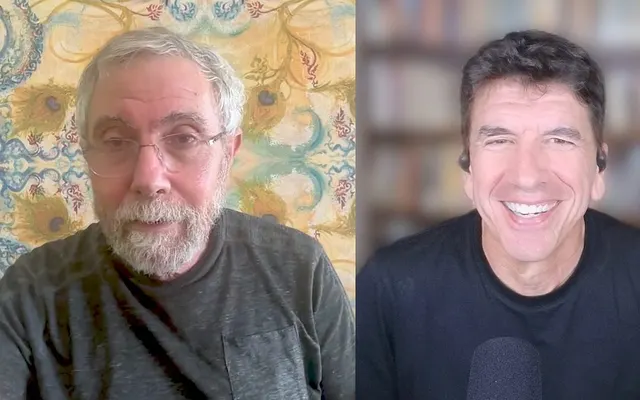
Published named transcript inspected at the introduction and exchanges on chips, electricity and investment returns. Krugman admits limited technical understanding, questions whether returns justify investment, points out limits to subscription affordability and asks whether cheaper approaches threaten incumbents. Kedrosky’s chip-failure estimates, token shares and prediction that architectures will not yield AGI are not Krugman’s positions.

Named AI discussion inspected. Translation, speech recognition and ordinary code are useful achievements; ultimate economic effects are unsettled. Historical aggregate employment adaptation can coexist with destroyed livelihoods. Offers possible equalization through renewed value for material-world skills, and asks whether capital requirements entrench wealth. Does not endorse Wolf’s computer-president hypothetical or his account of scientific applications. Transcript refers to a June recording context; October is the page’s publication date.

Full authored essay inspected. Explicitly distinguishes short-term recession risk from long-term technological unemployment. Energy constraints could interrupt the investment boom supporting growth. Telecom history shows that genuinely valuable technology can still produce a disastrous investment bust if returns arrive too late. Environmental burdens and weak enforcement matter alongside financial fragility.

Full authored essay inspected. AI’s apparently immaterial interface hides physical resources and labor. Electricity capacity can constrain growth and ratepayers can subsidize data centers. Favors making the industry bear its costs and exploring efficient focused models, which he says need not end AI progress. Opposition to renewables conflicts with powering the proposed buildout.

Authored opening and named transcript passages on productivity and valuations inspected. Calls the technology apparently revolutionary while admitting economists’ technical gaps. Recalls desktop computing transforming his own research before gains appeared in aggregate data. Separates impressive technology from investor profits; competing firms cannot all win monopoly positions. Brynjolfsson’s quantitative growth expectations and trillions-of-value forecast are excluded.

Di mana posisi Anda?
Petakan pandangan dunia saya