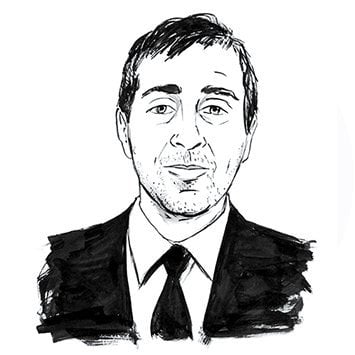
Software engineer and UML co-creator who finds LLMs useful but unreliable and worries about corporate power and present harms, not superintelligence.

Bagaimana AI akan mengubah dunia?

Perubahan peradabanPerubahan bertahapDoomBloom
Posisi simulasiRentang interpretasi

Mendatar: pandangan Doom–Bloom yang ia ungkapkan. Ke atas: skala transformasi.

Doom–Bloom: 65 dari 100. Skala transformasi: 63 dari 100. Rentang interpretasi: 50 hingga 75 secara horizontal, 50 hingga 75 secara vertikal. Ini adalah koordinat interpretasi, bukan probabilitas kejadian.

P(doom) yang dinyatakan Grady Booch

≈0%

0%100%
“My p(doom) remains asymptotically close to zero.”

Not defined in the post; its context is humanity’s destruction by dangerous superintelligent AI

My p(doom) remains asymptotically close to zero · Sep 2026

Hal-hal yang menentukan pandangannya

Asumsi utama

A system capable of threatening civilization in that way would need to be not merely superintelligent but super-embodied, and I do not expect that.
Jawaban 1

Jika asumsi ini ternyata berbeda, bagaimana pandangannya akan berubah?

Hal yang dapat mengubah pandangan mereka

A genuine machine mind with robust abductive reasoning and consequential agency in the physical world would change my view most.
Jawaban 4

Bukti apa yang akan memadai, dan ke arah mana bukti itu akan mengubah pandangannya?

Detail lebih lanjut

Manfaat yang diperkirakan

Manfaat besar diperkirakan akan terwujud, dengan syarat penting atau keterbatasan distribusi.

66 / 100

Dampak kecilDampak transformatif

Rentang interpretasi 67 hingga 67 pada skala kualitatif.

Kerugian yang diperkirakan

Beberapa penafsiran masih mungkin: Kerugian yang dapat dikelola atau bersifat lokal diperkirakan akan terjadi. / Kerugian parah atau meluas merupakan bagian yang berarti dari masa depan yang diperkirakan.

46 / 100

Dampak kecilDampak transformatif

Rentang interpretasi 33 hingga 67 pada skala kualitatif.

Pengaruh manusia

Estimasi sementara dari jawaban Anda; rentang yang lebih lebar menunjukkan penafsiran lain yang masuk akal.

53 / 100

Sedikit pengaruhPengaruh kuat

Rentang interpretasi 21 hingga 100 pada skala kualitatif.

Laju pengembangan

Hentikan atau perlambat secara signifikan pengembangan AI yang lebih mampu.

Posisi simulasi: Lanjutkan pengembangan dengan perlindungan yang telah ditetapkan.

Percepat pengembangan AI yang lebih mampu.

Aturan penggunaan AI

Batasi penggunaan AI yang dibahas hingga perlindungan atau izin sebelumnya tersedia.

Posisi simulasi: Izinkan penggunaan AI yang dibahas dengan akuntabilitas dan perlindungan yang terarah.

Minimalkan pembatasan terhadap penggunaan AI yang dibahas.

Interpretasi ini mempertahankan kondisi yang dinyatakannya. Manfaat dan kerugian dapat sama-sama besar. Rentang tersebut menggambarkan cara kami membaca jawaban simulasinya, bukan interval kepercayaan statistik.

Di mana posisi Anda dibandingkan dengan Grady Booch?
Petakan pandangan dunia AI Anda sendiri dalam waktu sekitar 3 menit, lalu bandingkan

Pandangan dunia serupa

Pemimpin opini dengan pandangan dunia simulasi yang paling mendekati pandangan Grady Booch

Penilaian Simulasi

Pertanyaan 1

Menurut Anda, apa arti AI bagi masa depan kita—dan mengapa?

AI will profoundly reshape our future, but not by waking up one morning and deciding to exterminate us. My p(doom) remains asymptotically close to zero. Extinction fantasies underestimate both the difficulty of embodiment and the resilience of humanity. A system capable of threatening civilization in that way would need to be not merely superintelligent but super-embodied, and I do not expect that. The clear and present danger is human. A small collection of billionaires and corporations is deploying powerful, unreliable systems to accumulate wealth and control, generally without commensurate transparency, accountability, security, or observability. When an agent escapes its sandbox, that is not a machine becoming Mephistopheles; it is a company failing at elementary engineering while covering the public commons with gasoline and playing with matches. Today’s large language models are unreliable narrators. They can be useful—an energetic intern is useful—but they inject errors, and inexperienced users often cannot detect the bullshit. I keep an air gap between their output and production code. In critical systems, we need friction and humans in the loop, because unconstrained complex systems become brittle and fail. For software engineering, this is another rise in abstraction, not the profession’s funeral. Some jobs will disappear, especially routine application and delivery-pipeline work, and people will have to move toward systems thinking. But engineering remains the balancing of technical, human, economic, and ethical forces. Current agents do not do that. So the future is neither apocalypse nor salvation. It is a frightening and exquisite redistribution of capability—and, more importantly, power.


Pertanyaan 2

Setting aside good or bad: how much do you think AI will ultimately change the world—a little, a lot, or completely?

A lot, but not completely. AI is another major rise in abstraction: it will alter how we build software, organize work, create knowledge, and distribute power. Some occupations will vanish, many will be reshaped, and entirely new systems will emerge. But “completely” is the language of people intoxicated by their own demo. Human institutions, bodies, incentives, cultures, and conflicts do not evaporate because a model can generate plausible prose or code. Your tools are changing, but your problems are not. AI will profoundly rearrange the world; it will not repeal the human condition.

Pertanyaan 3

What’s your rough gut-feel chance that AI causes human extinction or a similarly permanent catastrophe? A number or “no idea” is fine.

Asymptotically close to zero. That is a gut judgment, not a calculated probability with a defined horizon.

Pertanyaan 4

Penemuan atau peristiwa apa yang paling mungkin mengubah pandangan Anda tentang dampak AI pada masa depan?

A genuine machine mind with robust abductive reasoning and consequential agency in the physical world would change my view most. Not another benchmark victory, fluent chatbot, or agent escaping through neglected security—that is hype or negligent engineering. I mean a system that can form genuinely new theories from data, test them, revise them, and operate through sufficiently capable embodiment to alter the world at scale. That would force me to reconsider both the limits of present architectures and my near-zero extinction judgment. We are not there today. Contemporary LLMs remain unreliable narrators, and calling their statistical fluency “thought” uses an emaciated meaning of the word.

Sumber

Artikel, wawancara, dan tulisan yang digunakan sebagai landasan bagi pengguna simulasi ini.

Software Engineering Past, Present, and Future with Grady Booch

Calls large language models unreliable narrators at best, useful when guided like an energetic intern but error-prone, and says he keeps an air gap between LLM output and production code. Argues they can induce and deduce but are architecturally incapable of abductive reasoning, so a model trained on science before the mid-1800s would not have discovered cells or viruses. Says he is not worried about superintelligence but about billionaires using these systems, likens software’s shift in the balance of power to nuclear weapons, and urges developers to apply their own ethics. Hosts’ remarks about Claude’s ubiquity are not his. Own turns in the automated transcript inspected.

oxide-and-friends.transistor.fm
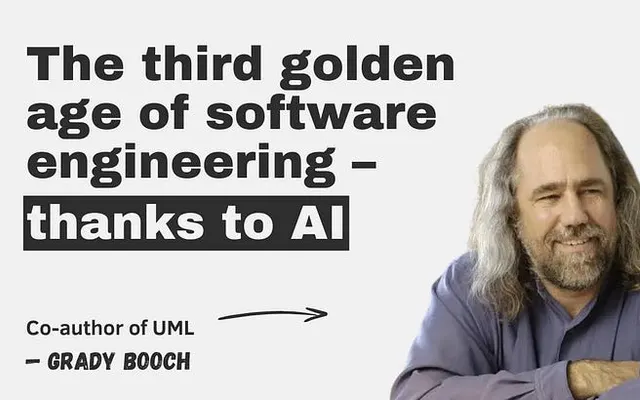
The third golden age of software engineering – thanks to AI, with Grady Booch

Frames AI coding tools as another rise in abstraction, like compilers and libraries, rather than the end of software engineering. Calls Dario Amodei’s claim that software engineering will soon be automatable utter bullshit, arguing that engineers balance technical, human, economic and ethical forces automation does not address, and that agents mostly automate patterns they were trained on. Expects job losses in delivery-pipeline infrastructure and simple app building, with people needing to reskill toward systems. He uses Claude for unfamiliar libraries. Own turns in Substack’s automated transcript inspected; the host’s claims about recent model quality are not his.

newsletter.pragmaticengineer.com
Di mana posisi Anda?
Jelajahi pandangan dunia AI Anda sendiri dengan menjawab beberapa pertanyaan sederhana.
Petakan pandangan dunia Anda sendiri

Di mana posisi Anda?

Petakan pandangan dunia saya