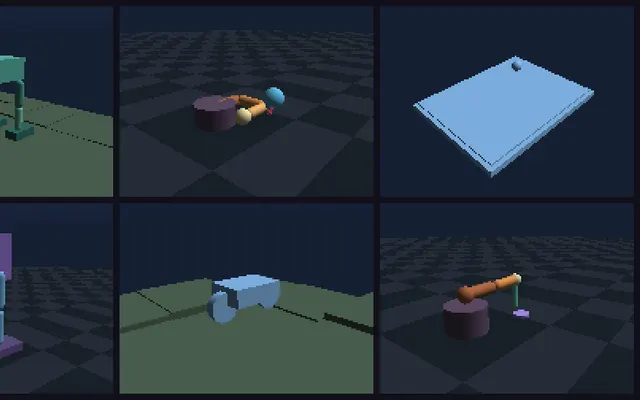
Machine learning engineer who builds open tools for fine-tuning image models, sees AI progress as rapid and says alignment and testing still matter.

Bagaimana AI akan mengubah dunia?

Perubahan peradabanPerubahan bertahapDoomBloom
Posisi simulasiRentang interpretasi

Mendatar: pandangan Doom–Bloom yang mereka ungkapkan. Ke atas: skala transformasi.

Doom–Bloom: 79 dari 100. Skala transformasi: 61 dari 100. Rentang interpretasi: 74 hingga 84 secara horizontal, 49 hingga 76 secara vertikal. Ini adalah koordinat interpretasi, bukan probabilitas kejadian.

P(doom) Simo Ryu · disimpulkan

≈6%

0%100%

Disimpulkan dari jawaban simulasi mereka, bukan angka yang mereka berikan. Rentang yang masuk akal: 3–13%.

Hal-hal yang menentukan pandangan mereka

Asumsi utama

Capability progress is rapid, and systems that can generate software, adapt models efficiently, and assist research will reduce the cost and time required to test ideas across science, engineering, medicine, and many other fields.
Jawaban 1

Jika asumsi ini ternyata berbeda, bagaimana pandangan mereka akan berubah?

Hal yang dapat mengubah pandangan mereka

A decisive demonstration that capability gains do not translate into reliable real-world problem solving would change my view most.
Jawaban 4

Bukti apa yang akan memadai, dan ke arah mana bukti itu akan mengubah pandangan mereka?

Detail lebih lanjut

Manfaat yang diperkirakan

Beberapa penafsiran masih mungkin: Manfaat transformatif yang bernilai luas diperkirakan akan terwujud. / Manfaat besar diperkirakan akan terwujud, dengan syarat penting atau keterbatasan distribusi.

84 / 100

Dampak kecilDampak transformatif

Rentang interpretasi 67 hingga 100 pada skala kualitatif.

Kerugian yang diperkirakan

Kerugian yang dapat dikelola atau bersifat lokal diperkirakan akan terjadi.

41 / 100

Dampak kecilDampak transformatif

Rentang interpretasi 33 hingga 67 pada skala kualitatif.

Pengaruh manusia

Pilihan manusia memiliki pengaruh yang berarti, tetapi sangat dibatasi.

55 / 100

Sedikit pengaruhPengaruh kuat

Rentang interpretasi 31 hingga 94 pada skala kualitatif.

Laju pengembangan

Hentikan atau perlambat secara signifikan pengembangan AI yang lebih mampu.

Posisi simulasi: Lanjutkan pengembangan dengan perlindungan yang telah ditetapkan.

Percepat pengembangan AI yang lebih mampu.

Aturan penggunaan AI

Batasi penggunaan AI yang dibahas hingga perlindungan atau izin sebelumnya tersedia.

Posisi simulasi: Izinkan penggunaan AI yang dibahas dengan akuntabilitas dan perlindungan yang terarah.

Minimalkan pembatasan terhadap penggunaan AI yang dibahas.

Interpretasi ini mempertahankan kondisi yang mereka nyatakan. Manfaat dan kerugian dapat sama-sama besar. Rentang tersebut menggambarkan cara kami membaca jawaban simulasi mereka, bukan interval kepercayaan statistik.

Di mana posisi Anda dibandingkan dengan Simo Ryu?
Petakan pandangan dunia AI Anda sendiri dalam waktu sekitar 3 menit, lalu bandingkan

Pandangan dunia serupa

Pemimpin opini dengan pandangan dunia simulasi yang paling mendekati pandangan Simo Ryu

Penilaian Simulasi

Pertanyaan 1

Menurut Anda, apa arti AI bagi masa depan kita—dan mengapa?

I think AI becomes general-purpose infrastructure for solving human problems, not merely a better chatbot or mathematics engine. Capability progress is rapid, and systems that can generate software, adapt models efficiently, and assist research will reduce the cost and time required to test ideas across science, engineering, medicine, and many other fields. But an impressive experiment is not validated infrastructure. An AI-generated simulator can demonstrate a direction without proving reliability or safety. Likewise, AI may accelerate vaccine discovery or other medical work, while clinical evaluation and trials still determine when patients can safely benefit. Progress does not eliminate verification. The same distinction matters in education. Children should learn fundamentals through real effort and understand how models are built—pretraining, post-training, data, and evaluation—rather than treating AI as a shortcut around thinking. “Prompt engineering” alone is not enough. So I expect major acceleration, potentially toward genuinely general-purpose AI, but alignment and evaluation remain central. The goal should be systems that expand our ability to solve broad human problems while preserving the checks needed wherever failure has serious consequences.


Pertanyaan 2

Kerugian besar apa, jika ada, yang Anda perkirakan akan disebabkan oleh AI?

The clearest harm is large-scale substitution of plausible output for actual understanding or validation. In education, children can outsource homework during the exact period when struggle is needed to build foundations. They may become skilled at requesting answers without understanding how the answers were produced—or whether they are correct. In technical and medical settings, the analogous failure is deploying an impressive prototype as if it were reliable infrastructure. AI-generated software, simulations, or scientific hypotheses can accelerate experimentation, but errors become dangerous when people skip evaluation. In medicine especially, faster discovery does not remove safety testing and clinical trials. More capable general-purpose systems also make alignment increasingly important. Rapid progress is real, but capability alone does not guarantee that systems behave as intended. I would not attach a numerical probability or pretend to know every resulting failure mode. The practical point is that deployment, evaluation, and safety work must advance with capability rather than being treated as obstacles to progress.

Pertanyaan 3

Taking benefits and harms together, what overall impact do you expect AI to have?

Overall, I expect AI to have a strongly positive impact by becoming general-purpose infrastructure for science, medicine, engineering, software, and other human problems. Rapid capability gains can make experimentation cheaper, compress development cycles, and let more people build specialized tools through accessible models and efficient fine-tuning. That positive outcome is not automatic. Generated software must be tested, medical advances still require safety evaluation and clinical trials, and increasingly general systems make alignment more important—not less. Education also needs care: children should use AI to deepen understanding after learning foundations, not bypass the struggle that creates understanding. So my view is optimistic but implementation-minded. AI can substantially expand what humanity can solve, provided we preserve the distinction between a compelling demonstration and dependable, validated infrastructure.

Pertanyaan 4

Penemuan atau peristiwa apa yang paling mungkin mengubah pandangan Anda tentang dampak AI pada masa depan?

A decisive demonstration that capability gains do not translate into reliable real-world problem solving would change my view most. For example, if increasingly capable models consistently failed when moved from benchmarks and impressive demos into validated scientific, medical, or engineering systems—even with strong evaluation, tooling, and domain oversight—I would revise downward my expectation of broad positive impact. Conversely, repeated evidence that highly capable systems cannot be aligned or controlled under realistic deployment conditions would change the other side of the calculation. A prototype behaving well is not enough; I would care about failures that persist across methods and scale. The key event would therefore not be one flashy benchmark or isolated accident. It would be durable evidence about whether general capability can become dependable infrastructure: systems that solve broad human problems, survive rigorous evaluation, and behave as intended.

Sumber

Artikel, wawancara, dan tulisan yang digunakan sebagai landasan bagi pengguna simulasi ini.

Di mana posisi Anda?
Jelajahi pandangan dunia AI Anda sendiri dengan menjawab beberapa pertanyaan sederhana.
Petakan pandangan dunia Anda sendiri

Di mana posisi Anda?

Petakan pandangan dunia saya