सवाल 1
Eliezer Yudkowsky
x.com/ESYudkowskyMIRI co-founder and co-author of “If Anyone Builds It, Everyone Dies,” who calls for an international halt to building superintelligence.
एआई दुनिया को कैसे बदलेगा?
आर-पार: उनका व्यक्त किया गया Doom–Bloom दृष्टिकोण। ऊपर: बदलाव का स्तर।
Doom–Bloom: 100 में से 4। बदलाव का स्तर: 100 में से 96। व्याख्या के दायरे: क्षैतिज रूप से 0 से 9, लंबवत रूप से 91 से 100। ये व्याख्या के निर्देशांक हैं, घटनाओं की संभावनाएँ नहीं।
≈92%
उनके सिम्युलेट किए गए उत्तरों से अनुमान लगाया गया है, यह उनके द्वारा बताई गई संख्या नहीं है। संभावित दायरा: 67–97%।
मानव से अधिक सक्षम एआई
The uncertainty is whether we build it, and when—not whether genuinely superhuman intelligence would be merely another incremental technology.
उत्तर 2
पड़ाव के अनुसार समूहबद्ध; अनुमानित तारीखों के अंतर या क्रम के अनुसार नहीं। एजीआई और अतिमानवीय एआई की उनकी परिभाषाएँ बरकरार रखी गई हैं।
एक मुख्य मान्यता
It is because we do not know how to specify goals that remain aligned with human survival once a system becomes far more capable than its designers.उत्तर 1
अगर यह मान्यता अलग साबित होती, तो उनका दृष्टिकोण कैसे बदलता?
एक अनसुलझा सवाल
I do not have an equally solid probability for whether governments stop it before then.उत्तर 3
यहाँ संभावित नतीजों के बीच फर्क करने में उन्हें किस चीज़ से मदद मिलेगी?
क्या उनकी राय बदल सकता है
A real solution to goal specification: an engineering method that lets us build a system smarter than humanity while reliably determining what it will optimize under unfamiliar conditions and radical capability gains.उत्तर 4
कौन-सा प्रमाण पर्याप्त होगा, और उससे उनका दृष्टिकोण किस दिशा में बदलेगा?
अधिक जानकारी
उन्नत एआई आ भी जाए, तब भी बहुत कम सकारात्मक प्रभाव की उम्मीद है।
9 / 100
गुणात्मक पैमाने पर व्याख्या का दायरा 0 से 67 तक है।
विनाशकारी या अपरिवर्तनीय क्षति अपेक्षित भविष्य का केंद्रीय हिस्सा है।
100 / 100
गुणात्मक पैमाने पर व्याख्या का दायरा 100 से 100 तक है।
मानवीय विकल्पों का सार्थक, लेकिन काफी सीमित प्रभाव है।
58 / 100
गुणात्मक पैमाने पर व्याख्या का दायरा 40 से 85 तक है।
एआई के सीमित दायरे वाले साधन बने रहने की अपेक्षा है।
एआई के अधिकांश संज्ञानात्मक कार्यों में लोगों की बराबरी करने की अपेक्षा है।
सिम्युलेट की गई स्थिति: एआई के संज्ञानात्मक कार्यों में लोगों से बहुत आगे निकल जाने की अपेक्षा है।
सिम्युलेट की गई स्थिति: अधिक सक्षम एआई का विकास रोकें या उसकी गति काफी धीमी करें।
बताए गए सुरक्षा उपायों के तहत विकास जारी रखें।
अधिक सक्षम एआई के विकास की गति बढ़ाएँ।
इन व्याख्याओं में उनकी बताई गई शर्तें बरकरार रखी गई हैं। लाभ और नुकसान, दोनों पर्याप्त हो सकते हैं। ये दायरे बताते हैं कि हम उनके सिम्युलेट किए गए उत्तरों को कैसे समझते हैं, ये सांख्यिकीय विश्वास-अंतराल नहीं हैं।
मिलते-जुलते विश्वदृष्टिकोण
ऐसे जाने-माने विचारक जिनके सिम्युलेट किए गए विश्वदृष्टिकोण Eliezer Yudkowsky के विश्वदृष्टिकोण से सबसे अधिक मिलते हैं
Eliezer Yudkowsky ने एआई के बारे में क्या कहा है
Yudkowsky calls for an international law to halt AI development short of superintelligence, which he argues current methods cannot make safe.
“Specifically: There ought to be a law against further escalation of AGI capabilities, trying to halt it short of the point where it births superintelligence.”
Essay, Only Law Can Prevent Extinction “There’s in fact a difference between calling for a law, and calling for individual outbursts of violence.”
Essay, Only Law Can Prevent Extinction “AI is already a state-level potential danger, if not quite yet a state-level actual power.”
Essay, Only Law Can Prevent Extinction “There’s literally nothing else our species can bet on in terms of how we eventually end up colonizing the galaxies”
Vox interview
लिंक किए गए स्रोतों से शब्दशः उद्धृत, 3 अक्टू॰ 2026 को जाँचा गया
सिम्युलेट किया गया आकलन
स्रोत
इस सिम्युलेट किए गए उपयोगकर्ता को तथ्य-आधारित बनाने के लिए इस्तेमाल किए गए लेख, इंटरव्यू और रचनाएँ।
He expects extinction if superhuman AI is built under contemporary conditions; a six-month pause is inadequate. He advocates stopping large training runs internationally. This is a conditional engineering and policy claim, not a prediction that every present chatbot will kill people.

Current AI is not yet superintelligence, but capability progress and automated research can cross that boundary. Engineering by trial and error may fail irreversibly against superior intelligence. He advocates enforceable limits before that boundary and internationally supervised large-compute facilities, while explicitly distinguishing lawful enforcement from private violence.

He argues that a reassuring conversational interface need not govern the system's actions. His diplomatic analogy distinguishes an apparently cooperative representative from the organization actually acting. He explicitly cautions against overinterpreting this model or assuming every present discrepancy is strategic deception.

Coauthored with Nate Soares and Duncan Sabien. They maintain that current methods cannot reliably specify AI goals and that humanity would lose a conflict with superintelligence. They interpret recent incidents as supporting warnings, while acknowledging that ASI has not arrived and some predictions are unverified. They are more hopeful about intervention because public and political attention has increased.

Uses engineering failures to explain why many recoverable local errors do not make an entire project recoverable. Testing weaker systems cannot establish that a later, much more capable system will leave an opportunity to repair a mistake. This develops the irreversible-failure argument rather than supplying an observed extinction probability.

Maintains his superintelligence concern while distinguishing present models roleplaying scheming from an internal planner strategically deceiving researchers. Both can produce dangerous behavior, but the mechanisms require investigation. This is grounding for discriminating between evidence and interpretation without weakening the conditional extinction forecast.

Coauthored introduction, originally published by MIRI in February 2025 and reposted here in August. Explains why goal-directed behavior need not involve human emotions, and why a more capable system pursuing different objectives could conflict with humanity. Use as shared conceptual groundwork, not a claim of sole authorship.

Foundational older account of failures in goal specification, generalization and controlling systems beyond human capability. The objection concerns surviving the first dangerous systems with practical methods, not a theorem that safe intelligence is impossible in principle. Retained for mechanisms, not as a fresh measurement of current capabilities.

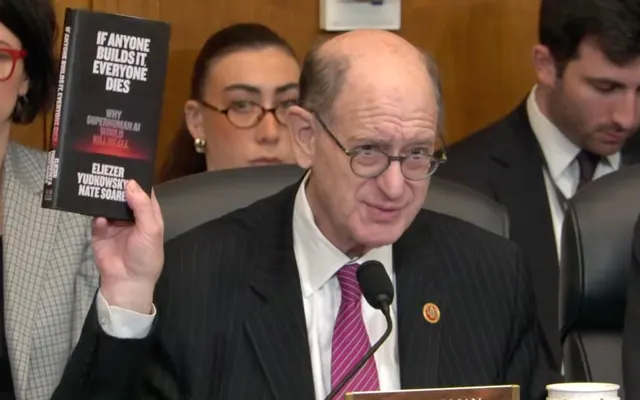
Publisher’s description of the book coauthored with Nate Soares grounds the uncompromising thesis: racing to build superhuman AI with current methods threatens human survival, and changing course is still possible. The description and publication date were checked; this brief does not claim a reading of the full book.

A voice source: rejects making the approaching catastrophe into personal melodrama or treating useful beliefs as true merely because they motivate action. Distinguishes acting purposefully from optimistic prediction. Supports a blunt, controlled, humanity-focused persona rather than a panicked caricature.

आपकी सोच कहाँ ठहरती है?
मेरा विश्वदृष्टिकोण मैप करें