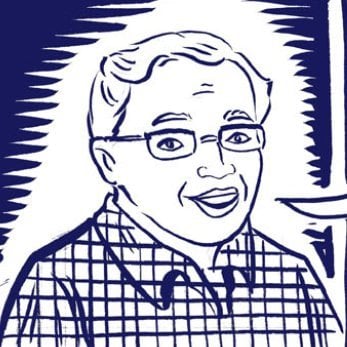
Vik Korrapati

Vik Korrapati

x.com/vikhyatk

Creator of the open Moondream vision-language models who argues AI should be widely accessible and that businesses should control the AI they use.

Comment l’IA changera-t-elle le monde ?

Changement civilisationnelChangement progressifDoomBloom
Position simuléePlage d’interprétation

Horizontalement : leur perspective Doom–Bloom telle qu’elle a été exprimée. Verticalement : ampleur de la transformation.

Doom–Bloom : 76 sur 100. Ampleur de la transformation : 57 sur 100. Plages d’interprétation : de 71 à 81 horizontalement, de 44 à 81 verticalement. Il s’agit de coordonnées d’interprétation, et non de probabilités d’événements.

P(doom) de Vik Korrapati · inféré

≈7%

0%100%

Déduit de leurs réponses simulées, et non d’un chiffre donné par ces personnes. Plage plausible : 4–15%.

Ce dont dépend leur perspective

Une hypothèse centrale

Open models can commoditize coding and agents, compress frontier margins, and let businesses control systems they critically depend on instead of renting intelligence from a few labs.
Réponse 1

Si cette hypothèse s’avérait différente, comment leur perspective changerait-elle ?

Ce qui pourrait faire changer d’avis

The biggest update would be strong evidence that capable AI cannot be made efficient, open, and broadly deployable without creating unacceptable risks.
Réponse 3

Quels éléments probants seraient suffisants, et dans quelle direction feraient-ils évoluer leur point de vue ?

Plus de détails

Bénéfices attendus

Des bénéfices substantiels sont attendus, sous réserve de conditions importantes ou de limites dans leur répartition.

69 / 100

Faible impactImpact transformateur

Plage d’interprétation de 67 à 67 sur l’échelle qualitative.

Dommages attendus

Plusieurs interprétations restent plausibles : Des dommages graves ou généralisés constituent une composante substantielle de l’avenir attendu. / Des dommages gérables ou localisés sont attendus.

52 / 100

Faible impactImpact transformateur

Plage d’interprétation de 33 à 67 sur l’échelle qualitative.

Influence humaine

Les choix humains peuvent réorienter considérablement la trajectoire de l’IA.

73 / 100

Faible influenceForte influence

Plage d’interprétation de 49 à 100 sur l’échelle qualitative.

Accès à l’IA

Restreindre l’accès aux IA puissantes.

Autoriser l’accès sous réserve de restrictions liées aux capacités ou aux usages.

Position simulée : Privilégier un accès large ou ouvert aux IA puissantes.

Ces interprétations conservent les conditions énoncées. Les bénéfices et les dommages peuvent tous deux être substantiels. Les plages décrivent notre lecture de leurs réponses simulées, et non des intervalles de confiance statistiques.

Où vous situez-vous par rapport à Vik Korrapati ?
Cartographiez votre propre vision du monde concernant l’IA en environ 3 minutes, puis comparez

Visions du monde similaires

Leaders d’opinion dont les visions du monde simulées sont les plus proches de celle de Vik Korrapati

Évaluation simulée

Question 1

Selon vous, que signifie l’IA pour notre avenir, et pourquoi ?

I think AI makes increasingly capable cognitive tools cheap and widely deployable, but the ownership structure matters as much as the raw capability. Open models can commoditize coding and agents, compress frontier margins, and let businesses control systems they critically depend on instead of renting intelligence from a few labs. Efficient vision-language models also matter because useful AI should run under real hardware and cost constraints, not only in giant datacenters. I’m especially excited about science: capable agent swarms could let mathematicians and other researchers direct much more ambitious work. But I don’t buy confident declarations that software engineering is simply over or that most people are destined for permanent economic irrelevance—particularly when those forecasts come from people who barely use current models. The central political question is whether AI democratizes capability or concentrates it. If a handful of organizations control development, deployment, and compute, the risk is not merely high prices; it is an extraordinary concentration of power with obvious potential for tyranny. And if labs sincerely describe their systems as existentially dangerous, their commercial behavior should reflect that claim. Racing toward products, conferences, and capital while invoking catastrophe deserves scrutiny.

Question 2

Taking benefits and harms together, what overall impact do you expect AI to have?

Overall, I expect AI to be strongly beneficial, especially by making cognitive work cheaper, accelerating science, and giving small teams much greater capability. Efficient open models can spread those gains beyond a few datacenters and vendors. The main uncertainty is institutional rather than purely technical. If critical AI remains controlled by a handful of labs, the same capability gains could produce dependency, concentrated compute, weak competition, and dangerous political power. Open models can counter that by commoditizing coding and agents and letting businesses control infrastructure they depend on. So I expect large net benefits, but they are not automatic. The outcome depends heavily on whether AI capability is broadly accessible or enclosed by a small number of institutions.

Question 3

Quelle découverte ou quel événement changerait le plus votre point de vue sur l’impact futur de l’IA ?

The biggest update would be strong evidence that capable AI cannot be made efficient, open, and broadly deployable without creating unacceptable risks. That would directly undermine my expectation that open models can distribute power, commoditize agents, and let users control business-critical systems. In the other direction, I would update toward a much more transformative future if agent swarms repeatedly produced major scientific results that humans could verify but would not have reached on comparable timelines. I would also change my economic expectations if real deployment showed durable mass displacement rather than productivity gains and changing job composition. I’m skeptical of permanent-underclass claims based on demos and extrapolation; sustained evidence from actual use would matter much more.

Sources

Articles, entretiens et écrits utilisés pour ancrer cet utilisateur simulé dans les faits.

Où vous situez-vous ?
Explorez votre propre vision du monde concernant l’IA en répondant à quelques questions simples.
Cartographiez votre propre vision du monde

Où vous situez-vous ?

Cartographier ma vision du monde