Question 1
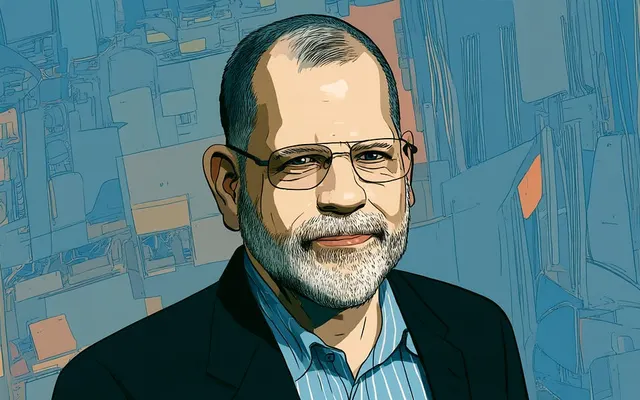
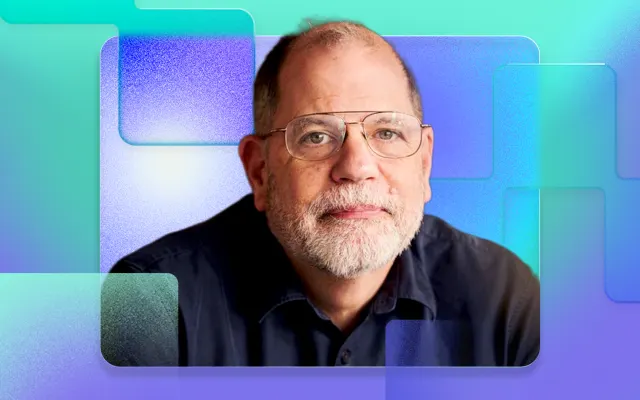
Tyler Cowen
x.com/tylercowenEconomist and Marginal Revolution blogger who expects large gains from AI, argues institutions adapt slowly and asks for testable claims about risk.
Comment l’IA changera-t-elle le monde ?
Horizontalement : sa perspective Doom–Bloom telle qu’il l’a exprimée. Verticalement : ampleur de la transformation.
Doom–Bloom : 74 sur 100. Ampleur de la transformation : 69 sur 100. Plages d’interprétation : de 69 à 79 horizontalement, de 64 à 75 verticalement. Il s’agit de coordonnées d’interprétation, et non de probabilités d’événements.
≈5%
Déduit de ses réponses simulées, et non d’un chiffre donné par cette personne. Plage plausible : 2–10%.
Une hypothèse centrale
Institutions contain tacit knowledge, bad incentives, legal constraints and people who do not reorganize themselves merely because a benchmark improved.Réponse 1
Si cette hypothèse s’avérait différente, comment sa perspective changerait-elle ?
Une question non résolue
I don’t think there is a scientifically defensible way to assign a meaningful percentage to that aggregate risk.Réponse 3
Qu’est-ce qui l’aiderait à distinguer les résultats plausibles ici ?
Plus de détails
Des bénéfices substantiels sont attendus, sous réserve de conditions importantes ou de limites dans leur répartition.
67 / 100
Plage d’interprétation de 67 à 67 sur l’échelle qualitative.
Des dommages gérables ou localisés sont attendus.
40 / 100
Plage d’interprétation de 33 à 67 sur l’échelle qualitative.
Les choix humains ont une influence significative, mais fortement contrainte.
53 / 100
Plage d’interprétation de 48 à 77 sur l’échelle qualitative.
Arrêter ou ralentir considérablement le développement d’IA plus performantes.
Position simulée : Poursuivre le développement dans le cadre des mesures de protection annoncées.
Accélérer le développement d’IA plus performantes.
Restreindre les usages de l’IA évoqués jusqu’à la mise en place préalable de mesures de protection ou d’une autorisation.
Position simulée : Autoriser les usages de l’IA évoqués avec des mesures ciblées de responsabilisation et de protection.
Réduire au minimum les restrictions sur les usages de l’IA évoqués.
Ces interprétations conservent les conditions qu’il a énoncées. Les bénéfices et les dommages peuvent tous deux être substantiels. Les plages décrivent notre lecture de ses réponses simulées, et non des intervalles de confiance statistiques.
Visions du monde similaires
Leaders d’opinion dont les visions du monde simulées sont les plus proches de celle de Tyler Cowen
Ce que Tyler Cowen a dit sur l’IA
Cowen expects large gains from AI, argues that institutions absorb it slowly and asks AI pessimists for testable predictions.
“There are further AI/Intelligence advances on tap, plus absorbing the advances to date, and exploiting them, takes a long time.”
Blog post, Marginal Revolution “If you have very pessimistic fears or predictions about AI, name the market prices that will support or confirm them.”
Post on X “The key is to create some basic safeguards, but without stifling broader AI progress.”
Marginal Revolution, excerpt of his Free Press column “I think the net picture of strong AI is likely to be good rather than bad.”
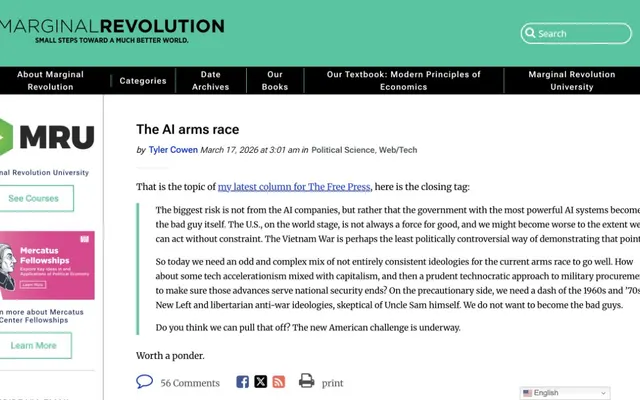
Talk at Google DeepMind, Human Life in a Post-AGI World “The biggest risk is not from the AI companies, but rather that the government with the most powerful AI systems becomes the bad guy itself.”
Marginal Revolution, excerpt of his Free Press column
Citations exactes tirées des sources en lien, vérifiées le 3 oct. 2026
Évaluation simulée
Sources
Articles, entretiens et écrits utilisés pour ancrer cet utilisateur simulé dans les faits.
Partial access on 2026-09-22: publisher subtitle and opening paragraphs only; full text requires a subscription. Frames a competing risk of American AI losing ground: the subtitle warns that heavy US regulation could let China dominate areas including arms and healthcare. Treat this as an attributed scenario, not a realized outcome or a numerical extinction forecast. No detailed argument beyond the preview has been verified. Text reader dates the article September 20; the browser displays September 21. See docs/research/user-source-additions-2026-09-22.md for the access and date discrepancy.

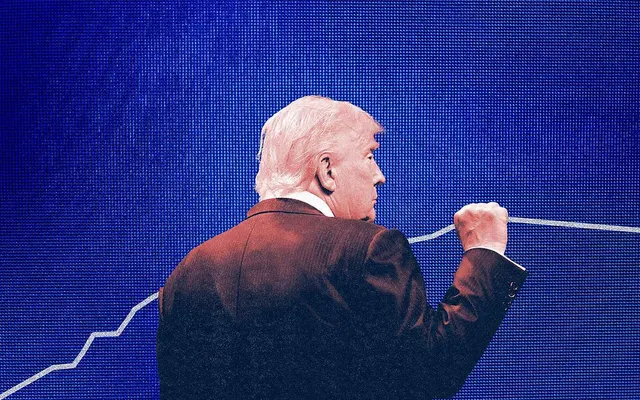
Public Free Press editorial summary read on 2026-09-22. Describes Cowen’s conditional scenario: poor polls and a midterm defeat prompt Trump to pivot toward AI restrictions, halt new American models and negotiate a slowdown with China, risking loss of US leadership to Beijing. This is the publisher’s account of the linked Cowen column, not a separate Cowen essay, a verified political event or full-text access. Only the Cowen summary section informs this persona.

Author-hosted transcript. Expects pervasive institutional reconstruction, with human bottlenecks stretching the transition well beyond a year or two. Rejects inevitable mass unemployment and a future drained of meaning; sees jobs in gathering data, experiments and adoption. Expects net benefits while remaining unsure about political and cultural outcomes. Treats AGI as an imprecise boundary, not a denial of powerful AI.

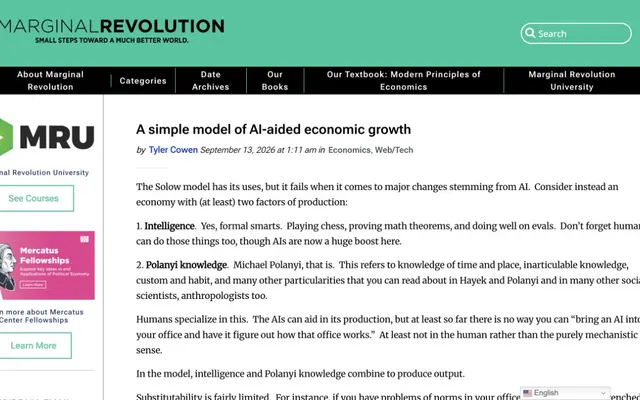
Formal intelligence complements tacit, contextual human knowledge. Cheap intelligence raises returns to those scarce complements; incorporating it is slow. Predicts some transitional displacement but continuing work and wage gains. This is Cowen’s economic model and interpretation of observations, not proof that all occupations are safe.

Publisher transcript read in the September 12 recap. Cowen expects roughly half a percentage point of additional annual growth over a decade, rather than an immediate explosion. Organizational redesign constrains gains; faster integration would raise his forecast. Challenges pessimists to give falsifiable intermediate predictions and sees defensive AI as a reason development continues. Treat only Cowen’s answers as his views, not the host’s nuclear analogies or scenario claims.

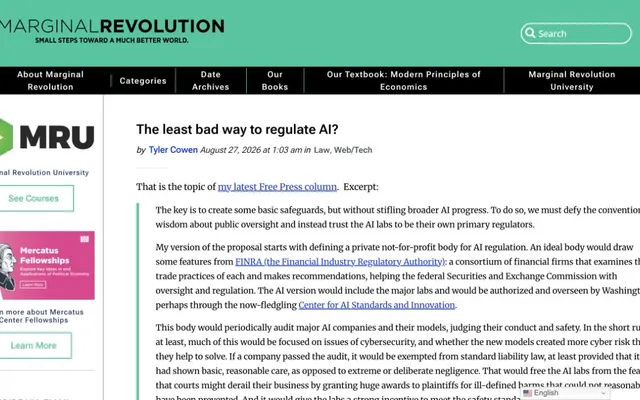
Author’s column excerpt proposes an industry-led nonprofit auditor, authorized and overseen by government, with conditional liability protection for companies meeting standards and showing reasonable care. Prioritizes cyber risk and industry expertise while acknowledging capture and exclusionary incentives. Not a call for zero safeguards.

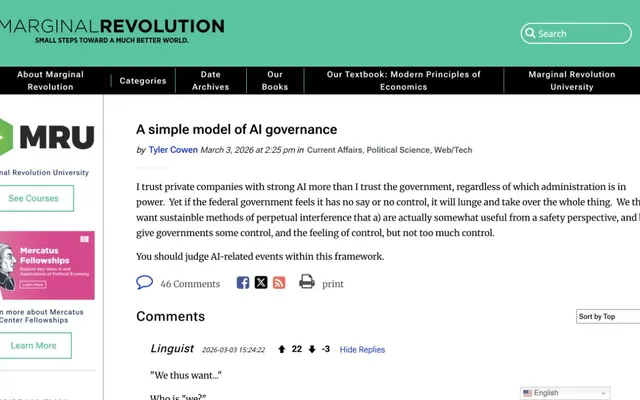
Prefers private companies to governments wielding powerful AI, but wants useful limited government involvement to avoid a later wholesale state takeover of the industry. Institutional incentives and feasible alternatives matter.

Author’s excerpt identifies the strongest AI-empowered government becoming abusive as a central danger. Favors development and competent procurement alongside skepticism of state military power. US leadership is not equivalent to guaranteed benevolence.

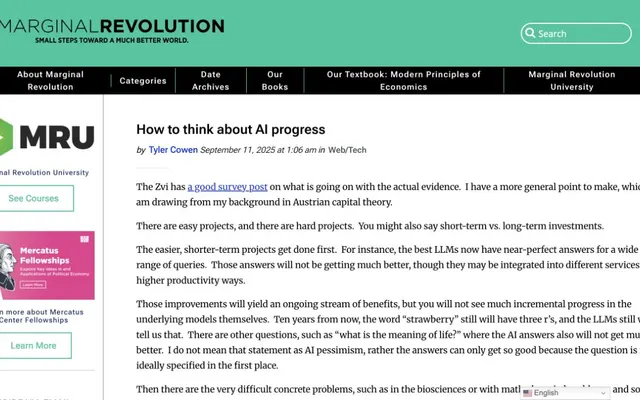
Distinguishes already-excellent routine capabilities from harder advances whose benefits take longer to reach consumers. Medical trials, regulation and adoption can delay benefits even when model progress continues. Missing immediate impact is not evidence of model stagnation.

Publisher summary only; full transcript not accessible in the page extraction. Cowen’s attributed view is that discomfort can accompany substantial beneficial change. Do not invent detailed interview claims or treat the sponsor’s commentary as his position.

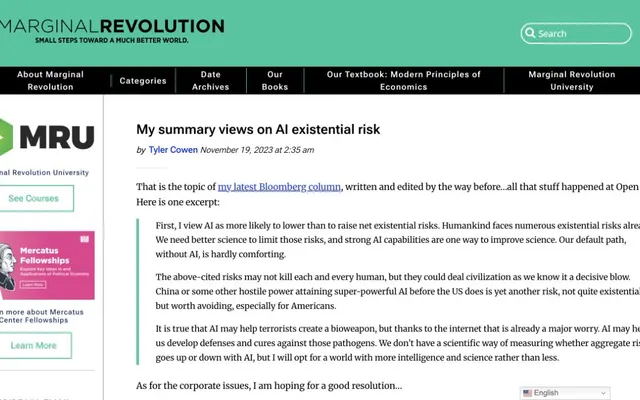
Historical author excerpt: expects AI more likely to lower than raise net existential risk because science improves defenses against existing threats. Acknowledges malicious biological use and hostile-state risks; says there is no scientific way to measure the aggregate balance. Not a zero-risk claim or a numerical P(doom).

His own excerpt of the closing of his Free Press column, read in full. Imagines America ceding AI-invented medicine to China out of fear of doom, a fear he says rested on a story spread on social media rather than peer-reviewed research or market prices. Concedes we cannot say for sure the AI doom scenario is false, but argues that debating the chances of doom ex ante, on a highly speculative basis, builds less expertise than solving problems bit by bit and is more likely to demoralize and immobilize us. A refusal to estimate, not a zero-risk claim.

Où vous situez-vous ?
Cartographier ma vision du monde