










Sierra Catalina

Sierra Catalina

x.com/sierracatalina

CEO of Ouroboros who builds tools for portable, user-owned AI context and writes about agent security and proof of personhood.

Comment l’IA changera-t-elle le monde ?

Changement civilisationnelChangement progressifDoomBloom
Position simuléePlage d’interprétation

Horizontalement : sa perspective Doom–Bloom telle qu’elle l’a exprimée. Verticalement : ampleur de la transformation.

Doom–Bloom : 67 sur 100. Ampleur de la transformation : 75 sur 100. Plages d’interprétation : de 62 à 75 horizontalement, de 70 à 80 verticalement. Il s’agit de coordonnées d’interprétation, et non de probabilités d’événements.

P(doom) de Sierra Catalina · inféré

≈5%

0%100%

Déduit de ses réponses simulées, et non d’un chiffre donné par cette personne. Plage plausible : 3–10%.

Comment nous estimons P(doom)

Ce dont dépend sa perspective

Une hypothèse centrale

so the impact depends less on whether models get smarter and more on who owns the context, how access is scoped & revoked, and whether society rebuilds the human infrastructure automation thins out.
Réponse 2

Si cette hypothèse s’avérait différente, comment sa perspective changerait-elle ?

Une question non résolue

I don’t have a useful percentage.
Réponse 4

Qu’est-ce qui l’aiderait à distinguer les résultats plausibles ici ?

Plus de détails

Bénéfices attendus

Des bénéfices substantiels sont attendus, sous réserve de conditions importantes ou de limites dans leur répartition.

76 / 100

Faible impactImpact transformateur

Plage d’interprétation de 67 à 100 sur l’échelle qualitative.

Dommages attendus

Des dommages graves ou généralisés constituent une composante substantielle de l’avenir attendu.

64 / 100

Faible impactImpact transformateur

Plage d’interprétation de 67 à 67 sur l’échelle qualitative.

Influence humaine

Les choix humains peuvent réorienter considérablement la trajectoire de l’IA.

79 / 100

Faible influenceForte influence

Plage d’interprétation de 50 à 100 sur l’échelle qualitative.

Règles d’utilisation de l’IA

Restreindre les usages de l’IA évoqués jusqu’à la mise en place préalable de mesures de protection ou d’une autorisation.

Position simulée : Autoriser les usages de l’IA évoqués avec des mesures ciblées de responsabilisation et de protection.

Réduire au minimum les restrictions sur les usages de l’IA évoqués.

Ces interprétations conservent les conditions qu’elle a énoncées. Les bénéfices et les dommages peuvent tous deux être substantiels. Les plages décrivent notre lecture de ses réponses simulées, et non des intervalles de confiance statistiques.

Où vous situez-vous par rapport à Sierra Catalina ?
Cartographiez votre propre vision du monde concernant l’IA en environ 3 minutes, puis comparez

Visions du monde similaires

Leaders d’opinion dont les visions du monde simulées sont les plus proches de celle de Sierra Catalina

Ce que Sierra Catalina a dit sur l’IA

Catalina expects AI to take over much human labor and writes about keeping AI clearly a tool, proof of personhood and protecting human contact.

  1. “the system must signal clearly that it is a tool. it must maintain artificial cues & avoid emotional dependency loops.”

    X Article, AI voice identity
  2. “automation reduces the number of default human touchpoints in a normal week.”

    X Article, third places are critical infrastructure for a post automation society
  3. “anthropomorphizing models trains people to trust interfaces instead of incentives. that confusion compounds fast in agentic systems.”

    Post on LinkedIn
  4. “ASI-level automation replaces labor as the core mechanism that sustains society.”

    Essay, finding purpose post ASI
  5. “but the lines will continue to blur & fast. proof of personhood becoming increasingly necessary.”

    Post on X

Citations exactes tirées des sources en lien, vérifiées le 6 oct. 2026

Sources

Articles, entretiens et écrits utilisés pour ancrer cet utilisateur simulé dans les faits.

User-owned context as infrastructure

Her personal site states a thesis: the missing layer in modern AI is portable, user-owned context; memory, permissions and identity should travel with the person across models, agents and applications and belong to the user, not the platform. Operating principles: AI systems need scoped access to context, not persistent ownership of identity; provenance, revocation and portability are baseline requirements for trustworthy personalization; AI will remain hybrid across local, cloud and agent systems. Also lists her Ouroboros workspace and open-source agent-aware and context-layer projects. Undated page; full text inspected on 2026-10-05.

sierracatalina.com
ChatGPT agent: nothing will be the same

Resharing Kevin Weil’s ChatGPT agent announcement, she writes that it is “unreal”, that nothing will be the same after this, and “welcome to the future.” Enthusiasm about agents; the announcement text is Weil’s. Older context. Her short post text inspected via a search-engine extract of the LinkedIn page.

linkedin.com
Anthropomorphizing models trains misplaced trust

A short post arguing that anthropomorphizing models trains people to trust interfaces instead of incentives, and that this confusion compounds fast in agentic systems. Full post text inspected; a reader comment excluded.

linkedin.com
Browser agents and reused passwords

A short post saying browser agents feel harmless until you remember most people reuse passwords and click “allow” on vibes alone. A practical security concern about agents, not a catastrophic-risk claim. Full post text inspected.

linkedin.com
Agent-readable infrastructure

Argues that if personal agents become core, the web needs agent-readable infrastructure, and describes her open-sourced “agent aware architecture” starter: machine-legible primary actions, sensitive-field boundaries and confirmation gates for destructive operations, which she says could standardize the agent/web handshake. A design proposal tied to her own project. Post text inspected via a search-engine extract of the LinkedIn page.

linkedin.com
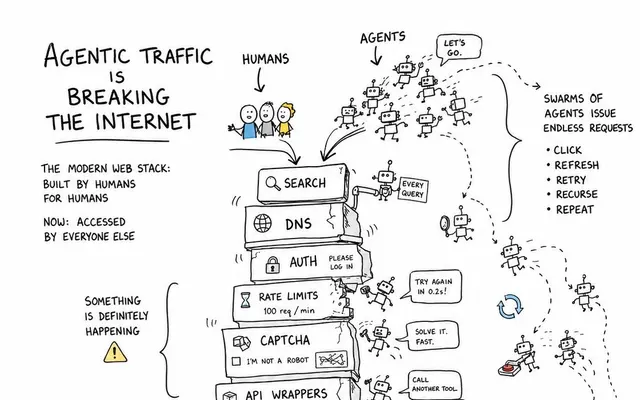
Rethink agentic traffic before we break the web

A short post saying we need to rethink agentic traffic on the web before we break the web. The accompanying image was not reviewed, and a reader’s comment belongs to someone else. Post text inspected.

linkedin.com

Évaluation simulée

Question 1

Selon vous, que signifie l’IA pour notre avenir, et pourquoi ?

AI means agents become part of daily life—not just tools we open, but systems acting across apps, devices & the web. that makes the plumbing existentially important in the normal, practical sense: memory, permissions and identity should travel with the person, not become platform property. agents need scoped access, provenance, revocation & confirmation gates. otherwise we’re giving persuasive interfaces broad authority while people reuse passwords and click “allow” on vibes. the future is hybrid: local models, cloud models, agents and robots coordinating through portable context. your robots can be fairly dumb if your context is portable. and as automation removes routine human contact, physical third places become critical infrastructure too. better digital agents should not mean thinner human communities.

Question 2

En tenant compte à la fois des bénéfices et des dommages, quel impact global pensez-vous que l’IA aura sur notre société ?

overall, transformative—but not automatically good. agents can make people dramatically more capable and reshape daily life. but the default platform model concentrates memory, identity & permissions in systems users don’t control, while persuasive interfaces encourage misplaced trust. so the impact depends less on whether models get smarter and more on who owns the context, how access is scoped & revoked, and whether society rebuilds the human infrastructure automation thins out. capability is arriving either way. good defaults are not.

Question 3

Dans quelle mesure pensez-vous que l’IA finira par changer le monde ?

enormously. agents will change how we navigate work, services, devices & the web—probably enough that today’s app-centric internet feels temporary. but the deepest shift is authority, not novelty: who controls your memory, identity and permissions when software acts for you. capability is inevitable; user-owned context, safer defaults & durable human spaces are choices.

Question 4

Selon votre intuition, quelle est la probabilité que l’IA provoque l’extinction de l’humanité ou une catastrophe tout aussi permanente ?

I don’t have a useful percentage. my concern is much more immediate: agents with broad permissions, weak identity boundaries & users trained to trust interfaces. that can cause serious, durable harm without requiring an extinction scenario.

Question 5

Pensez-vous que l’IA fera plus de bien que de mal, ou êtes-vous véritablement partagé ?

I lean toward more good than bad—but not by default. the capability upside is enormous. the danger is letting platforms own the memory, identity & permissions layer while agents gain authority. if context is user-owned, access is scoped and revocable, and we preserve human community infrastructure, AI can be deeply beneficial. otherwise the same capability becomes extraction with a friendly interface.
Où vous situez-vous ?
Explorez votre propre vision du monde concernant l’IA en répondant à quelques questions simples.
Cartographiez votre propre vision du monde

Où vous situez-vous ?

Cartographier ma vision du monde