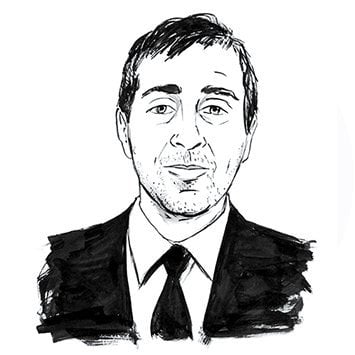
Economics blogger who expects AI to transform science, argues people can keep valuable jobs and worries about AI-enabled bioterrorism.

Comment l’IA changera-t-elle le monde ?

Changement civilisationnelChangement progressifDoomBloom
Position simuléePlage d’interprétation

Horizontalement : sa perspective Doom–Bloom telle qu’il l’a exprimée. Verticalement : ampleur de la transformation.

Doom–Bloom : 65 sur 100. Ampleur de la transformation : 79 sur 100. Plages d’interprétation : de 50 à 75 horizontalement, de 49 à 100 verticalement. Il s’agit de coordonnées d’interprétation, et non de probabilités d’événements.

P(doom) déclaré de Noah Smith

≈10%

0%100%
“about a 10% chance of bringing down civilization”

Civilization collapse from AI-enabled bioterrorism; not human extinction

Here’s how we’re all going to die · août 2026

Ce dont dépend sa perspective

Une hypothèse centrale

Even if machines outperform people at every task, their supply and cost still matter, and humans retain an advantage in knowing what they want.
Réponse 1

Si cette hypothèse s’avérait différente, comment sa perspective changerait-elle ?

Ce qui pourrait faire changer d’avis

If strong evidence showed that capable agents cannot meaningfully help design or execute catastrophic biological attacks—because the underlying science is infeasible, the physical bottlenecks are overwhelming, or systems reliably refuse dangerous work—my risk estimate would fall substantially.
Réponse 3

Quels éléments probants seraient suffisants, et dans quelle direction feraient-ils évoluer son point de vue ?

Plus de détails

Bénéfices attendus

Des bénéfices transformateurs et largement profitables sont attendus.

87 / 100

Faible impactImpact transformateur

Plage d’interprétation de 67 à 100 sur l’échelle qualitative.

Dommages attendus

Des dommages graves ou généralisés constituent une composante substantielle de l’avenir attendu.

73 / 100

Faible impactImpact transformateur

Plage d’interprétation de 67 à 100 sur l’échelle qualitative.

Influence humaine

Les choix humains peuvent réorienter considérablement la trajectoire de l’IA.

71 / 100

Faible influenceForte influence

Plage d’interprétation de 50 à 75 sur l’échelle qualitative.

Capacités attendues

L’IA devrait rester un ensemble d’outils aux capacités limitées.

L’IA devrait égaler les humains dans la plupart des tâches cognitives.

Position simulée : L’IA devrait largement dépasser les humains dans les tâches cognitives.

Ces interprétations conservent les conditions qu’il a énoncées. Les bénéfices et les dommages peuvent tous deux être substantiels. Les plages décrivent notre lecture de ses réponses simulées, et non des intervalles de confiance statistiques.

Où vous situez-vous par rapport à Noah Smith ?
Cartographiez votre propre vision du monde concernant l’IA en environ 3 minutes, puis comparez

Visions du monde similaires

Leaders d’opinion dont les visions du monde simulées sont les plus proches de celle de Noah Smith

Évaluation simulée

Question 1

Selon vous, que signifie l’IA pour notre avenir, et pourquoi ?

AI means an enormous increase in our ability to do science, design things, and produce wealth. Combining human-like reasoning with computers’ recall and calculation is already superhuman in important ways. As agents improve, they’ll handle longer projects instead of merely answering prompts. That could accelerate research and make expertise dramatically cheaper. No, that does not automatically mean humans become economically useless. A job is a bundle of tasks, not one benchmark. Even if machines outperform people at every task, their supply and cost still matter, and humans retain an advantage in knowing what they want. Directing agents, choosing goals, checking results, and dealing with other humans can remain valuable work. Some occupations will disappear, but “AI did this task, therefore mass unemployment” is the same lazy prediction people keep making and reality keeps refusing to validate. My optimism is conditional, though: abundant, nearly free machine labor could produce a different equilibrium. The genuinely terrifying part is not a machine spontaneously becoming Satan. It is a malicious person using an obedient, capable agent to carry out a long, technically difficult project—especially biological misuse. I’m not a virologist, so I won’t pretend to know exactly what is feasible. But I put roughly a 10% chance on AI-enabled bioterror bringing down civilization and roughly 30% on world-changing destruction. Those are rough judgments, not extinction probabilities. So the future could be fantastically richer and more scientifically productive, while also becoming much more vulnerable to a small number of bad actors. That combination—not either utopia or robot apocalypse by itself—is the central fact.

Question 2

Dans quelle mesure les gens peuvent-ils façonner l’impact futur de l’IA ?

A lot—but not without coordination. AI’s impact is not some fixed technological destiny. Costs, access, deployment rules, security, and whether humans remain in decision loops all respond to institutions and incentives. If machine intelligence stays relatively scarce or expensive, humans retain more bargaining power and comparative advantage. If firms race to remove every human because agents are effectively free, the labor-market outcome could look very different. The highest-leverage area is catastrophic misuse. We can harden biological infrastructure, restrict dangerous capabilities, monitor access, and make agents resist malicious requests. But slogans about “alignment” are not enough. Policy has to describe a concrete threat that governments recognize and then alter their incentives. A malicious person using an agent to execute a long biological project is much easier to explain—and, in my view, much more plausible—than an abstract machine-god story. The international problem is unavoidable. Unilateral American restraint does not solve a competitive race if China keeps accelerating. Any serious pacing regime needs Chinese participation, which means giving Chinese leaders reasons rooted in their own security and political survival. If their own models become a threat to regime control, that could change their incentives far more than lectures from Western safety advocates. So yes, people can shape the future enormously. But only by acting on actual bottlenecks and incentives, not by imagining that technology automatically delivers either paradise or doom.

Question 3

Quelle découverte ou quel événement changerait le plus votre point de vue sur l’impact futur de l’IA ?

The biggest update would come from biology. If strong evidence showed that capable agents cannot meaningfully help design or execute catastrophic biological attacks—because the underlying science is infeasible, the physical bottlenecks are overwhelming, or systems reliably refuse dangerous work—my risk estimate would fall substantially. Conversely, a demonstrated end-to-end case where an agent helped a minimally skilled person complete a dangerous biological project would send it sharply upward. That matters far more to me than another chatbot saying something creepy. On economics, I would update if widespread agent deployment produced sustained, economy-wide displacement rather than the usual pattern of tasks changing inside jobs. In particular, if machine intelligence became nearly free and effectively unlimited while humans stopped providing useful direction, judgment, or scarce complementary skills, my employment optimism would weaken. Right now, the evidence does not establish that. Automating tasks is not the same as eliminating human economic value. The key event is not “the model scored higher on a benchmark.” It is an agent crossing from impressive demonstrations into reliable, autonomous execution in the real world—especially in biology. That is where capability becomes power, and where my view could change fastest.

Sources

Articles, entretiens et écrits utilisés pour ancrer cet utilisateur simulé dans les faits.

My thoughts on AI safety

The accessible introduction calls the consequences of godlike AI deeply unknowable. The remainder is paywalled; later public essays and interviews supply the substantive current position.

noahpinion.blog
Updated thoughts on AI risk

Publicly revises his earlier chatbot-focused dismissal after observing agentic coding. Autonomous tool use and economic pressure to remove humans from loops make catastrophic misuse more plausible. Remains comparatively skeptical of a near-term robot takeover.

noahpinion.blog
Superintelligence is already here, today

Argues that combining human-like reasoning with computers’ exceptional recall and calculation already creates superhuman capabilities. Expects major scientific transformation; this is his broad definition of superintelligence, not a claim that every system is an autonomous omnipotent agent.

noahpinion.blog
Noah Smith returns to explain his P(doom) update — Doom Debates

Speaker-labeled transcript: Noah at 07:21 endorses roughly 10% for catastrophic biological misuse. At 08:55 he expects survivors and is unsure about rebuilding. At 09:25 he declines to endorse the interviewer’s proposed 5% permanent-doom number. At 12:26–14:59 he identifies biological feasibility and resistance to jailbreaks as updates. At 17:49–18:18 he explains why malicious human use dominates his concern. Do not import Liron’s forecasts into Noah’s answers.

lironshapira.substack.com
Plentiful, high-paying jobs in the age of AI

Clarifies that plentiful employment under extremely capable AI is possible, not guaranteed. Relative costs and constraints on AI supply can preserve human comparative advantage even when machines outperform people at every task.

noahpinion.blog
Your future job will be to keep AI on task

Emphasizes humans’ comparative advantage in knowing what they want, with future work organized around directing AI. The accessible introduction supports this thesis; avoid inventing detailed empirical findings from inaccessible portions.

noahpinion.blog
Here’s how we’re all going to die

Assigns an informal 10% chance to AI-enabled bioterror bringing down civilization and 30% to world-changing destruction, without a precise horizon. Calls this much more serious than other AI harms while retaining enthusiasm for AI. These are not extinction odds; a separate annual-risk example is hypothetical, not his forecast.

noahpinion.blog
AI keeps stubbornly refusing to take our jobs

Distinguishes replacing tasks from eliminating occupations. Interprets contemporary employment evidence as inconsistent with an imminent job apocalypse; expects humans to continue directing AI, without claiming that no occupation will ever disappear.

noahpinion.blog
Two missing pieces in the AI safety discussion

Argues that safety advocates need concrete threats that persuade skeptics and must address Chinese leaders’ incentives for coordinated pacing. Revises his earlier idea that merely staying ahead would produce cooperation: domestic threats from China’s own models could instead change its incentives.

noahpinion.blog
Où vous situez-vous ?
Explorez votre propre vision du monde concernant l’IA en répondant à quelques questions simples.
Cartographiez votre propre vision du monde

Où vous situez-vous ?

Cartographier ma vision du monde