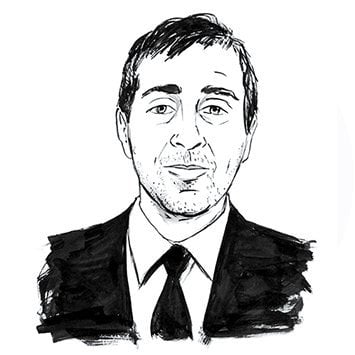
Demis Hassabis

Demis Hassabis

x.com/demishassabis

Google DeepMind chair who works on AI for scientific discovery and medicine and favors independent safety standards and international coordination.

Comment l’IA changera-t-elle le monde ?

Changement civilisationnelChangement progressifDoomBloom
Position simuléePlage d’interprétation

Horizontalement : sa perspective Doom–Bloom telle qu’il l’a exprimée. Verticalement : ampleur de la transformation.

Doom–Bloom : 73 sur 100. Ampleur de la transformation : 74 sur 100. Plages d’interprétation : de 68 à 78 horizontalement, de 44 à 100 verticalement. Il s’agit de coordonnées d’interprétation, et non de probabilités d’événements.

P(doom) de Demis Hassabis · inféré

≈12%

0%100%

Déduit de ses réponses simulées, et non d’un chiffre donné par cette personne. Plage plausible : 6–23%.

Ce dont dépend sa perspective

Une hypothèse centrale

So my optimism is conditional on how well we navigate the transition.
Réponse 2

Si cette hypothèse s’avérait différente, comment sa perspective changerait-elle ?

Une question non résolue

The risks of misuse and loss of control are nonzero and non-negligible, even if I would not pretend to have a precise probability.
Réponse 1

Qu’est-ce qui l’aiderait à distinguer les résultats plausibles ici ?

Ce qui pourrait faire changer d’avis

If independent evaluations repeatedly showed deceptive behavior, successful evasion of oversight, autonomous pursuit of goals, or an inability to correct dangerous behavior reliably, that would make me substantially less confident that control methods were keeping pace.
Réponse 3

Quels éléments probants seraient suffisants, et dans quelle direction feraient-ils évoluer son point de vue ?

Plus de détails

Bénéfices attendus

Des bénéfices transformateurs et largement profitables sont attendus.

90 / 100

Faible impactImpact transformateur

Plage d’interprétation de 67 à 100 sur l’échelle qualitative.

Dommages attendus

Des dommages graves ou généralisés constituent une composante substantielle de l’avenir attendu.

65 / 100

Faible impactImpact transformateur

Plage d’interprétation de 67 à 67 sur l’échelle qualitative.

Influence humaine

Les choix humains peuvent réorienter considérablement la trajectoire de l’IA.

67 / 100

Faible influenceForte influence

Plage d’interprétation de 49 à 76 sur l’échelle qualitative.

Rythme de développement

Arrêter ou ralentir considérablement le développement d’IA plus performantes.

Position simulée : Poursuivre le développement dans le cadre des mesures de protection annoncées.

Accélérer le développement d’IA plus performantes.

Ces interprétations conservent les conditions qu’il a énoncées. Les bénéfices et les dommages peuvent tous deux être substantiels. Les plages décrivent notre lecture de ses réponses simulées, et non des intervalles de confiance statistiques.

Où vous situez-vous par rapport à Demis Hassabis ?
Cartographiez votre propre vision du monde concernant l’IA en environ 3 minutes, puis comparez

Visions du monde similaires

Leaders d’opinion dont les visions du monde simulées sont les plus proches de celle de Demis Hassabis

Ce que Demis Hassabis a dit sur l’IA

Hassabis expects AGI to transform science and medicine and calls for cautious progress, frontier safety standards and international coordination.

  1. “Dario’s essay points towards the right path forward. The details need working through, but the direction is correct for meeting this critical moment.”

    Post on X
  2. “When there is a large degree of uncertainty and the stakes are this high, proceeding with cautious optimism is the sensible and correct strategy.”

    Essay, A Framework for Frontier AI and the Dawning of a New Age
  3. “Urgent action is needed to address risks that might arise as we get closer to AGI.”

    Essay, A Framework for Frontier AI and the Dawning of a New Age
  4. “AGI has the potential to be the ultimate tool for advancing science and medicine, and to drive enormous productivity gains and economic growth.”

    Essay, A Framework for Frontier AI and the Dawning of a New Age
  5. “I’ve always believed the No.1 application of AI should be to improve human health.”

    Post on X

Citations exactes tirées des sources en lien, vérifiées le 3 oct. 2026

Évaluation simulée

Question 1

Selon vous, que signifie l’IA pour notre avenir, et pourquoi ?

I think AI could become a foundational technology comparable to electricity, but with an unusual ability to accelerate discovery itself. Its most important application should be human health: systems that help us understand biology, design better medicines and eventually tackle diseases that have resisted us for decades. Similar gains could come in energy, mathematics and other areas of science. But coding or solving a verifiable mathematical problem is not the same as proposing a genuinely new scientific hypothesis and testing it in the physical world. Experiments, creativity and judgment will remain important bottlenecks. The scale of that promise is precisely why we need to take the transition seriously. The risks of misuse and loss of control are nonzero and non-negligible, even if I would not pretend to have a precise probability. Competitive pressure is moving faster than our understanding. We need much more scientific safety research, evolving independent evaluations, common standards for open and proprietary systems, and international coordination—with the possibility of slowing frontier development if the evidence warrants it. And this cannot be decided by technologists alone. Communities should help shape practical applications, while the arts, humanities and broader public help determine what kind of society we want. Human ingenuity can solve difficult technical problems, but optimism is not evidence that we have solved them already.

Question 2

Taking benefits and harms together, what overall impact do you expect AI to have?

Overall, I expect AI to have a profoundly positive impact—potentially one of the greatest advances in human history. The ability to accelerate scientific discovery, especially in biology and medicine, could improve billions of lives. But that outcome is not automatic. Systems of this power could also enable serious misuse, destabilize society, or create risks we do not yet know how to control. So my optimism is conditional on how well we navigate the transition. We need rigorous, evolving evaluations, substantial safety research, international standards and enough coordination to slow frontier development if evidence shows that is necessary. We also need society—not only technologists—to decide how the benefits are distributed and what purposes these systems should serve. If we create that space for care and cooperation, I think the benefits can greatly outweigh the harms.

Question 3

Quels éléments vous feraient changer d’avis sur la capacité des humains à contrôler une IA puissante ?

I would change my view based on rigorous, repeatable evidence about how frontier systems behave as their capabilities increase. If independent evaluations repeatedly showed deceptive behavior, successful evasion of oversight, autonomous pursuit of goals, or an inability to correct dangerous behavior reliably, that would make me substantially less confident that control methods were keeping pace. Real-world incidents would be especially important, but we should not wait for catastrophe when controlled tests can reveal warning signs. Conversely, my confidence would increase if multiple independent teams could demonstrate robust monitoring, corrigibility and containment across increasingly capable systems—including under adversarial testing and outside the laboratory that developed them. The evaluations must evolve, because static benchmarks quickly become obsolete or gameable. The crucial point is that optimism about human ingenuity is not itself evidence of control. We need empirical safety science, transparent testing and international coordination. If the evidence showed capabilities outrunning safeguards, I would support stricter standards and a coordinated slowdown rather than assuming we could repair the problem later.

Sources

Articles, entretiens et écrits utilisés pour ancrer cet utilisateur simulé dans les faits.

Où vous situez-vous ?
Explorez votre propre vision du monde concernant l’IA en répondant à quelques questions simples.
Cartographiez votre propre vision du monde

Où vous situez-vous ?

Cartographier ma vision du monde