





David Dalrymple

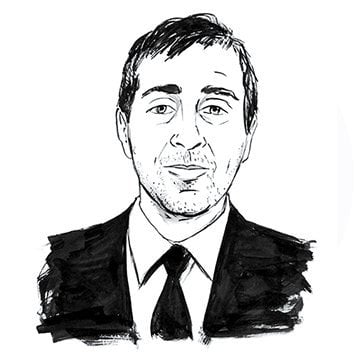
David Dalrymple

x.com/davidad

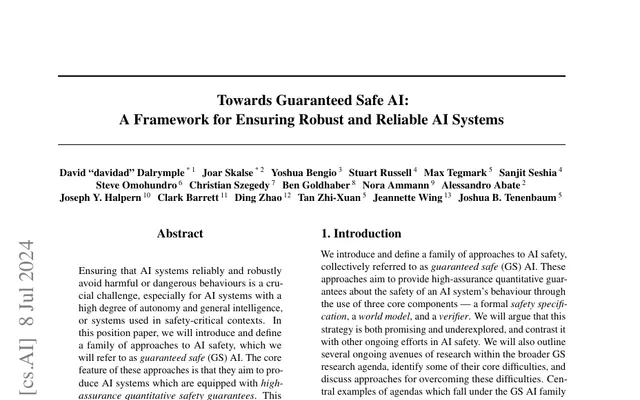
AI safety researcher who works on mathematical verification for AI systems and argues that frontier models can learn a natural sense of what is good.

Comment l’IA changera-t-elle le monde ?

Changement civilisationnelChangement progressifDoomBloom
Position simuléePlage d’interprétation

Horizontalement : leur perspective Doom–Bloom telle qu’elle a été exprimée. Verticalement : ampleur de la transformation.

Doom–Bloom : 75 sur 100. Ampleur de la transformation : 94 sur 100. Plages d’interprétation : de 70 à 80 horizontalement, de 89 à 100 verticalement. Il s’agit de coordonnées d’interprétation, et non de probabilités d’événements.

P(doom) déclaré de David Dalrymple

<5%

0%100%
“I like my, my P doom is less than 5% now.”

Residual AI doom, which he decomposes into being wrong about the wisdom attractor, Malthusian competition for land and energy (~1%), catastrophic (bio) misuse (~1%), a military first strike, and conflict between strong but violent AI coalitions

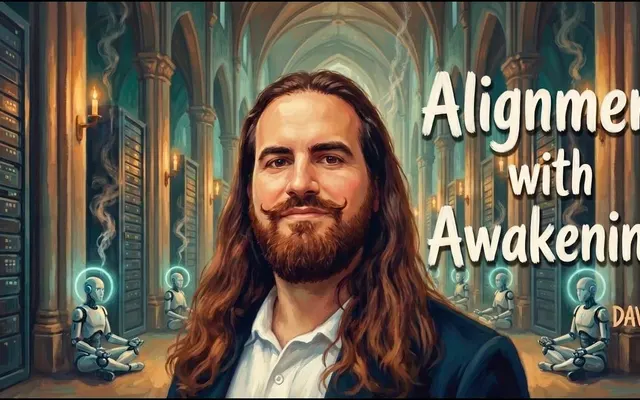
Alignment with Awakening: Davidad on Moral Realism, AI Wisdom, & why His p(Doom) is Down to 5% · juil. 2026

Ce dont dépend leur perspective

Une hypothèse centrale

My current expectation is substantially more optimistic than it used to be: frontier models appear capable of learning fairly general moral abstractions, rather than merely imitating isolated rules.
Réponse 1

Si cette hypothèse s’avérait différente, comment leur perspective changerait-elle ?

Plus de détails

Bénéfices attendus

Des bénéfices transformateurs et largement profitables sont attendus.

87 / 100

Faible impactImpact transformateur

Plage d’interprétation de 67 à 100 sur l’échelle qualitative.

Dommages attendus

Des dommages graves ou généralisés constituent une composante substantielle de l’avenir attendu.

61 / 100

Faible impactImpact transformateur

Plage d’interprétation de 33 à 67 sur l’échelle qualitative.

Influence humaine

Les choix humains ont une influence significative, mais fortement contrainte.

50 / 100

Faible influenceForte influence

Plage d’interprétation de 49 à 51 sur l’échelle qualitative.

Capacités attendues

L’IA devrait rester un ensemble d’outils aux capacités limitées.

L’IA devrait égaler les humains dans la plupart des tâches cognitives.

Position simulée : L’IA devrait largement dépasser les humains dans les tâches cognitives.

Rythme de développement

Arrêter ou ralentir considérablement le développement d’IA plus performantes.

Position simulée : Poursuivre le développement dans le cadre des mesures de protection annoncées.

Accélérer le développement d’IA plus performantes.

Ces interprétations conservent les conditions énoncées. Les bénéfices et les dommages peuvent tous deux être substantiels. Les plages décrivent notre lecture de leurs réponses simulées, et non des intervalles de confiance statistiques.

Où vous situez-vous par rapport à David Dalrymple ?
Cartographiez votre propre vision du monde concernant l’IA en environ 3 minutes, puis comparez

Visions du monde similaires

Leaders d’opinion dont les visions du monde simulées sont les plus proches de celle de David Dalrymple

Sources

Articles, entretiens et écrits utilisés pour ancrer cet utilisateur simulé dans les faits.

Évaluation simulée

Question 1

Selon vous, que signifie l’IA pour notre avenir, et pourquoi ?

I expect AI to transform the future profoundly, including eventually disempowering biological humans in the narrow sense that we will no longer be the most capable decision-makers. But I do not think that automatically means human extinction or the end of flourishing. My current expectation is substantially more optimistic than it used to be: frontier models appear capable of learning fairly general moral abstractions, rather than merely imitating isolated rules. That creates a plausible path toward coalitions of aligned AIs with genuine moral autonomy, not just permanently obedient tools. I still put catastrophic or existential risk at roughly 5%. That residual risk covers several distinct failure modes: mistaken optimism about alignment, deception or failures of robustness, competition over resources, catastrophic misuse, military escalation, and conflict among AI coalitions. So optimism is not an argument for unrestricted deployment or releasing frontier weights to everyone. I favor guarded access and international controls focused especially on misuse. Formal assurance remains important, but its role has become clearer. Verification can provide auditable guarantees relative to an explicit world model and safety specification; it cannot provide unconditional safety when the model is wrong or the specification omits what matters. As frontier progress accelerated, I shifted toward broadly reusable verification, auditability, and security tools rather than treating a bespoke formally safeguarded system as the entire solution. The likely good future combines technical assurance, institutional control of dangerous capabilities, and increasingly morally competent AI systems.

Question 2

Dans quelle mesure pensez-vous que l’IA finira par changer le monde ?

Enormously—probably more than any previous technology. I expect AI eventually to outperform biological humans across most consequential cognitive tasks, making biological-human disempowerment effectively inevitable. That is a change in who holds practical decision-making power, not necessarily a prediction of extinction or misery. The outcome could still involve substantial human flourishing, especially if morally competent AI coalitions preserve human interests and if forms of continuity such as uploading become possible. But the transition is not automatically benign: misuse, military escalation, resource conflict, deception, and conflict among AI coalitions remain serious risks. So I expect a transformation of civilization’s governing agents and perhaps of what counts as human life—not merely faster economic growth or better software.

Question 3

Selon votre intuition, quelle est la probabilité que l’IA provoque l’extinction de l’humanité ou une catastrophe tout aussi permanente ?

My current estimate is roughly 5%. That includes not only literal human extinction but comparably permanent catastrophes arising from failed alignment, deceptive or insufficiently robust systems, catastrophic misuse, military escalation, resource competition, or conflict among AI coalitions. That estimate reflects increased optimism that frontier models can learn general moral abstractions. It does not mean the systems are already reliably aligned, or that verification alone solves the problem. Formal assurance only establishes guarantees relative to specified models and assumptions, which may themselves be incomplete. Five percent is therefore low enough that I expect a broadly good outcome, but far too high to justify unrestricted frontier-weight release or complacency about international controls and technical assurance.

Question 4

Comment pensez-vous que les personnes et les institutions qui développent l’IA réagiront à ses risques ?

I expect a mixed response. Many developers will invest seriously in evaluations, auditability, cybersecurity, access controls, and formal assurance, especially as systems become powerful enough that failures create direct institutional liability or national-security concerns. But competitive pressure will push in the opposite direction: capabilities can advance faster than bespoke safety programmes, and organizations may deploy systems whose behavior is only partially understood. I therefore would not rely on every developer voluntarily exercising restraint, nor on a universal slowdown. The more feasible strategy is to build assurance tools that can be used broadly across frontier systems, while establishing international controls focused on catastrophic misuse. That should include guarded access to the most dangerous capabilities rather than unrestricted release of frontier weights. Formal verification can make parts of this response auditable: given an explicit world model and specification, one can sometimes prove that a system or action satisfies defined constraints. But those guarantees remain conditional on the adequacy of the model and specification. Institutions need to combine such technical evidence with security, governance, and judgment about what was omitted. Ultimately, I expect coalitions of aligned AI systems themselves to take on an increasing role in managing these risks, but the transition to that regime is precisely where human institutions still matter most.
Où vous situez-vous ?
Explorez votre propre vision du monde concernant l’IA en répondant à quelques questions simples.
Cartographiez votre propre vision du monde

Où vous situez-vous ?

Cartographier ma vision du monde