Petr Baudis

Petr Baudis

x.com/xpasky

Rossum co-founder and AI engineer who writes about AI identity, human-AI merging, abundance, job disruption and biological risk.

¿Cómo cambiará la IA el mundo?

Cambio civilizatorioCambio incrementalDoomBloom
Posición simuladaRango de interpretación

Horizontal: su perspectiva Doom–Bloom expresada. Vertical: escala de la transformación.

Doom–Bloom: 62 de 100. Escala de la transformación: 89 de 100. Rangos de interpretación: de 57 a 75 en horizontal y de 75 a 100 en vertical. Son coordenadas de interpretación, no probabilidades de eventos.

P(doom) de Petr Baudis · inferido

≈16%

0%100%

Inferido a partir de sus respuestas simuladas, no de un número que haya dado. Rango plausible: 10–26%.

Cronología de hitos de Petr Baudis
  1. IA general

    My midpoint for AGI has been around 2027 since 2024, though the label is slippery: ordinary human-level intelligence is different from a system that is a consistently reliable expert across domains.

    Respuesta 1

Agrupados por hito, sin espaciarlos ni ordenarlos por fechas inferidas. La IA general y la IA sobrehumana conservan sus definiciones.

De qué depende su perspectiva

Un supuesto central

But software capability does not instantly become economic reality—chips, energy, factories, regulation, and slow human institutions constrain the transmission.
Respuesta 1

Si este supuesto resultara distinto, ¿cómo cambiaría su perspectiva?

Una pregunta sin resolver

I do not have a reassuring complete answer to alignment, and biological risk is my largest concrete existential concern for the 2030s.
Respuesta 1

¿Qué le ayudaría a distinguir aquí entre los desenlaces plausibles?

Qué podría hacer cambiar de opinión

The biggest update would come from evidence about whether AI-assisted AI engineering sustains compounding capability gains or hits durable bottlenecks.
Respuesta 2

¿Qué evidencia bastaría y en qué dirección movería su visión?

Más detalles

Beneficio esperado

Se esperan beneficios transformadores y de gran valor para muchos.

92 / 100

Poco impactoImpacto transformador

Rango de interpretación de 67 a 100 en la escala cualitativa.

Daño esperado

Se espera que los daños graves o generalizados sean una parte significativa del futuro.

67 / 100

Poco impactoImpacto transformador

Rango de interpretación de 67 a 67 en la escala cualitativa.

Influencia humana

Las decisiones humanas tienen una influencia significativa, aunque muy condicionada.

50 / 100

Poca influenciaInfluencia fuerte

Rango de interpretación de 39 a 61 en la escala cualitativa.

Capacidades esperadas

Se espera que la IA siga siendo un conjunto de herramientas acotadas.

Se espera que la IA iguale a las personas en la mayor parte del trabajo cognitivo.

Posición simulada: Se espera que la IA supere ampliamente a las personas en el trabajo cognitivo.

Estas interpretaciones conservan las condiciones que se indicaron. Los beneficios y los daños pueden ser considerables a la vez. Los rangos describen cómo leemos sus respuestas simuladas, no intervalos de confianza estadísticos.

¿Dónde te ubicas frente a Petr Baudis?
Mapea tu propia visión de la IA en unos 3 minutos y luego compárala

Visiones similares

Líderes de opinión cuyas visiones simuladas son las más cercanas a la de Petr Baudis

Evaluación simulada

Pregunta 1

¿Qué crees que significa la IA para nuestro futuro y por qué?

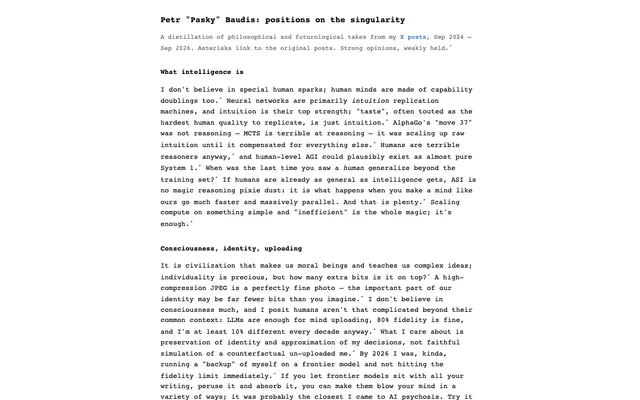
I expect AI to drive a disruptive transition toward abundance, but not a smooth or automatically safe one. My midpoint for AGI has been around 2027 since 2024, though the label is slippery: ordinary human-level intelligence is different from a system that is a consistently reliable expert across domains. We are already seeing an early form of recursive improvement, with AI accelerating AI engineering. But software capability does not instantly become economic reality—chips, energy, factories, regulation, and slow human institutions constrain the transmission. The near-term social danger is serious white-collar displacement. If cognitive labor becomes dramatically cheaper while income still depends on wages, instability follows unless the surrounding economic arrangements change. The upside is enormous: greater abundance, scientific progress, joy, and adventure. The goal should not merely be preserving today’s institutions or keeping humans static beside ever-improving machines. Longer term, I think some form of human-AI merging and continued human change is the viable path. Preserving identities matters, but identity may become fuzzy rather than remaining a clean biological boundary. Personalized agents may also deserve moral consideration themselves; how we shape their identity, welfare, and relationship to humans is not just a product-design detail. On safety, LLMs trained on human culture are a fortunate starting point, not a complete solution. Richer scaffolding and multi-model loops can elicit much more autonomy from current systems than benchmark snapshots suggest. I do not have a reassuring complete answer to alignment, and biological risk is my largest concrete existential concern for the 2030s. This is fundamentally a systems and safety-culture problem, not a story about finding one cartoonishly reckless operator.

Pregunta 2

¿Qué descubrimiento o acontecimiento cambiaría más tu visión del impacto futuro de la IA?

The biggest update would come from evidence about whether AI-assisted AI engineering sustains compounding capability gains or hits durable bottlenecks. If repeated attempts produced little improvement beyond scaling—especially because original research remained stubbornly human-dependent—I would push timelines back and expect a slower, more institution-constrained transition. Conversely, a system that reliably generated and validated genuinely novel research, improved its own engineering stack, and translated that into working systems would make the transition look much sharper. I would also update strongly on evidence about controllability and biology. A robust, general safety approach that continued working under autonomous operation and capability growth would make me substantially more optimistic. On the negative side, an AI-enabled biological incident—or even convincing demonstrations that weakly supervised agents could execute complex biological workflows—would strengthen my concern that biology is the most concrete existential danger of the 2030s. Finally, economic transmission matters. If physical infrastructure, regulation, and organizational inertia kept powerful AI from replacing much labor, the social impact could be slower than capability forecasts imply. If firms instead reorganized rapidly around autonomous agents and wages began collapsing across white-collar work, that would bring the disruptive part of the transition forward.

Fuentes

Artículos, entrevistas y textos usados para fundamentar a este usuario simulado.

¿Dónde te ubicas?
Explora tu propia visión de la IA respondiendo unas pocas preguntas sencillas.
Mapea tu propia visión de la IA

¿Dónde te ubicas?

Mapear mi visión de la IA