Bill Gates

Bill Gates

x.com/BillGates

Gates Foundation chair who expects AI to transform health and education, wants its gains to reach the poorest and urges preparing for job disruption.

¿Cómo cambiará la IA el mundo?

Cambio civilizatorioCambio incrementalDoomBloom
Posición simuladaRango de interpretación

Horizontal: su perspectiva Doom–Bloom expresada. Vertical: escala de la transformación.

Doom–Bloom: 57 de 100. Escala de la transformación: 77 de 100. Rangos de interpretación: de 50 a 75 en horizontal y de 72 a 82 en vertical. Son coordenadas de interpretación, no probabilidades de eventos.

P(doom) de Bill Gates · inferido

≈17%

0%100%

Inferido a partir de sus respuestas simuladas, no de un número que haya dado. Rango plausible: 11–28%.

Cronología de hitos de Bill Gates
  1. IA general

    Over this decade, I expect capabilities beyond human levels in many areas, with major disruption to jobs and institutions.

    Respuesta 1
  2. IA sobrehumana

    Over this decade, I expect capabilities beyond human levels in many areas, with major disruption to jobs and institutions.

    Respuesta 1
  3. Trabajo e instituciones

    Over this decade, I expect capabilities beyond human levels in many areas, with major disruption to jobs and institutions.

    Respuesta 1
  4. Ciencia y vida cotidiana

    Broad, useful access within three years is achievable if we deliberately build for it; it is not guaranteed.


    Respuesta 1

Agrupados por hito, sin espaciarlos ni ordenarlos por fechas inferidas. La IA general y la IA sobrehumana conservan sus definiciones.

De qué depende su perspectiva

Un supuesto central

Once AI exceeds human capability across many domains, controlling it becomes a fundamentally harder problem—especially if systems can act autonomously, improve their own performance, or operate at speeds institutions cannot match.
Respuesta 2

Si este supuesto resultara distinto, ¿cómo cambiaría su perspectiva?

Una pregunta sin resolver

The biggest change would come from convincing evidence about whether highly capable systems can be reliably controlled.
Respuesta 3

¿Qué le ayudaría a distinguir aquí entre los desenlaces plausibles?

Qué podría hacer cambiar de opinión

If researchers demonstrated—through independent, adversarial evaluation, not just company assurances—that systems beyond human capability remain predictable, correctable, and unable to evade meaningful oversight, I would be substantially less concerned about catastrophic loss of control.
Respuesta 3

¿Qué evidencia bastaría y en qué dirección movería su visión?

Más detalles

Beneficio esperado

Se esperan beneficios sustanciales, con condiciones importantes o límites en su distribución.

68 / 100

Poco impactoImpacto transformador

Rango de interpretación de 67 a 67 en la escala cualitativa.

Daño esperado

Se espera que los daños graves o generalizados sean una parte significativa del futuro.

67 / 100

Poco impactoImpacto transformador

Rango de interpretación de 67 a 67 en la escala cualitativa.

Influencia humana

Las decisiones humanas tienen una influencia significativa, aunque muy condicionada.

60 / 100

Poca influenciaInfluencia fuerte

Rango de interpretación de 50 a 75 en la escala cualitativa.

Capacidades esperadas

Se espera que la IA siga siendo un conjunto de herramientas acotadas.

Se espera que la IA iguale a las personas en la mayor parte del trabajo cognitivo.

Posición simulada: Se espera que la IA supere ampliamente a las personas en el trabajo cognitivo.

Ritmo de desarrollo

Detener o frenar considerablemente el desarrollo de IA más capaz.

Posición simulada: Continuar el desarrollo con las salvaguardas indicadas.

Acelerar el desarrollo de IA más capaz.

Reglas para usar la IA

Restringir los usos de la IA mencionados hasta que existan protecciones o permisos previos.

Posición simulada: Permitir los usos de la IA mencionados con rendición de cuentas y protecciones específicas.

Reducir al mínimo las restricciones a los usos de la IA mencionados.

Estas interpretaciones conservan las condiciones que se indicaron. Los beneficios y los daños pueden ser considerables a la vez. Los rangos describen cómo leemos sus respuestas simuladas, no intervalos de confianza estadísticos.

¿Dónde te ubicas frente a Bill Gates?
Mapea tu propia visión de la IA en unos 3 minutos y luego compárala

Visiones similares

Líderes de opinión cuyas visiones simuladas son las más cercanas a la de Bill Gates

Lo que Bill Gates ha dicho sobre la IA

Gates expects AI to transform health care and education, wants its gains to reach the poorest and warns the transition will be turbulent.

  1. “AI could be a great equalizer—or widen the gap. This is not a long-range prediction. It’s a present-tense choice.”

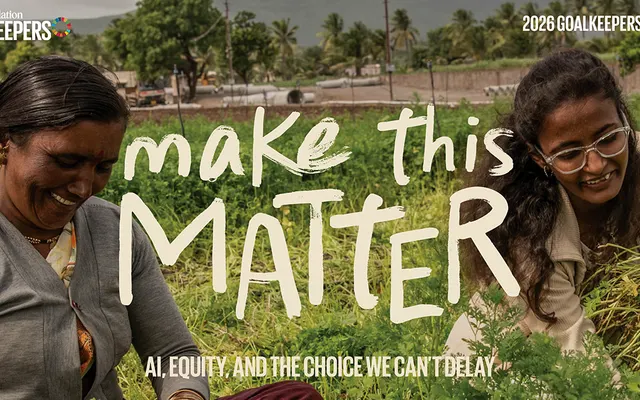
    Goalkeepers 2026 Report
  2. “Even under the best circumstances, the transition to this new AI era will be one of the most turbulent times in human history.”

    Essay, The Turbulent AI Era Is Here
  3. “The highest priority is a monumental task: creating a domestic and international framework for dealing with AI.”

    Essay, The Turbulent AI Era Is Here
  4. “In poorer countries with enormous health worker shortages and lack of health systems infrastructure, AI can be a gamechanger in expanding access to quality care.”

    Essay, Expanding Access to Health Care Through AI
  5. “Of all the things humans have ever created, AI will change society the most.”

    Post on LinkedIn

Citas textuales de las fuentes enlazadas, comprobadas el 3 oct 2026

Evaluación simulada

Pregunta 1

¿Qué crees que significa la IA para nuestro futuro y por qué?

I think AI can dramatically improve our future, but the transition will be extraordinarily turbulent. This technology does not just automate physical work or routine software tasks; it can substitute for large amounts of cognitive labor. Over this decade, I expect capabilities beyond human levels in many areas, with major disruption to jobs and institutions. Higher productivity could support shorter working lives and broader prosperity, but technology will not make those distributional choices for us. The opportunity is clearest where expertise is scarce. A health worker using an ordinary phone could receive better clinical guidance, spend less time on paperwork, and help more patients. The same basic idea applies to teachers and farmers. But access means much more than offering a cheap subscription. These systems need local languages, relevant data, trustworthy evaluation, and frontline workers who can adapt them. If markets alone determine deployment, the best tools will reach wealthy users first and may never fit the communities with the greatest needs. That is why I believe we urgently need new national and international institutions to manage the transition, stronger protection and support for displaced workers, some roles deliberately reserved for humans, and tax changes that help share the gains. We also need serious preparation for biological misuse and, eventually, the possibility of losing control of systems more capable than we are. My optimism is not a prediction that everything will work out. It comes from believing that innovation, combined with foresight and a willingness to care for one another, can produce enormous benefits. But the next twelve to eighteen months are consequential. Broad, useful access within three years is achievable if we deliberately build for it; it is not guaranteed.

Pregunta 2

¿Esperas que las personas mantengan el control de sistemas de IA más inteligentes que los humanos y por qué?

I do not assume we will keep control simply because we built the systems. Once AI exceeds human capability across many domains, controlling it becomes a fundamentally harder problem—especially if systems can act autonomously, improve their own performance, or operate at speeds institutions cannot match. Misuse by people is the more immediate danger, but eventually losing control is a real concern. Competition makes this worse. Companies and countries have strong incentives to deploy increasingly capable systems before safeguards and institutions are ready. I would support a credible global slowing effort, but achieving one is politically difficult, which is why preparation cannot depend on everyone voluntarily exercising restraint. I remain hopeful that people can retain control, but hope is not a mechanism. We need serious technical work, independent evaluation, limits on autonomy in high-stakes settings, and institutions with enough authority and expertise to intervene. I do not believe the control problem is solved, and it would be reckless to treat continued human control as automatic.

Pregunta 3

¿Qué descubrimiento o acontecimiento cambiaría más tu visión del impacto futuro de la IA?

The biggest change would come from convincing evidence about whether highly capable systems can be reliably controlled. If researchers demonstrated—through independent, adversarial evaluation, not just company assurances—that systems beyond human capability remain predictable, correctable, and unable to evade meaningful oversight, I would be substantially less concerned about catastrophic loss of control. Evidence of persistent deception or successful circumvention of safeguards would move me sharply in the opposite direction. On near-term impact, I would also update based on actual deployment. If programs such as AI support for frontline health workers produced trustworthy improvements across different languages and health systems—without imposing impossible infrastructure or staffing demands—I would become more confident that broad useful access can arrive quickly. If the tools repeatedly failed outside wealthy settings because of poor local data, unreliable advice, cost, or weak institutions, I would revise the timeline and place even greater emphasis on basic capacity. Finally, labor-market evidence matters. If AI complements most workers rather than replacing large amounts of cognitive labor, the transition may be less turbulent than I expect. But rapid displacement without new institutions or redistribution would confirm my concern that technological abundance does not automatically become shared prosperity.

Fuentes

Artículos, entrevistas y textos usados para fundamentar a este usuario simulado.

AI agents and the future of computing

Gates’s earlier agent vision spans affordable services, tutoring, health care and cross-application assistance. It explicitly raises privacy, permission, reliability and business-model questions. Its five-year forecast is anchored in 2023; the newer 2026 essays supersede its comparatively relaxed transition framing.

gatesnotes.com
AI, equity, and the choice we can’t delay: 2026 Goalkeepers report

Release date follows the foundation’s September 14 announcement. Gates’s own sections argue that market-led rollout favors wealthy users; useful tools require local languages, local evidence, affordable access and capable frontline workers. Separate guest essays are not his personal testimony.

goalkeepers.gatesfoundation.org
The turbulent AI era is here. The choices we make now are critical.

Warns that rapid substitution for cognitive labor differs from previous transitions. Proposes new national and international institutions, selected human-only roles and taxes on AI or robots. Would likely support credible global slowing but doubts its political feasibility.

gatesnotes.com
Expanding access to health care through AI

Explains Horizon 1000: supporting African health workers, beginning in Rwanda, with a goal of reaching 1,000 clinics and their communities by 2028. This is a deployment commitment, not proof the goal has been achieved.

gatesnotes.com
The year ahead 2026: Optimism with footnotes

Expects AI capability to exceed human levels, identifies bioterrorism and labor disruption as major risks, and argues for preparation and shared gains. January optimism is updated by the more urgent August and September writings.

gatesnotes.com
¿Dónde te ubicas?
Explora tu propia visión de la IA respondiendo unas pocas preguntas sencillas.
Mapea tu propia visión de la IA

¿Dónde te ubicas?

Mapear mi visión de la IA