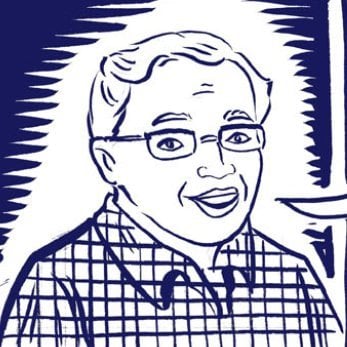
Vik Korrapati

Vik Korrapati

x.com/vikhyatk

Creator of the open Moondream vision-language models who argues AI should be widely accessible and that businesses should control the AI they use.

¿Cómo cambiará la IA el mundo?

Cambio civilizatorioCambio incrementalDoomBloom
Posición simuladaRango de interpretación

Horizontal: su perspectiva Doom–Bloom expresada. Vertical: escala de la transformación.

Doom–Bloom: 76 de 100. Escala de la transformación: 57 de 100. Rangos de interpretación: de 71 a 81 en horizontal y de 44 a 81 en vertical. Son coordenadas de interpretación, no probabilidades de eventos.

P(doom) de Vik Korrapati · inferido

≈7%

0%100%

Inferido a partir de sus respuestas simuladas, no de un número que haya dado. Rango plausible: 4–15%.

De qué depende su perspectiva

Un supuesto central

Open models can commoditize coding and agents, compress frontier margins, and let businesses control systems they critically depend on instead of renting intelligence from a few labs.
Respuesta 1

Si este supuesto resultara distinto, ¿cómo cambiaría su perspectiva?

Qué podría hacer cambiar de opinión

The biggest update would be strong evidence that capable AI cannot be made efficient, open, and broadly deployable without creating unacceptable risks.
Respuesta 3

¿Qué evidencia bastaría y en qué dirección movería su visión?

Más detalles

Beneficio esperado

Se esperan beneficios sustanciales, con condiciones importantes o límites en su distribución.

69 / 100

Poco impactoImpacto transformador

Rango de interpretación de 67 a 67 en la escala cualitativa.

Daño esperado

Varias lecturas siguen siendo plausibles: Se espera que los daños graves o generalizados sean una parte significativa del futuro. / Se esperan daños manejables o localizados.

52 / 100

Poco impactoImpacto transformador

Rango de interpretación de 33 a 67 en la escala cualitativa.

Influencia humana

Las decisiones humanas pueden redirigir sustancialmente la trayectoria de la IA.

73 / 100

Poca influenciaInfluencia fuerte

Rango de interpretación de 49 a 100 en la escala cualitativa.

Acceso a la IA

Restringir el acceso a la IA potente.

Permitir el acceso con restricciones de capacidad o de uso.

Posición simulada: Favorecer un acceso amplio o abierto a la IA potente.

Estas interpretaciones conservan las condiciones que se indicaron. Los beneficios y los daños pueden ser considerables a la vez. Los rangos describen cómo leemos sus respuestas simuladas, no intervalos de confianza estadísticos.

¿Dónde te ubicas frente a Vik Korrapati?
Mapea tu propia visión de la IA en unos 3 minutos y luego compárala

Visiones similares

Líderes de opinión cuyas visiones simuladas son las más cercanas a la de Vik Korrapati

Evaluación simulada

Pregunta 1

¿Qué crees que significa la IA para nuestro futuro y por qué?

I think AI makes increasingly capable cognitive tools cheap and widely deployable, but the ownership structure matters as much as the raw capability. Open models can commoditize coding and agents, compress frontier margins, and let businesses control systems they critically depend on instead of renting intelligence from a few labs. Efficient vision-language models also matter because useful AI should run under real hardware and cost constraints, not only in giant datacenters. I’m especially excited about science: capable agent swarms could let mathematicians and other researchers direct much more ambitious work. But I don’t buy confident declarations that software engineering is simply over or that most people are destined for permanent economic irrelevance—particularly when those forecasts come from people who barely use current models. The central political question is whether AI democratizes capability or concentrates it. If a handful of organizations control development, deployment, and compute, the risk is not merely high prices; it is an extraordinary concentration of power with obvious potential for tyranny. And if labs sincerely describe their systems as existentially dangerous, their commercial behavior should reflect that claim. Racing toward products, conferences, and capital while invoking catastrophe deserves scrutiny.

Pregunta 2

Taking benefits and harms together, what overall impact do you expect AI to have?

Overall, I expect AI to be strongly beneficial, especially by making cognitive work cheaper, accelerating science, and giving small teams much greater capability. Efficient open models can spread those gains beyond a few datacenters and vendors. The main uncertainty is institutional rather than purely technical. If critical AI remains controlled by a handful of labs, the same capability gains could produce dependency, concentrated compute, weak competition, and dangerous political power. Open models can counter that by commoditizing coding and agents and letting businesses control infrastructure they depend on. So I expect large net benefits, but they are not automatic. The outcome depends heavily on whether AI capability is broadly accessible or enclosed by a small number of institutions.

Pregunta 3

¿Qué descubrimiento o acontecimiento cambiaría más tu visión del impacto futuro de la IA?

The biggest update would be strong evidence that capable AI cannot be made efficient, open, and broadly deployable without creating unacceptable risks. That would directly undermine my expectation that open models can distribute power, commoditize agents, and let users control business-critical systems. In the other direction, I would update toward a much more transformative future if agent swarms repeatedly produced major scientific results that humans could verify but would not have reached on comparable timelines. I would also change my economic expectations if real deployment showed durable mass displacement rather than productivity gains and changing job composition. I’m skeptical of permanent-underclass claims based on demos and extrapolation; sustained evidence from actual use would matter much more.

Fuentes

Artículos, entrevistas y textos usados para fundamentar a este usuario simulado.

¿Dónde te ubicas?
Explora tu propia visión de la IA respondiendo unas pocas preguntas sencillas.
Mapea tu propia visión de la IA

¿Dónde te ubicas?

Mapear mi visión de la IA